Trump Drug Prices Explained: Costs, Discounts, and What You Pay Out-of-Pocket
Last updated: October 17, 2026
Quick Answer
Trump administration drug pricing policy centers on “Most Favored Nation” (MFN) pricing, which ties U.S. drug prices to the lowest price paid by comparable wealthy nations. This framework now extends to all 50 state Medicaid programs and to TrumpRx.gov, a direct-to-consumer discount portal [1][2][8]. Out-of-pocket impact varies widely: cash-paying and uninsured patients using TrumpRx can see MFN-level discounts immediately, Medicare Part D enrollees benefit from a separate $2,000 annual out-of-pocket cap, and Medicaid savings mostly flow to state and federal budgets rather than directly into enrollees’ wallets [1][6].
Key Takeaways
- Trump Drug Prices Explained: Costs, Discounts, and What You Pay Out-of-Pocket depends heavily on which program you use, Medicaid, Medicare Part D, or TrumpRx.gov, because each one passes savings through differently.
- MFN pricing now applies to the large majority of branded drugs sold in the United States [4].
- All 50 state Medicaid programs are now linked to MFN pricing through a federal initiative sometimes called “Generous” [1][2].
- TrumpRx.gov offers MFN-benchmark cash prices directly to patients, which helps uninsured and underinsured shoppers the most [8].
- Medicare Part D out-of-pocket drug spending is capped at $2,000 per year, a separate but complementary protection [6].
- The White House has described the rollout as the “largest prescription drug price drop in over 60 years,” though independent reporting shows the real-world effect is uneven across drugs and patients [4][7].
- A proposed “Great Healthcare Plan” would expand MFN-style discounts further and send savings directly to households, but it remains a legislative proposal, not current law [3][9].
- Several drugmakers, including Regeneron, have signed individual MFN pricing deals that lower Medicaid and TrumpRx costs for specific medicines [5].
What Did Trump Do About Drug Prices?
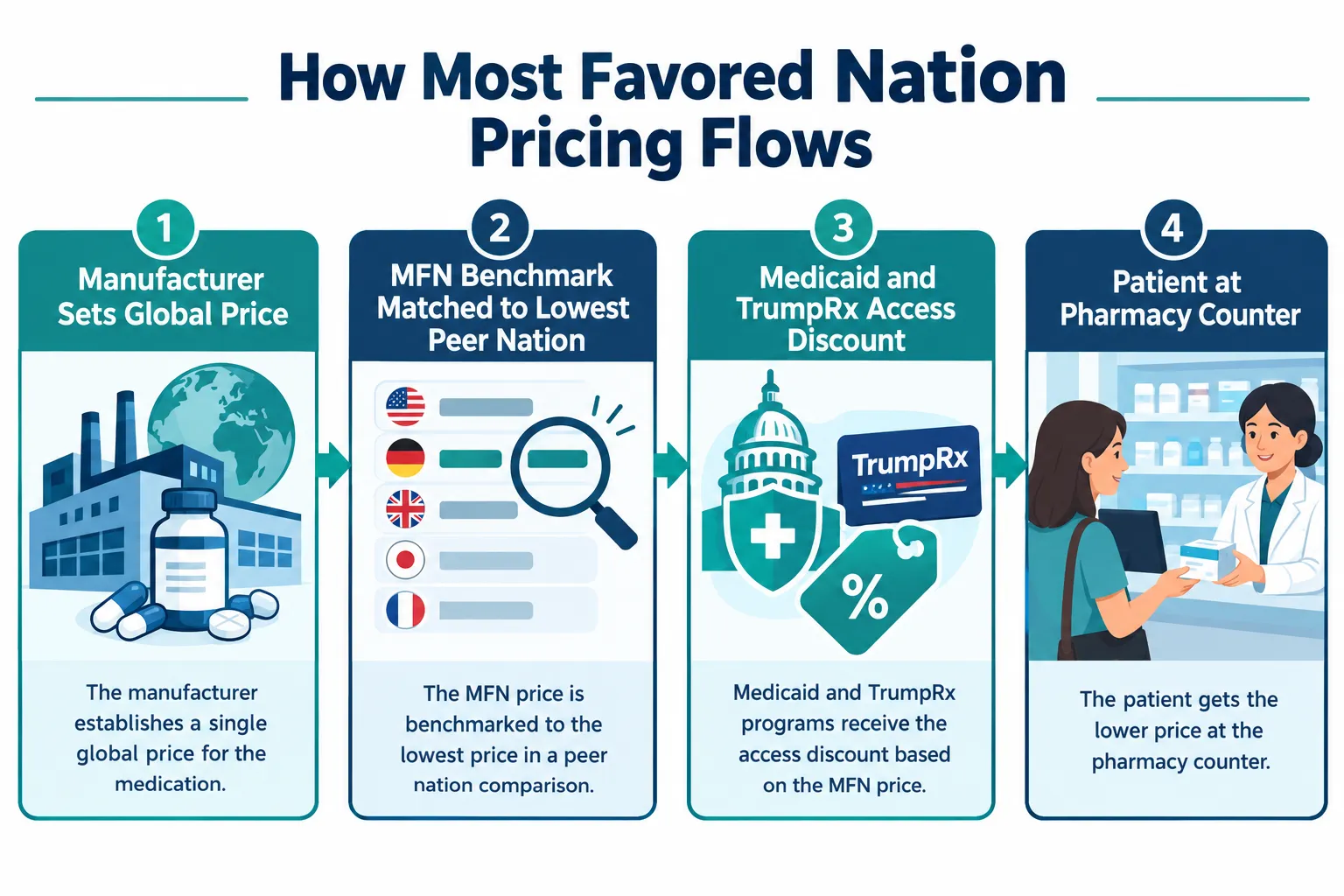
The core action was extending Most Favored Nation pricing, a policy that benchmarks U.S. drug prices against the lowest price charged in other wealthy countries, across Medicaid nationwide and into a new consumer-facing platform called TrumpRx.gov [1][2][8]. This replaced a patchwork of state-by-state Medicaid drug pricing with one federal benchmark tied to international prices.
Specific administration actions include:
- Extending MFN pricing to every state Medicaid program through a coordinated federal initiative [1][2].
- Launching and expanding TrumpRx.gov so individual consumers can buy certain drugs at or near the MFN benchmark price without going through insurance [8].
- Negotiating direct pricing agreements with individual manufacturers, including a deal covering nine additional pharmaceutical companies in August 2026 [5].
- Promoting a separate legislative proposal, the Great Healthcare Plan, that would codify MFN discounts into law and send rebate-style payments to households [3][9].
A common mistake people make is assuming MFN pricing is a single law that covers every drug and every patient automatically. In reality, it is a mix of executive actions, agency rules, and voluntary manufacturer deals that apply differently depending on your coverage type.
How Do Trump’s Drug Price Policies Affect What You Pay Out-of-Pocket?
Your actual out-of-pocket cost depends on whether you are on Medicaid, Medicare, private insurance, or paying cash, the discount does not land the same way for everyone. Trump Drug Prices Explained: Costs, Discounts, and What You Pay Out-of-Pocket really comes down to which “lane” you’re in when you pick up a prescription.
Here is how the main lanes compare:
- Cash-paying or uninsured patients on TrumpRx.gov: Pay close to the MFN benchmark price directly at checkout, often without needing insurance approval [8].
- Medicaid enrollees: Benefit indirectly. The state and federal government capture most of the MFN savings on the back end; the enrollee’s copay, if any, usually doesn’t change much [1].
- Medicare Part D enrollees: Covered by the separate $2,000 annual out-of-pocket cap, which limits total yearly drug spending regardless of MFN pricing on the ingredient itself [6].
- Privately insured patients: See the least direct change so far, since MFN deals currently target Medicaid and TrumpRx rather than commercial insurance formularies broadly.
Decision rule: If you’re uninsured or your insurance plan has a high deductible, check TrumpRx.gov before filling a prescription at a regular pharmacy, the cash price there may beat your insurance’s negotiated rate for certain drugs.
Trump Drug Price Negotiation Explained
Trump’s drug price negotiation strategy relies on manufacturer-by-manufacturer deals layered on top of the MFN benchmark, rather than one single government-run negotiation process for every drug. The White House announced deals with nine additional pharmaceutical manufacturers in August 2026, adding to earlier agreements [5].
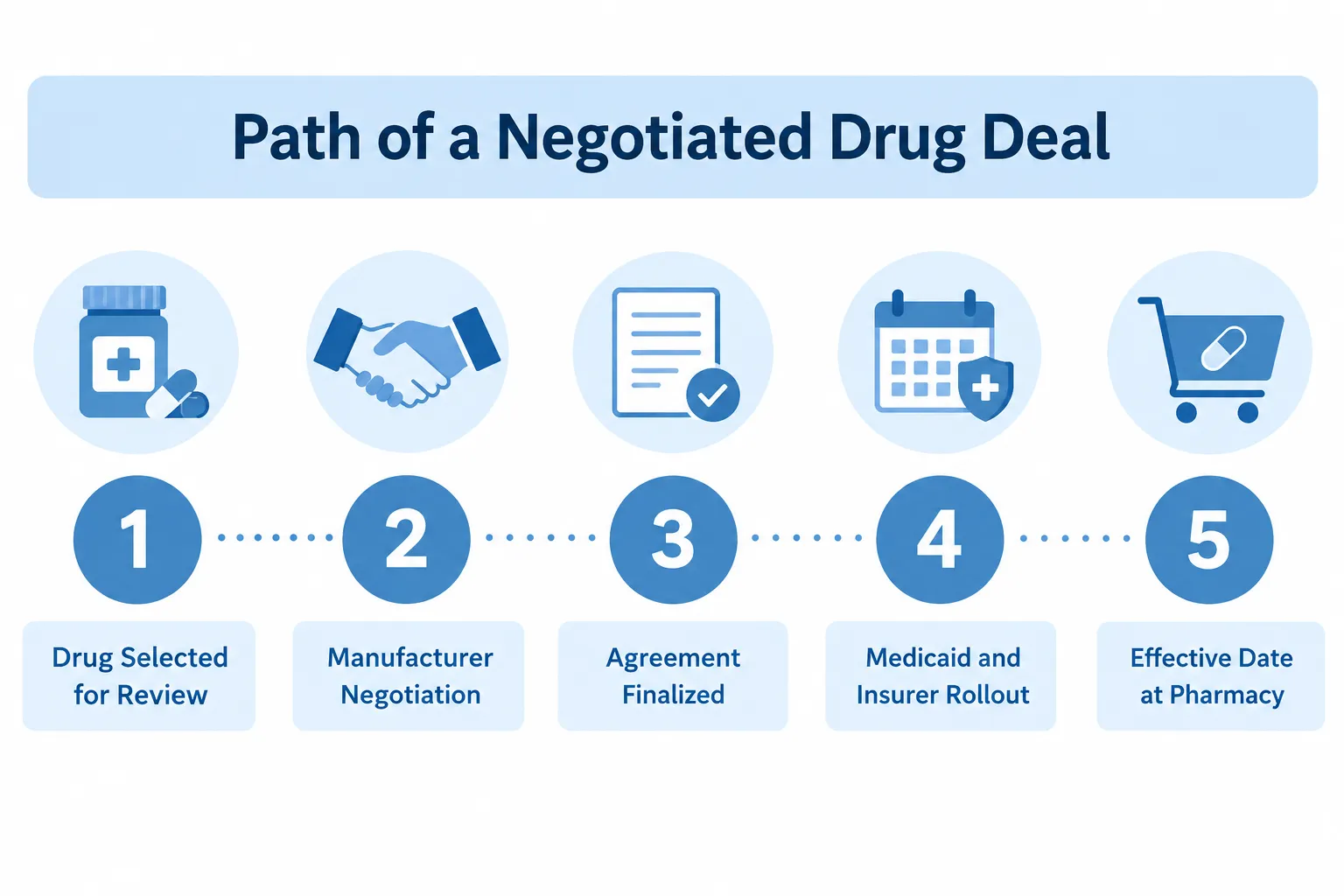
How the negotiation process generally works:
- A drug is identified as a candidate, often a high-cost branded medicine with significant Medicaid or Medicare spending.
- Federal officials and the manufacturer negotiate a price tied to the MFN benchmark, the lowest price that drug sells for in a comparable wealthy nation.
- The agreed price applies to Medicaid programs nationwide and, in many cases, to TrumpRx.gov listings [1][5][8].
- The manufacturer can still set a different list price for commercial insurance markets, which is why list price and negotiated price often diverge.
Regeneron is one of the named companies in these selected MFN deals, and its agreement illustrates how discounts flow specifically into Medicaid and TrumpRx channels rather than every point of sale [5]. If you’re trying to use this program, the practical takeaway is: negotiated pricing is drug-specific and channel-specific, not a blanket discount card you can use anywhere.
Are Drug Prices Lower Under Trump Policies?
For a defined set of branded drugs sold through Medicaid and TrumpRx, yes, list-to-net prices have dropped meaningfully, and the administration calls this the largest prescription drug price drop in over 60 years [4]. But independent analysis shows the benefit is concentrated, not universal, across all prescriptions and all patients [7].
Key nuances:
- MFN pricing now covers the vast majority of branded drugs sold in the U.S., which is a broad structural shift [4].
- The “60-year” claim refers to the scale of the administration’s pricing action, not necessarily a uniform price cut felt by every patient at every pharmacy [4][7].
- Media and policy analysts describe the rollout as an ambitious experiment with real but limited scope so far, especially outside Medicaid and TrumpRx [7][10].
- Generic drugs, which already make up most prescriptions filled in the U.S., were largely inexpensive before these policies and see less dramatic change.
Edge case: A patient with employer-sponsored insurance buying a brand-name drug not yet covered by an MFN deal may see no price change at all, even while headlines report record-setting drops elsewhere in the system.
Which Drugs Are Covered, and Which Are Excluded, From Trump Price Controls
MFN pricing currently reaches most branded, high-cost drugs sold through Medicaid and TrumpRx.gov, but generics, many older drugs, and drugs outside signed manufacturer agreements are generally excluded or less affected [1][4][8]. Coverage expands as new manufacturer deals get signed.
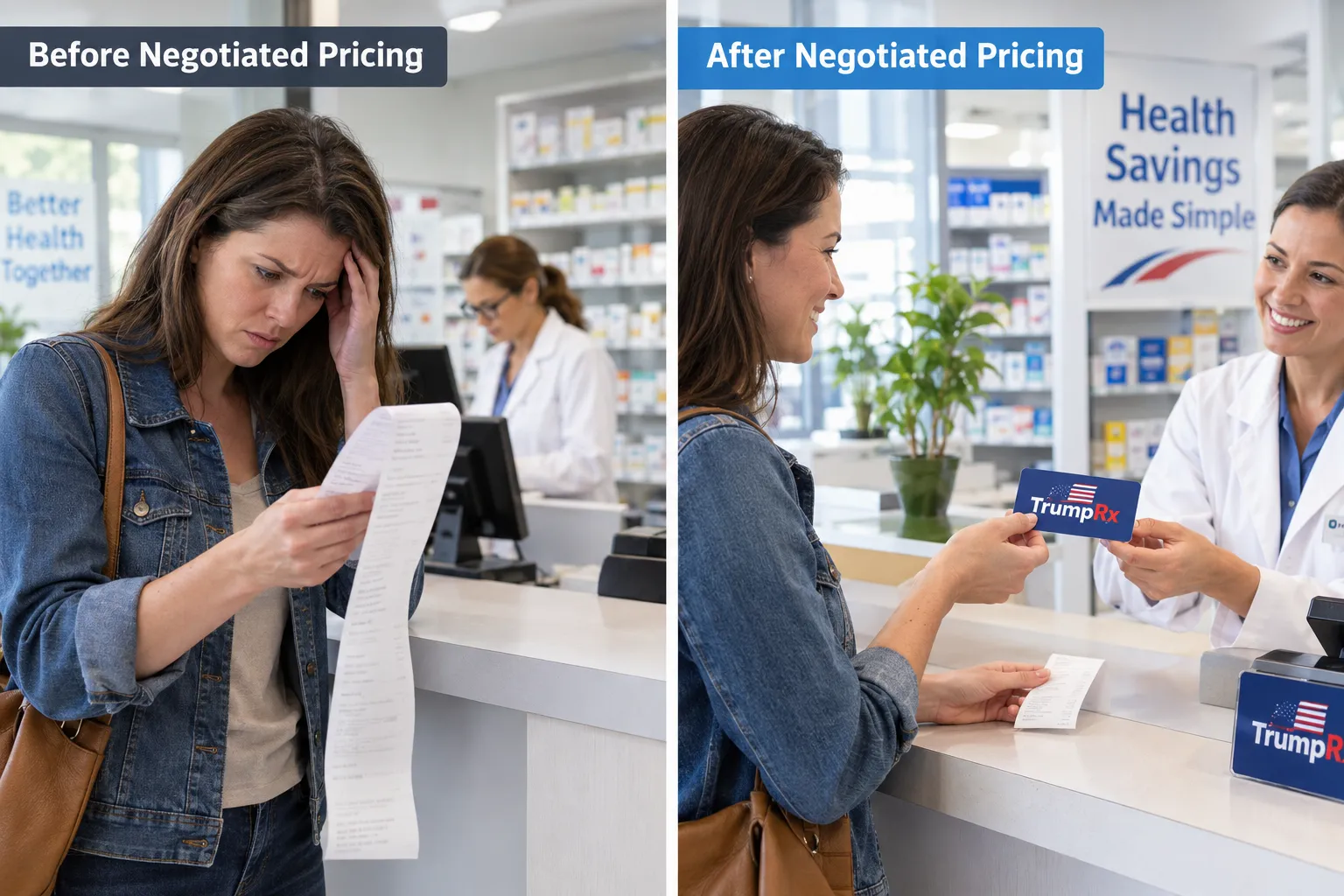
Typically covered:
- Branded specialty and chronic-condition drugs where a manufacturer has signed an MFN agreement [5].
- Drugs listed for direct purchase on TrumpRx.gov [8].
- Medicines dispensed through state Medicaid formularies now tied to the MFN benchmark [1][2].
Typically excluded or less affected:
- Generic and biosimilar drugs not targeted by MFN deals, since they’re often already low-cost.
- Drugs from manufacturers that haven’t signed an MFN agreement with the federal government.
- Many drugs purchased through standard commercial insurance plans outside Medicaid or TrumpRx channels.
Common mistake: Assuming a drug is automatically discounted just because it’s a brand name. Check TrumpRx.gov or ask your pharmacist whether a specific medicine is part of a signed MFN deal before expecting a lower price.
How Much Can You Save With Trump Drug Price Rules?
Savings vary by program: TrumpRx.gov cash buyers can get prices near the international MFN benchmark, which can be a substantial percentage off U.S. list price for covered drugs, while Medicare Part D enrollees are protected by the $2,000 annual out-of-pocket ceiling regardless of individual drug price [6][8]. There is no single savings percentage that applies to every patient.
- TrumpRx.gov users: Savings reflect the gap between the old U.S. list price and the MFN benchmark price for that specific drug, this gap is large for some specialty drugs and smaller for others [4][8].
- Medicare Part D enrollees: The real savings story is the $2,000 cap, which protects patients with high annual drug costs from unlimited exposure, a significant change from prior years [6].
- Medicaid enrollees: Savings are mostly structural (state and federal budgets pay less), so individual out-of-pocket change may be modest [1].
Quick example: A Medicare enrollee taking an expensive specialty drug who previously faced several thousand dollars a year in cost-sharing now has their annual out-of-pocket drug spending capped at $2,000, regardless of how many refills they need that year [6].
Trump Drug Prices vs. Biden Administration Comparison
The biggest structural difference is scope and mechanism: the Biden administration used Medicare’s IRA-authorized negotiation process for a short list of specific high-spend drugs, while the Trump administration layered MFN international-price benchmarking across Medicaid nationwide and added a direct consumer portal in TrumpRx.gov [1][2][6][8]. Both approaches aim at lowering net drug costs, but they use different levers.
| Feature | Trump-era approach | Prior (Biden-era) approach |
|---|---|---|
| Core mechanism | MFN international price benchmarking | Medicare direct price negotiation under IRA authority |
| Program reach | All 50 state Medicaid programs plus TrumpRx.gov | A defined list of selected Medicare Part D drugs |
| Consumer access | Direct cash purchase option via TrumpRx.gov | Primarily through Medicare plan benefit design |
| Out-of-pocket protection | $2,000 Part D cap continues under current rules | $2,000 Part D cap originated under prior rules |
| Political framing | “Largest drug price drop in over 60 years” | Incremental negotiated list, phased rollout |
Both frameworks share one consumer protection: the $2,000 Medicare Part D out-of-pocket cap, which has continued across the transition and remains one of the more consistently cited savings drivers for Medicare beneficiaries with high drug costs [6].
Do Medicare Drug Price Negotiations Actually Work?
Yes, with caveats: Medicare’s negotiated and benchmarked prices lower list costs for targeted drugs, and the $2,000 out-of-pocket cap delivers concrete, measurable savings for beneficiaries with expensive prescriptions [6]. The open question experts raise is whether negotiation scales fast enough to cover the full range of costly drugs patients actually use [7][10].
- Works well for: Medicare beneficiaries with high annual drug costs who hit the $2,000 cap, their savings are real and predictable [6].
- Works less well for: Patients taking drugs not yet included in a negotiated deal, where price relief depends on future expansion rounds.
- Analyst view: Reporting describes the program as an ambitious experiment with real impact but a scope that’s still limited relative to the full prescription drug market [7][10].
Decision rule: If your annual drug costs are high and you’re on Medicare Part D, the $2,000 cap is likely your single biggest protection, track your year-to-date spending so you know when you’ll hit it.
List Price vs. Negotiated Price: What’s the Difference?
List price is the sticker price a manufacturer sets before any discount, while the negotiated price (or MFN benchmark price) is what Medicaid, TrumpRx, or a negotiated deal actually charges after rebates and agreements are applied [1][4][5]. The gap between these two numbers is often where most of the “price drop” headlines come from.
- List price: Set unilaterally by the manufacturer; this is the number quoted before insurance, rebates, or government deals are applied.
- Negotiated/MFN price: The lower, benchmark-tied price that applies specifically within Medicaid, TrumpRx.gov, or a signed manufacturer agreement [1][8].
- What patients actually pay: Depends on their coverage type, cash buyers on TrumpRx see something close to the negotiated price, while someone using standard commercial insurance may still be billed closer to a list-price-derived rate.
Common mistake: Comparing a drug’s list price in a news headline to what you pay at your local pharmacy and assuming they should match. They often won’t, because your specific insurance, pharmacy, and program eligibility all affect the final number.
Who Benefits Most, and Who’s Still Paying Full Price?
Uninsured and underinsured cash buyers who use TrumpRx.gov, plus Medicare Part D enrollees with high annual drug costs, see the clearest direct benefit; Medicaid savings mostly benefit government budgets rather than individual enrollees, and privately insured patients on non-MFN drugs often see little change [1][6][8].
Who benefits most:
- Cash-paying patients without insurance, who can shop TrumpRx.gov for MFN-level pricing [8].
- Medicare Part D enrollees with expensive chronic or specialty prescriptions, thanks to the $2,000 cap [6].
- State Medicaid programs and the federal budget, which capture most of the structural MFN savings [1].
Who sees little change:
- Patients whose specific drug hasn’t been part of a signed MFN manufacturer deal.
- Commercially insured patients on plans that haven’t adjusted formularies around MFN pricing.
- Patients relying on generics, which were typically already inexpensive before these policies began.
If you or a family member manage ongoing conditions covered under our women’s health or men’s health resources, it’s worth checking TrumpRx.gov directly for any maintenance medications, since specialty drugs in these categories are often among those targeted by MFN deals.
How Insurance Companies and Medicaid Handle Negotiated Prices
Medicaid programs apply MFN pricing automatically at the state level through federal rule changes, while private insurers largely continue using their own formulary and rebate negotiations unless a specific MFN deal applies to a drug on their plan [1][2]. This is why two patients on different insurance types can pay very different amounts for the same medicine.
- Medicaid: All 50 states are now tied into MFN pricing, meaning the lower benchmark price applies broadly across state programs without the patient needing to do anything extra [1][2].
- Private/commercial insurance: Generally unaffected unless the insurer’s formulary already reflects a manufacturer’s MFN agreement; plan design and pharmacy benefit manager contracts still drive most commercial pricing.
- Edge case: A patient who is dual-eligible for Medicare and Medicaid may see layered benefits, the Part D $2,000 cap plus Medicaid’s MFN-linked drug access, which can meaningfully lower their total annual drug spending [1][6].
When Do Trump Drug Price Changes Take Effect?
Effective dates vary by program: Medicaid’s nationwide MFN extension and related fact sheets were announced in September 2026, TrumpRx.gov expansion was announced in May 2026, and the broader “largest price drop” rollout was framed around announcements in August 2026 [1][2][4][5][8]. The Great Healthcare Plan proposal, announced in January 2026, has not yet taken effect as law [3][9].
- TrumpRx.gov expansion: Announced May 2026, bringing more everyday medicines onto the direct-purchase platform [8].
- Manufacturer deals (including the nine-company deal): Announced August 2026 alongside the “60-year” price drop claim [4][5].
- Nationwide Medicaid MFN extension: Announced September 2026, applying the benchmark pricing structure to all 50 state programs [1][2].
- Great Healthcare Plan: Proposed January 2026; remains a legislative proposal and is not current law [3][9].
Decision rule: If you’re deciding whether to wait for a lower price before refilling a prescription, check whether your specific drug and state Medicaid program are already listed under an active MFN deal, rollout timing differs drug by drug.
Frequently Asked Questions
What is Most Favored Nation (MFN) drug pricing? MFN pricing ties U.S. drug prices to the lowest price the same drug sells for in comparable wealthy countries, and it now applies to most branded drugs sold through Medicaid and TrumpRx.gov [1][4][8].
Is TrumpRx.gov free to use? TrumpRx.gov itself doesn’t charge a membership fee; it offers direct cash-purchase pricing near the MFN benchmark for listed drugs, which is especially useful for uninsured or underinsured patients [8].
Does Medicaid automatically give me the lowest MFN price? Yes, in the sense that all 50 states are now structurally tied into MFN pricing, though your individual copay rules depend on your state’s specific Medicaid plan design [1][2].
What is the $2,000 Medicare Part D cap? It’s an annual limit on out-of-pocket prescription drug spending for Medicare Part D enrollees, meaning once you hit $2,000 in covered drug costs in a year, you generally don’t pay more for covered prescriptions that year [6].
Are all drugs covered by these price controls? No. Coverage depends on whether a manufacturer has signed an MFN agreement or whether the drug is listed on TrumpRx.gov; many generics and non-participating brand drugs fall outside current deals [1][4][5].
Is the Great Healthcare Plan already in effect? No. It was announced in January 2026 as a proposal to codify and expand MFN discounts and send savings directly to households, but it has not been enacted into law [3][9].
How is this different from what the Biden administration did? The prior approach used Medicare’s IRA negotiation authority on a defined list of drugs, while the current approach uses MFN international benchmarking across Medicaid and a direct consumer portal, a broader but differently structured mechanism [1][2][6][8].
Why do experts say the impact is uneven? Because MFN deals are negotiated drug-by-drug and manufacturer-by-manufacturer, some medicines see large price drops while others, especially those outside signed agreements, see little to no change yet [7][10].
Conclusion
Trump Drug Prices Explained: Costs, Discounts, and What You Pay Out-of-Pocket boils down to one practical rule: your savings depend on which door you walk through. Medicaid enrollees benefit mostly through government-level savings, Medicare Part D enrollees lean on the $2,000 out-of-pocket cap, and cash-paying patients get the most direct, visible discount through TrumpRx.gov [1][6][8]. None of these programs cover every drug yet, and coverage expands as new manufacturer deals get signed [5].
If you want to act on this today: check TrumpRx.gov before filling a brand-name prescription, ask your pharmacist whether your specific medication falls under an MFN agreement, and if you’re on Medicare Part D, track your year-to-date drug spending against the $2,000 cap so you know exactly when your out-of-pocket exposure ends for the year. For broader context on managing ongoing health needs while these policies evolve, our wellness and weight loss resources can help you think through medication and lifestyle choices together, and our home page has links to additional condition-specific guides.
References
[1] President Trump Extends Most Favored Nation Pricing To Every Medicaid Program In America – https://www.whitehouse.gov/releases/2026/09/president-trump-extends-most-favored-nation-pricing-to-every-medicaid-program-in-america/ [2] Fact Sheet President Donald J Trump Announces Lower Drug Prices For All 50 State Medicaid Programs – https://www.whitehouse.gov/fact-sheets/2026/09/fact-sheet-president-donald-j-trump-announces-lower-drug-prices-for-all-50-state-medicaid-programs/ [3] President Trump Unveils The Great Healthcare Plan To Lower Costs And Deliver Money Directly To The People – https://www.whitehouse.gov/releases/2026/01/president-trump-unveils-the-great-healthcare-plan-to-lower-costs-and-deliver-money-directly-to-the-people/ [4] President Trump Delivers Largest Prescription Drug Price Drop In Over 60 Years – https://www.whitehouse.gov/releases/2026/08/president-trump-delivers-largest-prescription-drug-price-drop-in-over-60-years/ [5] Fact Sheet President Donald J Trump Announces Deal With Nine Additional Pharmaceutical Manufacturers To Lower Drug Prices For Americans – https://www.whitehouse.gov/briefings-statements/2026/08/fact-sheet-president-donald-j-trump-announces-deal-with-nine-additional-pharmaceutical-manufacturers-to-lower-drug-prices-for-americans/ [6] Cms Releases 2025 Medicare Part D Bid Information Announces Premium Stabilization Demonstration – https://www.cms.gov/newsroom/fact-sheets/cms-releases-2025-medicare-part-d-bid-information-announces-premium-stabilization-demonstration [7] Midterms Election Trump Drug Prices Affordability – https://www.nytimes.com/2026/10/16/business/midterms-election-trump-drug-prices-affordability.html [8] Fact Sheet President Donald J Trump Announces Expansion Of Trumprx Gov To Bring Americans Transparency And Choice On Everyday Medicines – https://www.whitehouse.gov/fact-sheets/2026/05/fact-sheet-president-donald-j-trump-announces-expansion-of-trumprx-gov-to-bring-americans-transparency-and-choice-on-everyday-medicines/ [9] The Great Healthcare Plan – https://www.whitehouse.gov/wp-content/uploads/2026/01/The-Great-Healthcare-Plan.pdf [10] Trump Drug Prices Medicaid – https://www.nytimes.com/2026/09/18/business/trump-drug-prices-medicaid.html