Drug Prices Under Trump: Key Discounts, Reforms, and Savings Policies
Last updated: October 17, 2026
Quick Answer
Drug prices under Trump have fallen for many brand-name medications through Most Favored Nation (MFN) pricing deals covering roughly 89 to 90 percent of the branded drug market, according to White House figures released in August 2026 [9]. The administration calls this the largest reported prescription drug price drop in more than 60 years [1], though independent analysts and some patients say the savings are uneven and don’t touch every drug or every pocketbook [10].
Key Takeaways
- The White House reports the largest prescription drug price cut in over 60 years following a wave of 2026 pricing deals [1].
- Twenty-six pharmaceutical companies, covering about 89 to 90 percent of the branded drug market, signed MFN agreements between August and September 2026 [9].
- MFN pricing now applies to all 50 state Medicaid programs as of September 18, 2026 [2][3].
- TrumpRx.gov, a direct-to-consumer discount platform, launched February 6, 2026, letting patients buy certain drugs at negotiated rates [5].
- Federal estimates project $64.3 billion in Medicaid savings over 10 years from the MFN policy [3].
- Orphan drugs and some specialty medications remain outside the main discount deals, so not every prescription gets cheaper.
- Some voters and independent price trackers say real-world savings vary and certain drugs still cost more in the US than in peer countries [10].
Drug Prices Under Trump: Key Discounts, Reforms, and Savings Policies at a Glance
The Trump administration built its drug pricing strategy around one core idea: tie US prices to what other wealthy countries pay for the same medications. This “Most Favored Nation” approach, combined with a new consumer website and a Medicaid expansion, forms the backbone of drug pricing reform in 2026.
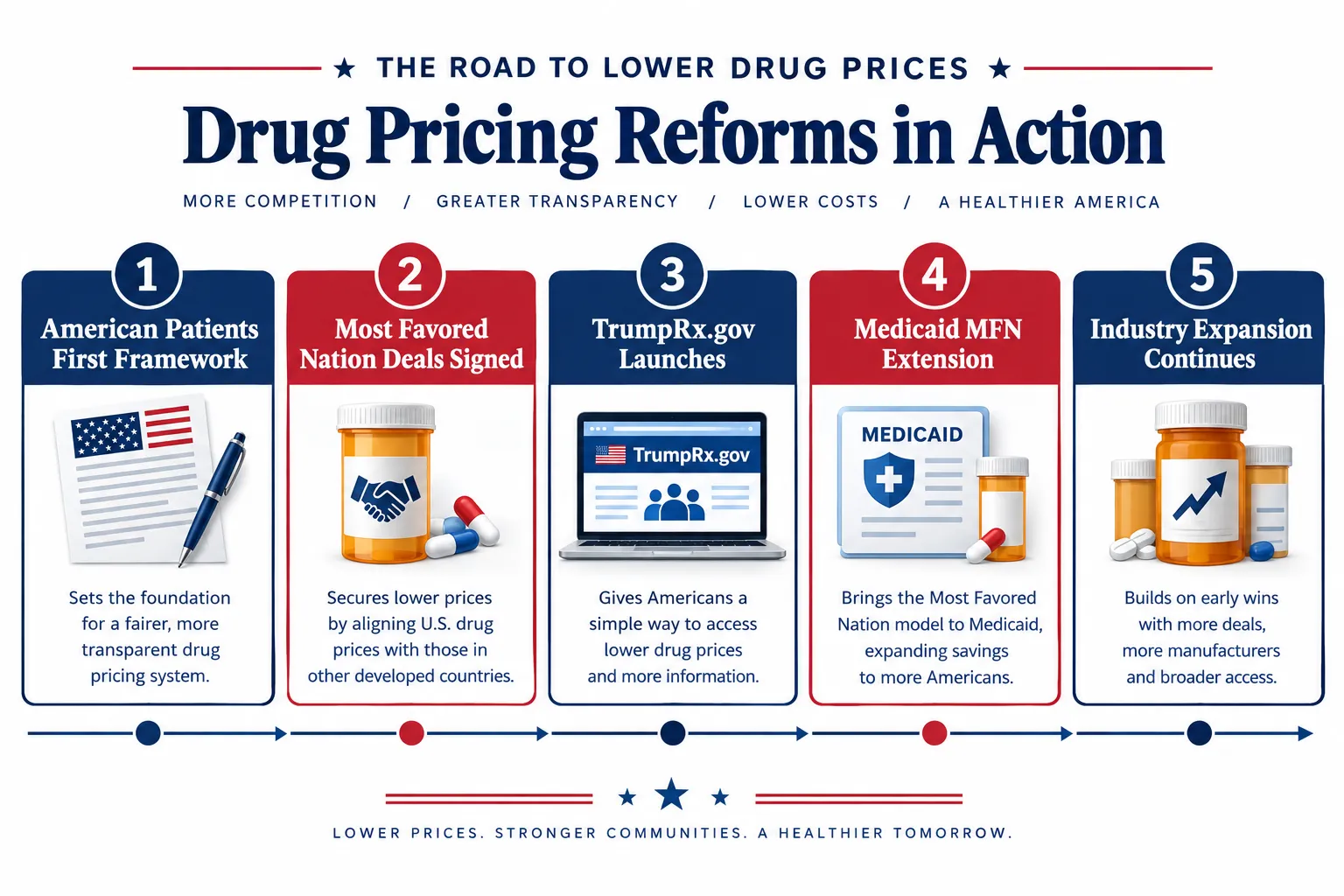
The policy grew out of the American Patients First framework introduced in May 2025, which set out to end what officials called foreign free-riding on US pharmaceutical innovation [4]. From there, the administration layered on additional actions:
- July 2025: Executive actions aimed at securing “best prices in the world” for US patients [8].
- December 2025: The first major batch of MFN agreements with drug manufacturers [7].
- January 2026: The broader “Great Healthcare Plan,” designed to lower costs and send savings directly to patients [6].
- February 2026: Launch of TrumpRx.gov as a direct discount portal [5].
- August to September 2026: Expansion of MFN deals to 26 companies and extension of MFN pricing into every state Medicaid program [2][3][9].
If you’re tracking how these policies touch your own medications, the Medicaid and TrumpRx pieces are the two most likely to affect your out-of-pocket costs right now.
How Much Did Drug Prices Drop Under Trump?
Drug prices dropped the most for brand-name medications covered under the 2026 Most Favored Nation deals, which the White House describes as the largest reported price reduction in more than 60 years [1]. The size of the drop depends heavily on which drug, which insurer, and which state you’re looking at.
Here’s what the numbers show so far:
- 26 drug companies signed MFN agreements, representing close to 90 percent of the branded pharmaceutical market by value [9].
- $64.3 billion in projected Medicaid savings over a decade, based on a May 2026 federal analysis of the MFN extension [3].
- 50 out of 50 states now operate under MFN Medicaid pricing as of mid-September 2026 [2].
Choose to treat these figures as directional rather than universal. A price drop announced for one branded drug through an MFN deal does not automatically apply to every generic, every insurance plan, or every pharmacy counter in the country.
Trump’s Drug Price Negotiation Policy Explained
Trump’s drug price negotiation policy works by pressuring manufacturers to sign Most Favored Nation agreements that peg US list prices to the lowest price charged in comparable wealthy nations. Unlike a government-run negotiation board, this model relies on voluntary deals backed by regulatory and trade pressure.
The mechanism breaks down into a few moving parts:
- Federal officials identify reference countries with lower drug prices than the US.
- Manufacturers negotiate or agree to MFN pricing for specific drugs, often under threat of tariffs, import competition, or public pressure [7][8].
- Agreed prices flow into Medicaid programs nationwide, since Medicaid now mandates MFN pricing in all 50 states [2][3].
- TrumpRx.gov displays discounted cash prices directly to consumers, bypassing some of the traditional insurance and pharmacy benefit manager layers [5].
A common mistake people make is assuming this is the same as the Medicare drug price negotiation program created under the Inflation Reduction Act. It isn’t. MFN deals are separate, broader in company participation, and apply to Medicaid and direct consumer sales rather than only Medicare Part D.
Are Drug Prices Actually Cheaper Under Trump Policies? Which Drugs Got Cuts
Yes, for a defined set of brand-name drugs covered by MFN agreements, list and negotiated prices are lower than before the 2025-2026 deals took effect. But “cheaper” doesn’t mean cheap across the board, and the discount size varies by drug and by payer.
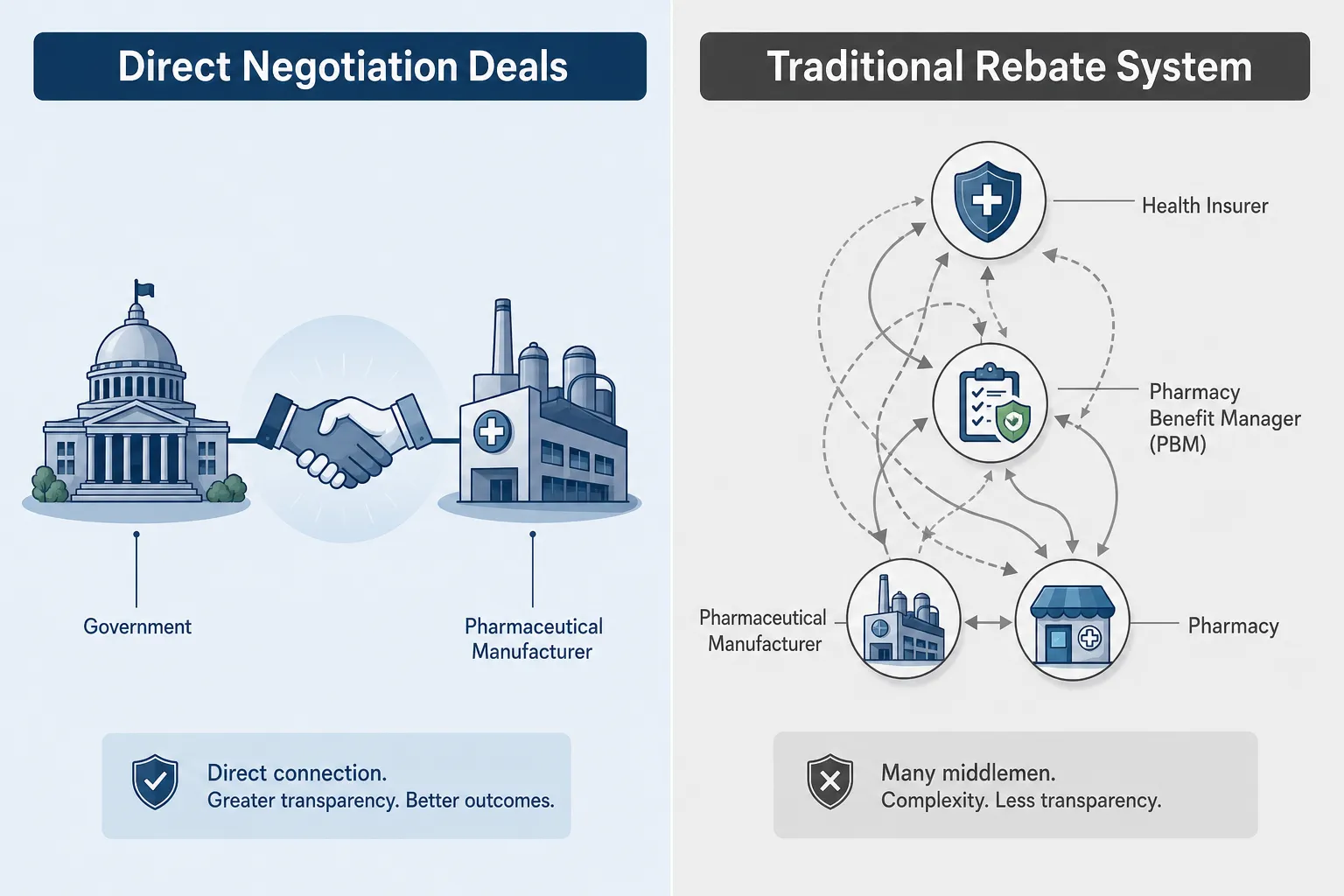
What changed, in practical terms:
| Policy Lever | What It Covers | Who Sees the Savings |
|---|---|---|
| MFN manufacturer deals | ~26 companies, ~89-90% of branded market [9] | Medicaid enrollees, some commercial plans |
| Medicaid MFN mandate | All 50 states [2][3] | Medicaid patients nationwide |
| TrumpRx.gov | Select brand drugs sold direct-to-consumer [5] | Cash-paying and uninsured patients |
| Great Healthcare Plan | Broader cost-sharing and rebate reforms [6] | Patients across multiple coverage types |
Drugs tied to the earliest and largest MFN deals, generally high-cost brand medications with few generic alternatives, saw the most visible list-price reductions. Generics, which already carry low prices, saw little change because they weren’t the target of these deals in the first place.
How Does Trump’s Drug Pricing Compare to Biden’s Approach?
Trump’s approach centers on voluntary MFN deals negotiated company by company, while the Biden-era policy under the Inflation Reduction Act used a formal, legally mandated Medicare negotiation process for a limited list of high-spend drugs. Both aim to lower costs, but they use different levers and cover different patient populations.
Key differences:
- Scope: MFN deals under Trump touch Medicaid and direct consumer sales across dozens of companies [2][3][9]. The Biden-era Medicare negotiation program applied to a smaller, specific list of drugs within Medicare Part D.
- Mechanism: Trump’s model leans on trade and regulatory pressure to extract voluntary agreements [7][8]. The Biden model used statutory authority requiring manufacturers to negotiate with Medicare or face penalties.
- Consumer-facing tools: TrumpRx.gov is a new direct-purchase platform launched in 2026 [5], something the prior administration did not build.
- Interaction, not replacement: Medicare price negotiation continues to operate alongside MFN deals and includes carveouts for orphan drugs, meaning the two frameworks overlap rather than cancel each other out.
Choose to think of these as complementary tools rather than competing ones. A patient on Medicare Part D may benefit from both the existing negotiated Medicare prices and any MFN-driven discount applied by their specific drug’s manufacturer.
Can Trump Force Pharmaceutical Companies to Lower Prices?
No single law lets a president directly set a private company’s drug price, but the administration has used trade threats, tariff leverage, and public pressure to push companies into voluntary MFN agreements. The result functions similarly to a mandate, even though it technically relies on negotiated consent.
This matters for a few reasons:
- Companies that don’t sign MFN deals risk tariff exposure or losing favorable treatment in federal programs [7][8].
- Because Medicaid now requires MFN pricing in every state, manufacturers selling into Medicaid effectively must comply or exit that market [2][3].
- The approach avoids a lengthy legislative process, which is faster but also easier for a future administration to unwind.
Edge case: a company with a single orphan drug and no major Medicaid exposure has much less incentive to sign an MFN deal, which is one reason certain specialty medications remain outside the discount structure.
What Is the Right to Try Act and Drug Pricing
The Right to Try Act is a 2018 federal law that lets terminally ill patients access experimental drugs that haven’t completed FDA approval, and it is not a direct drug pricing policy. It intersects with pricing discussions because expanded access to unapproved treatments can create costs that fall entirely on patients, since insurance typically won’t cover drugs outside the approval pathway.
A few points worth knowing:
- Right to Try does not require manufacturers to provide drugs for free or at a discount.
- It does not set or cap prices for experimental treatments.
- Patients using this pathway should expect to pay out-of-pocket unless a manufacturer voluntarily offers compassionate pricing.
If you or a family member is weighing this option, treat it as a separate track from MFN or Medicaid reforms. It solves an access problem for unapproved drugs, not an affordability problem for approved ones.
Did Trump’s Drug Policies Actually Help Patients Save Money? Who Benefits Most
Patients on Medicaid and those buying select brand drugs through TrumpRx.gov have seen the clearest savings, while people on employer-sponsored insurance or Medicare Advantage plans may notice smaller or no changes depending on their specific drug and plan. The benefit is real but unevenly distributed.
Groups most likely to benefit:
- Medicaid enrollees, since MFN pricing is now mandatory in all 50 states [2][3].
- Uninsured or cash-paying patients, who can shop TrumpRx.gov for discounted brand drugs without going through insurance [5].
- Patients on drugs covered by the 26 participating manufacturers, especially high-cost specialty and brand medications [9].
Groups seeing less change:
- People taking generics, which were already inexpensive.
- Patients whose specific drug’s manufacturer has not signed an MFN deal.
- Commercially insured patients whose plan design and pharmacy benefit manager contracts haven’t adjusted to reflect new negotiated prices.
A October 2026 New York Times analysis found that affordability concerns persisted among voters heading into the midterms, suggesting the savings haven’t fully translated into a widespread sense of relief at the pharmacy counter [10].
“The size of a policy announcement and the size of a patient’s pharmacy bill are two different measurements, and 2026 has shown how far apart they can be.”
Are There Loopholes in Trump’s Drug Price Reforms? What’s Still Expensive
Yes, several categories of drugs sit outside the main MFN framework, including many orphan drugs and medications from manufacturers that haven’t signed agreements. These gaps mean some of the most expensive treatments in the country remain largely untouched by the 2026 reforms.
Common loopholes and exceptions:
- Orphan drug carveouts: Medications for rare diseases often fall outside standard negotiation frameworks, keeping prices high for patients with limited treatment alternatives.
- Non-participating manufacturers: Roughly 10 to 11 percent of the branded market, by the White House’s own figures, sits outside the current MFN deals [9].
- New drug launches: Newly approved medications may launch at high list prices before any negotiation or MFN agreement applies.
- Commercial insurance gaps: Savings negotiated for Medicaid or direct-to-consumer sales don’t automatically transfer to employer-sponsored insurance pricing structures.
Common mistake: assuming an MFN announcement for one drug in a manufacturer’s portfolio means the entire product line got cheaper. In practice, deals are often drug-specific or indication-specific, not company-wide.
Skeptics, including patient advocacy groups, have argued that headline savings figures overstate real-world impact once these carveouts and gaps are accounted for, a critique echoed in multiple October 2026 policy reviews.
How Do Other Countries Negotiate Drug Prices Better Than the US?
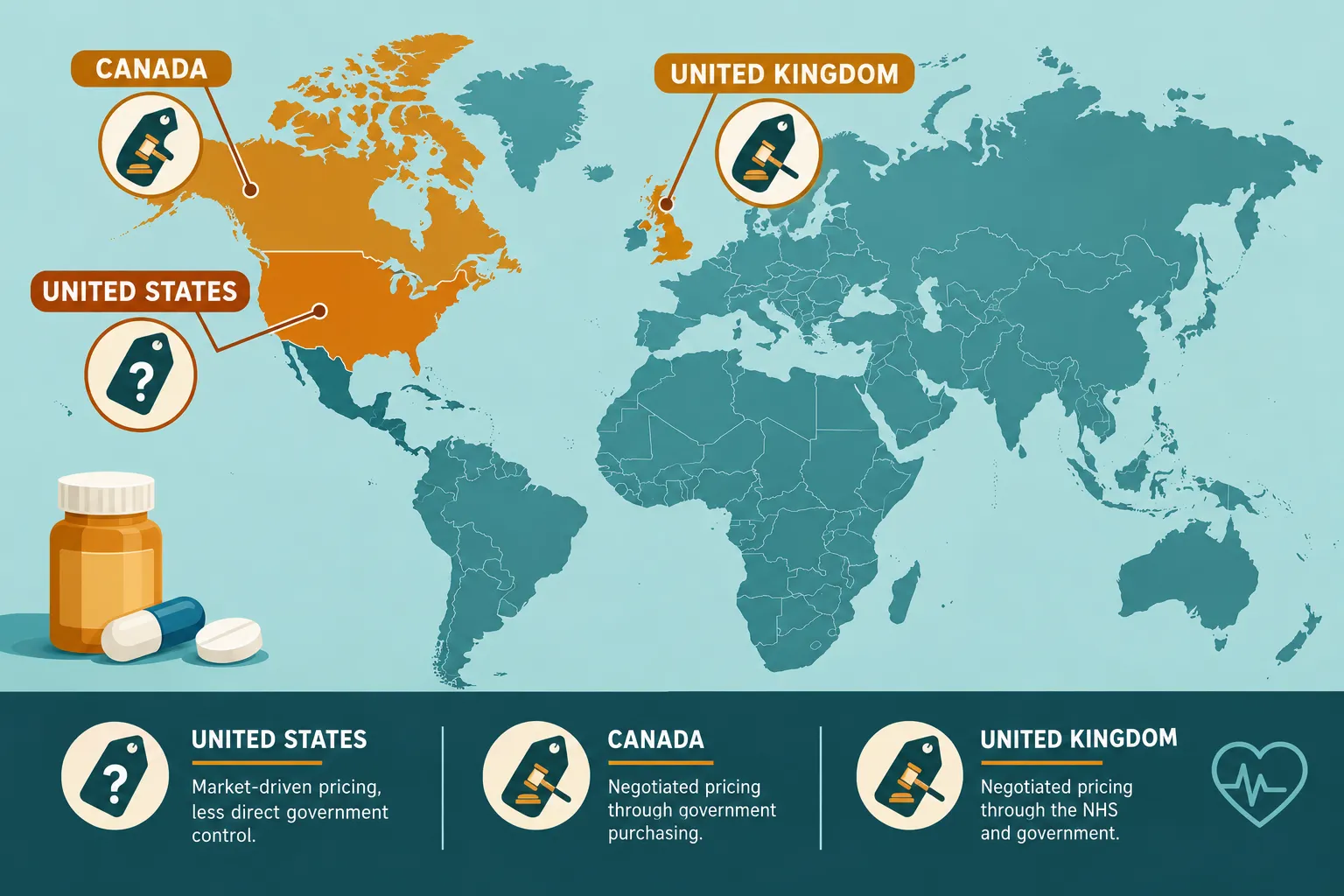
Countries like the United Kingdom and Canada use centralized government bodies that evaluate a drug’s cost-effectiveness before setting a price, giving them stronger leverage than the fragmented US system of private insurers and pharmacy benefit managers. This is precisely the price gap the MFN policy was designed to close by referencing those lower international prices.
How the systems differ:
- UK and Canada: A single national body negotiates directly with manufacturers and can decline to cover a drug if the price doesn’t meet a cost-effectiveness threshold.
- United States (pre-reform): Multiple private insurers and pharmacy benefit managers each negotiate separately, which fragments bargaining power.
- United States (under MFN): The federal government references prices set in countries like the UK and Canada, then pushes US manufacturers toward matching rates [4][8].
Choose the MFN comparison model if you want to understand why US officials point to other countries’ prices as justification for domestic reform. The tradeoff, according to independent price trackers, is that even with MFN deals, some US prices still run higher than equivalent drugs sold abroad, suggesting the gap hasn’t fully closed [10].
For readers managing chronic conditions where drug costs are a major budget line, understanding broader health and wellness strategies alongside medication costs can help. Resources on wellness and women’s health or men’s health cover lifestyle factors that can reduce reliance on certain prescriptions over time, and patients using GLP-1 or other weight management drugs may also want to review current weight loss treatment and cost information.
What Happens to Drug Prices Under Trump: Key Discounts, Reforms, and Savings Policies If They’re Reversed?
If a future administration or Congress rolled back MFN agreements, drug prices for the affected medications would likely rise back toward pre-2026 levels, since the discounts depend on active federal pressure and voluntary manufacturer compliance rather than permanent statutory price caps. Medicaid’s MFN mandate is more durable because it’s now embedded in state program requirements, but it could still be modified through future federal rulemaking or legislation.
What would likely happen in a reversal scenario:
- Medicaid pricing: Could remain stable short-term since it’s now a structural requirement across all 50 states [2][3], but future administrations could adjust the underlying rules.
- TrumpRx.gov pricing: Likely to fluctuate fastest, since it’s a direct platform dependent on ongoing manufacturer participation [5].
- MFN manufacturer deals: Could lapse or get renegotiated if federal pressure eases, since many are framed as voluntary agreements rather than permanent law [7][9].
Decision rule: if you’re relying on a specific discount for a long-term chronic medication, don’t assume the current price is locked in indefinitely. Check your plan’s formulary and pricing at least once a year, since policy-driven discounts can shift with political and regulatory changes.
Frequently Asked Questions
What did Trump do to lower drug prices? The administration negotiated Most Favored Nation pricing deals with 26 pharmaceutical companies, extended MFN pricing to all 50 state Medicaid programs, and launched TrumpRx.gov as a direct-to-consumer discount platform [2][3][5][9].
How much did drug prices drop under Trump? The White House reported the largest prescription drug price drop in over 60 years following the 2026 MFN deals, though the size of the drop varies significantly by drug and payer [1].
Is TrumpRx.gov actually cheaper than buying through insurance? For some brand drugs, yes, especially for uninsured patients, but independent price comparisons found that TrumpRx prices are sometimes still higher than equivalent prices in peer countries [10].
Does the MFN policy apply to generic drugs? No, MFN deals primarily target high-cost brand-name medications since generics were already priced lower before the reforms began.
Can patients on Medicare use TrumpRx.gov? TrumpRx.gov is designed as a direct-purchase option that can work alongside existing coverage, but patients should compare it against their Medicare Part D plan’s negotiated price before switching how they fill a prescription.
Are drug companies required to sign MFN agreements? No, participation has been voluntary, though trade pressure and Medicaid requirements have pushed most major manufacturers, representing about 89 to 90 percent of the branded market, to sign on [9].
What drugs are not covered by these reforms? Many orphan drugs for rare diseases, newly launched medications, and products from the roughly 10 percent of the branded market that hasn’t signed MFN deals remain largely unaffected.
How does this compare to the Biden administration’s drug pricing plan? Biden-era reform relied on a legally mandated Medicare negotiation process for a limited drug list, while Trump’s approach uses broader voluntary MFN deals covering Medicaid and direct consumer sales, with both frameworks now operating in parallel.
Conclusion
Drug Prices Under Trump: Key Discounts, Reforms, and Savings Policies represent a real shift in how the federal government pressures manufacturers, but the savings aren’t evenly spread across every patient or every drug. Medicaid enrollees and TrumpRx.gov shoppers have the clearest path to lower costs right now, while people on commercial insurance or taking orphan drugs may see little change.
If you want to actually benefit from these reforms, take three concrete steps: check whether your specific medication’s manufacturer has signed an MFN deal, compare your current pharmacy price against TrumpRx.gov’s listed price before refilling a prescription, and review your Medicaid or Medicare plan’s formulary at least annually since policy-driven pricing can shift. Staying informed, rather than assuming a headline discount automatically applies to your bottle of pills, is still the most reliable way to manage prescription costs in 2026.
References
[1] President Trump Delivers Largest Prescription Drug Price Drop In Over 60 Years – https://www.whitehouse.gov/releases/2026/08/president-trump-delivers-largest-prescription-drug-price-drop-in-over-60-years/ [2] Fact Sheet President Donald J Trump Announces Lower Drug Prices For All 50 State Medicaid Programs – https://www.whitehouse.gov/fact-sheets/2026/09/fact-sheet-president-donald-j-trump-announces-lower-drug-prices-for-all-50-state-medicaid-programs/ [3] President Trump Extends Most Favored Nation Pricing To Every Medicaid Program In America – https://www.whitehouse.gov/releases/2026/09/president-trump-extends-most-favored-nation-pricing-to-every-medicaid-program-in-america/ [4] Fact Sheet President Donald J Trump Announces Actions To Put American Patients First By Lowering Drug Prices And Stopping Foreign Free Riding On American Pharmaceutical Innovation – https://www.whitehouse.gov/fact-sheets/2025/05/fact-sheet-president-donald-j-trump-announces-actions-to-put-american-patients-first-by-lowering-drug-prices-and-stopping-foreign-free-riding-on-american-pharmaceutical-innovation/ [5] Fact Sheet President Donald J Trump Launches Trumprx Gov To Bring Lower Drug Prices To American Patients – https://www.whitehouse.gov/fact-sheets/2026/02/fact-sheet-president-donald-j-trump-launches-trumprx-gov-to-bring-lower-drug-prices-to-american-patients/ [6] President Trump Unveils The Great Healthcare Plan To Lower Costs And Deliver Money Directly To The People – https://www.whitehouse.gov/releases/2026/01/president-trump-unveils-the-great-healthcare-plan-to-lower-costs-and-deliver-money-directly-to-the-people/ [7] Fact Sheet President Donald J Trump Announces Largest Developments To Date In Bringing Most Favored Nation Pricing To American Patients – https://www.whitehouse.gov/fact-sheets/2025/12/fact-sheet-president-donald-j-trump-announces-largest-developments-to-date-in-bringing-most-favored-nation-pricing-to-american-patients/ [8] Fact Sheet President Donald J Trump Announces Actions To Get Americans The Best Prices In The World For Prescription Drugs – https://www.whitehouse.gov/fact-sheets/2025/07/fact-sheet-president-donald-j-trump-announces-actions-to-get-americans-the-best-prices-in-the-world-for-prescription-drugs/ [9] Trump Drug Pricing Deals – https://www.cnbc.com/2026/08/31/trump-drug-pricing-deals.html [10] Midterms Election Trump Drug Prices Affordability – https://www.nytimes.com/2026/10/16/business/midterms-election-trump-drug-prices-affordability.html