Can Trump Lower Drug Prices? How New Initiatives Work for Patients
Last updated: October 17, 2026
Quick Answer
Trump cannot personally set drug prices, but his administration has used executive orders, manufacturer negotiations, and a new federal buying portal to push prices down on many brand-name drugs. The core tool is “Most Favored Nation” (MFN) pricing, which ties U.S. prices to the lowest price charged in other wealthy countries. By mid-2026, the White House reported deals with 26 drug makers and a 3.9% average drop in prescription prices, though independent reporting shows many patients still don’t feel the savings at the pharmacy counter.[3][6][8]
Key Takeaways
- Trump’s main lever is “Most Favored Nation” pricing, started by a May 2025 executive order that pushes manufacturers to match the lowest price they charge in other developed nations.
- TrumpRx.gov launched February 6, 2026, letting cash-paying patients buy certain drugs directly from manufacturers at MFN prices, skipping some middlemen.[4]
- By August 31, 2026, 26 pharmaceutical companies had signed MFN deals covering an estimated 86 to 90% of the branded U.S. drug market.[6]
- The White House says prescription drug prices fell 3.9% overall since Trump took office, with some drugs dropping 50 to 90% in list price.[3]
- Medicaid now has MFN pricing in all 50 states, D.C., and Puerto Rico as of September 18, 2026, with a projected $65 billion in savings over ten years.[1][2]
- A January 2026 proposal called “The Great Healthcare Plan” would write these deals into federal law instead of leaving them as voluntary agreements.[5][9]
- Reporting from October 2026 found many voters still say they haven’t personally seen lower costs, mostly because of insurance deductibles and formulary rules.[8]
- Generic drugs are largely untouched by MFN deals since the policy targets branded, patent-protected medicines where the biggest price gaps with other countries exist.
What Policies Has Trump Proposed to Lower Drug Prices
Trump’s drug pricing strategy centers on Most Favored Nation pricing, a policy requiring manufacturers to sell certain U.S. drugs at or near the lowest price they charge in comparable wealthy countries. The administration frames this as ending “foreign free-riding,” the idea that other nations get cheap drugs while Americans cover the research costs.[10]
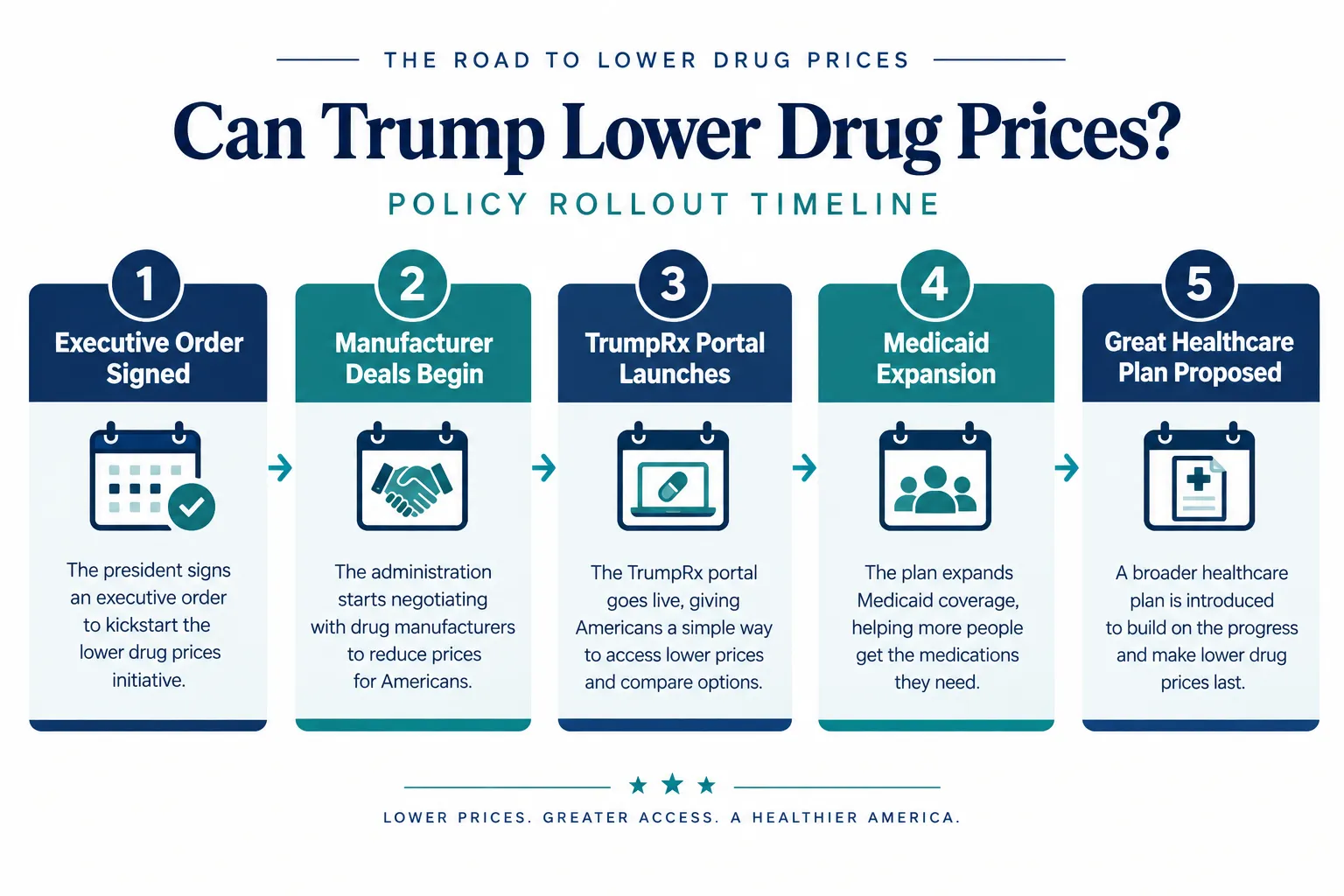
The policy stack includes several connected pieces:
- Executive Order on MFN pricing (May 12, 2025): directs federal agencies to negotiate MFN deals and threatens regulation if manufacturers refuse voluntary agreements.
- TrumpRx.gov: a direct-to-consumer purchasing site launched in February 2026.[4]
- The Great Healthcare Plan: a January 2026 legislative proposal to lock MFN savings into law.[5][9]
- Medicaid MFN expansion: nationwide rollout completed September 2026.[1]
- Targeted drug subsidies: special low-cost programs for insulin and epinephrine announced in 2025.
If you’re tracking this issue, the thing to watch is which pieces are executive actions (which a future president could reverse) versus the legislative plan (which would need Congress and last longer).
How Do Trump’s Drug Price Initiatives Actually Work for Patients
Trump’s drug price initiatives work mainly through manufacturer agreements and a new buying channel, not through government-set price caps written into law. A company agrees to MFN pricing, then either lowers its U.S. list price or offers that lower price through specific channels like Medicaid or TrumpRx.
Here’s the practical mechanism, step by step:
- The administration negotiates with a manufacturer, often company by company, rather than imposing a single blanket rule.
- The manufacturer sets an MFN price benchmarked to its lowest price among comparable developed countries.
- That price becomes available through Medicaid, TrumpRx.gov, or direct-to-patient cash sales, depending on the deal.
- Patients who qualify (cash payers, Medicaid enrollees, or people buying through TrumpRx) see the reduced price; people using private insurance may not, since insurers negotiate separately with pharmacy benefit managers.
A concrete example: Regeneron’s April 2026 deal cut the cholesterol drug Praluent from $537 to $225 for direct TrumpRx purchases, with the company committing to MFN pricing on all future products sold to U.S. patients.[7] That’s the model repeated across dozens of deals: a public announcement, a specific price cut, and a defined sales channel.
Can the President Directly Lower Prescription Drug Costs
No single president can directly set drug prices by decree because manufacturers set their own list prices under current U.S. law. What a president can do is use executive authority to pressure companies into voluntary agreements, adjust how federal health programs pay for drugs, and build new purchasing channels that bypass normal pricing layers.[10]
This distinction matters for expectations:
- Direct price control would require new legislation from Congress, similar to how the Inflation Reduction Act created limited Medicare negotiation authority.
- Executive pressure relies on companies agreeing to deals, often because they want to avoid tariffs, import competition, or stricter future regulation.
- Federal program pricing (Medicare, Medicaid) is more directly controllable since the government is the buyer.
Choose to trust headline price-cut numbers only when they specify the channel (Medicaid, TrumpRx, or list price) because a 90% cut on a cash-pay site doesn’t always match what an insured patient pays at a retail pharmacy.
Trump’s Plan vs. Biden’s Drug Price Policy: What’s the Difference
Trump’s MFN approach negotiates company-by-company price matches tied to international benchmarks, while Biden’s policy used the Inflation Reduction Act to let Medicare directly negotiate prices on a short list of high-spend drugs. Both aim to cut costs, but they use different legal tools and cover different drugs.
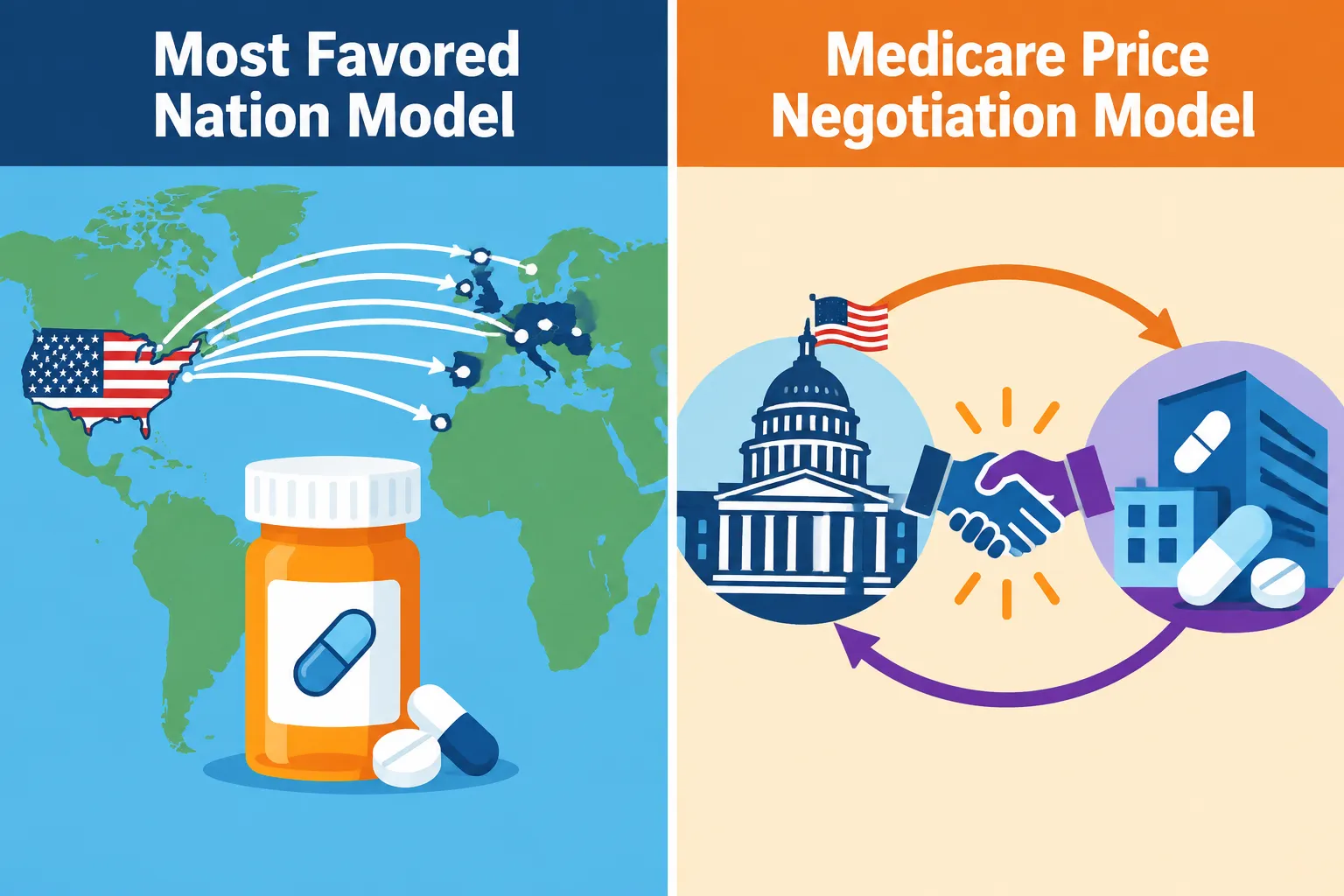
| Feature | Trump’s MFN Approach | Biden’s IRA Negotiation |
|---|---|---|
| Legal basis | Executive orders and voluntary deals | Legislation (Inflation Reduction Act) |
| Price benchmark | Lowest price in other developed countries | Negotiated “maximum fair price” with Medicare |
| Drugs covered | Dozens of branded drugs via company deals | Small annual list of top Medicare-spend drugs |
| Patient access point | TrumpRx, Medicaid, select retail | Medicare Part B and D plans |
| Durability | Can be reversed by executive action | Written into federal law |
| Status in late 2026 | 26 manufacturer deals; Great Healthcare Plan pending in Congress[6][9] | Ongoing annual negotiation rounds under existing law |
A notable wrinkle: progressive critics point out that a Trump-era budget law exempted certain widely used, high-priced drugs from Medicare’s IRA-style negotiations, which they argue softened the Biden-era mechanism rather than replacing it with something stronger.
Which Drugs, Including Generics, Would Be Affected by Trump’s Price Controls
Trump’s MFN deals mostly target high-cost branded drugs, not generics, because the biggest price gap between the U.S. and other countries shows up in patented medicines still under exclusive manufacturer control. Generic drugs are already relatively cheap in the U.S. compared to brand names, so they aren’t the focus of these negotiations.
Drug categories affected so far include:
- Weight-loss and diabetes drugs: Novo Nordisk’s Ozempic and Wegovy, with TrumpRx prices cited around $199 versus prior list prices above $1,000 and $1,300 respectively.
- Cholesterol drugs: Regeneron’s Praluent, cut from $537 to $225 through TrumpRx.[7]
- Insulin and epinephrine: targeted subsidy programs bringing insulin to as little as $0.03 per unit plus fees for qualifying low-income patients, and epinephrine to around $15.
- Fertility treatments, inhalers, and other chronic-disease drugs: cited in an August 2026 White House release as seeing 50 to 90%+ list-price cuts.[3]
If you take a generic version of a common medication, don’t expect MFN headlines to change your cost much. The savings story is built around brand-name drugs where list prices were highest to begin with. For broader context on weight management treatment options, see this overview of weight loss approaches and how drug costs fit into the bigger picture.
How Long Would It Take to See Lower Drug Prices Under Trump’s Plan
Some patients already see lower prices if they buy specific drugs through TrumpRx or live in a state where Medicaid has implemented MFN pricing, while others may wait years for savings to reach retail pharmacy counters through private insurance. Timing depends heavily on which purchasing channel you use.
Rough timeline based on announced milestones:
- May 2025: MFN executive order signed, starting manufacturer negotiations.
- February 2026: TrumpRx.gov launches for direct cash purchases.[4]
- April to August 2026: individual manufacturer deals roll out one by one (Regeneron, Novo Nordisk, and others).[6][7]
- September 2026: Medicaid MFN pricing live in all 50 states.[1]
- Ongoing: The Great Healthcare Plan still needs congressional approval to become permanent law.[5][9]
Common mistake: assuming a national price cut happened on a single date. In reality, this rolled out drug by drug and program by program over roughly 18 months, and private insurance pricing has lagged behind the cash-pay and Medicaid channels.
What Do Pharmaceutical Companies Say About Trump’s Drug Pricing Proposals
Pharmaceutical companies have largely agreed to MFN deals rather than fighting them outright, likely to avoid the threat of tariffs or stricter federal regulation if voluntary agreements failed. By August 2026, 26 major manufacturers had signed on, covering most of the branded U.S. market.[6]

So why haven’t companies simply lowered prices on their own before now?
- Pricing is tied to global contracts: many companies have long-term deals with foreign governments and insurers that make unilateral U.S. price cuts complicated without renegotiating those agreements.
- Shareholder and revenue pressure: public companies answer to investors expecting steady revenue, and U.S. sales have historically subsidized lower prices abroad.
- No single regulator forced action before: without federal pressure like the 2025 executive order, there was limited incentive to cut the one market where prices were highest.
- Deals get negotiated company by company: each manufacturer has different products, patents, and international pricing structures, so a blanket policy doesn’t fit every company equally.
Critics from progressive groups argue the deals still favor industry overall, noting that certain high-priced drugs remain shielded from deeper Medicare negotiation under current law.
Would Trump’s Drug Price Plan Work for Medicare and Medicaid Patients
Medicaid patients already have MFN pricing nationwide as of September 2026, while Medicare patients see more mixed results since Medicare negotiation runs on a separate legal track established by earlier legislation. The two programs are not using identical pricing tools.
Key distinctions:
- Medicaid: all 50 states, D.C., and Puerto Rico now apply MFN pricing, with a projected $65 billion in savings over ten years benefiting low-income families, children, seniors, and people with disabilities.[1][2]
- Medicare: continues to rely mainly on its existing negotiated “maximum fair price” list for select high-spend drugs, a process that predates the MFN push and runs on its own annual schedule.
- Dual-eligible patients (those on both Medicare and Medicaid) may see Medicaid’s MFN pricing apply to drugs covered under that program.
Choose to check your specific drug plan’s formulary before assuming MFN pricing applies, since Medicare Part D plans negotiate separately with pharmacy benefit managers and don’t automatically mirror Medicaid’s new MFN rates.
Downsides and Risks of Trump’s Drug Pricing Initiatives
The biggest risk is a gap between announced list-price cuts and what patients actually pay, since insurance deductibles, formularies, and pharmacy benefit manager contracts sit between manufacturer pricing and the checkout counter. An October 2026 New York Times report found many voters still feel they haven’t personally benefited despite the headline numbers.[8]
Other risks worth knowing about:
- Reversibility: executive orders can be undone by a future administration, unlike the permanent legislation proposed in The Great Healthcare Plan.[5]
- Industry carve-outs: a Trump-era budget law reportedly exempted certain high-priced drugs from deeper Medicare negotiation, which watchdog groups say limits how much patients actually save.
- Uneven channel access: TrumpRx and cash-pay discounts mainly help people without strong insurance coverage or those willing to pay out of pocket, which doesn’t automatically translate to lower co-pays for insured patients.
- Global pricing ripple effects: tying U.S. prices to international benchmarks could, in theory, push manufacturers to raise prices abroad instead of lowering them here, though this effect is still being studied.
How Other Countries Negotiate Drug Prices Compared to Trump’s Approach
Most developed countries set drug prices through direct government negotiation or national formularies before a drug reaches patients, while Trump’s approach uses the existing list-price system and pressures manufacturers to extend their lowest foreign price to the U.S. market. The mechanisms differ even though the stated goal, lower costs, is similar.
- United Kingdom and most of Europe: national health systems negotiate prices directly as a condition of covering a drug at all, often before launch.
- Canada: uses a patented medicine price review board to cap prices based on international comparisons.
- Trump’s MFN model: instead of setting a price before launch, it benchmarks the U.S. price to whatever the lowest price already is abroad, after those other negotiations have already happened.
This means the U.S. approach is somewhat dependent on other countries’ negotiating power. If foreign governments push prices lower, MFN theoretically pulls U.S. prices down too, but the reverse risk is that manufacturers could raise prices abroad to keep their global “lowest price” benchmark higher.
Which Patients Benefit Most, and Has This Plan Been Tried Before
Patients most likely to benefit are Medicaid enrollees, cash-paying patients without strong insurance, and people taking specific high-cost brand drugs now covered by MFN deals, such as certain diabetes, cholesterol, and fertility medications. People relying on private insurance with high deductibles may see less immediate benefit.
This isn’t the first attempt at MFN pricing. Trump’s first term floated a similar rule in 2020 aimed at Medicare Part B drugs, but it faced legal challenges and was withdrawn before full implementation. The 2025-2026 version is broader, covering more drug categories and adding the TrumpRx direct-purchase channel, which didn’t exist in the earlier attempt.
Decision rule: if you’re a Medicaid patient or you’re willing to pay cash through TrumpRx for a covered drug, you’re in the group most likely to see real savings right now. If you rely on employer insurance, savings depend on whether your specific drug and plan have been affected by a signed MFN deal. For general guidance on managing chronic conditions affected by these drug categories, see resources on men’s health, women’s health, and broader wellness strategies that complement medication costs.
FAQ
Does Trump have the legal power to force drug companies to lower prices? No. Trump cannot legally force manufacturers to cut prices by decree. His administration negotiates voluntary MFN agreements and uses the threat of tariffs or regulation as leverage, but companies ultimately choose to sign deals.
What is TrumpRx.gov and who can use it? TrumpRx.gov is a federal website launched February 6, 2026 where cash-paying patients can buy certain high-priced medicines directly from manufacturers at MFN prices, bypassing some pharmacy middlemen.[4]
Are generic drugs covered by Trump’s MFN deals? Generally no. MFN deals focus on branded, patent-protected drugs where U.S. prices are far higher than in other countries. Generic drug prices in the U.S. are already comparatively low.
How many drug companies have signed MFN deals so far? By August 31, 2026, 26 pharmaceutical manufacturers had announced MFN agreements, covering an estimated 86 to 90% of the branded U.S. drug market.[6]
Will my Medicare Part D plan automatically reflect these price cuts? Not necessarily. Medicare continues to rely on its own negotiated pricing process established under earlier legislation, separate from the MFN deals applied to Medicaid and TrumpRx.
Why do some voters say they haven’t seen lower drug prices? An October 2026 New York Times report found many patients still face high costs due to insurance deductibles, formulary restrictions, and difficulty navigating new programs like TrumpRx, even as official price-cut numbers rose.[8]
What is The Great Healthcare Plan? It’s a January 2026 proposal to write Trump’s MFN agreements into permanent federal law rather than leaving them as reversible executive actions, while also promising broader premium reductions and pricing transparency.[5][9]
Did Medicaid patients get drug price cuts too? Yes. As of September 18, 2026, MFN pricing applies to Medicaid programs in all 50 states, D.C., and Puerto Rico, with a projected $65 billion in savings over the next decade.[1][2]
Conclusion
Trump’s drug pricing initiatives represent a real, measurable shift, not just political messaging. The Most Favored Nation strategy, TrumpRx.gov, and the nationwide Medicaid expansion have produced documented price cuts on specific drugs, and the White House’s claim of a 3.9% overall drop since early 2025 is backed by official releases.[1][3][4] At the same time, I’d encourage you to separate headline numbers from your actual out-of-pocket cost, because insurance structure still determines what most insured patients pay.
If you want to act on this today: check whether your specific prescription is on a TrumpRx or Medicaid MFN list, ask your pharmacist directly about cash-pay pricing versus insurance pricing, and watch whether Congress moves on The Great Healthcare Plan, since that vote will decide whether these savings become permanent law or stay reversible executive policy. For more on managing health costs alongside medication decisions, visit the Health Trust MD home page for additional resources.
References
[1] President Trump Extends Most Favored Nation Pricing To Every Medicaid Program In America – https://www.whitehouse.gov/releases/2026/09/president-trump-extends-most-favored-nation-pricing-to-every-medicaid-program-in-america/ [2] Fact Sheet President Donald J Trump Announces Lower Drug Prices For All 50 State Medicaid Programs – https://www.whitehouse.gov/fact-sheets/2026/09/fact-sheet-president-donald-j-trump-announces-lower-drug-prices-for-all-50-state-medicaid-programs/ [3] President Trump Delivers Largest Prescription Drug Price Drop In Over 60 Years – https://www.whitehouse.gov/releases/2026/08/president-trump-delivers-largest-prescription-drug-price-drop-in-over-60-years/ [4] Fact Sheet President Donald J Trump Launches Trumprx Gov To Bring Lower Drug Prices To American Patients – https://www.whitehouse.gov/fact-sheets/2026/02/fact-sheet-president-donald-j-trump-launches-trumprx-gov-to-bring-lower-drug-prices-to-american-patients/ [5] President Trump Unveils The Great Healthcare Plan To Lower Costs And Deliver Money Directly To The People – https://www.whitehouse.gov/releases/2026/01/president-trump-unveils-the-great-healthcare-plan-to-lower-costs-and-deliver-money-directly-to-the-people/ [6] Fact Sheet President Donald J Trump Announces Deal With Nine Additional Pharmaceutical Manufacturers To Lower Drug Prices For Americans – https://www.whitehouse.gov/fact-sheets/2026/08/fact-sheet-president-donald-j-trump-announces-deal-with-nine-additional-pharmaceutical-manufacturers-to-lower-drug-prices-for-americans/ [7] Fact Sheet President Donald J Trump Announces Deal With Regeneron To Bring Most Favored Nation Pricing To American Patients – https://www.whitehouse.gov/fact-sheets/2026/04/fact-sheet-president-donald-j-trump-announces-deal-with-regeneron-to-bring-most-favored-nation-pricing-to-american-patients/ [8] Midterms Election Trump Drug Prices Affordability – https://www.nytimes.com/2026/10/16/business/midterms-election-trump-drug-prices-affordability.html [9] The Great Healthcare Plan – https://www.whitehouse.gov/wp-content/uploads/2026/01/The-Great-Healthcare-Plan.pdf [10] Fact Sheet President Donald J Trump Announces Actions To Get Americans The Best Prices In The World For Prescription Drugs – https://www.whitehouse.gov/fact-sheets/2025/07/fact-sheet-president-donald-j-trump-announces-actions-to-get-americans-the-best-prices-in-the-world-for-prescription-drugs/