The Trump Drug Price Executive Order: Most-Favored-Nation Pricing Explained
Last updated: October 17, 2026
Quick Answer
The Trump Drug Price Executive Order (Executive Order 14297, signed May 12, 2025) directs federal agencies to push pharmaceutical companies toward “most-favored-nation” pricing, meaning US prices for certain drugs should match the lowest price paid by comparable wealthy nations. Instead of forcing this through mandatory regulation, the administration built a voluntary framework of manufacturer deals, Medicaid agreements, and new CMS payment models that rolled out through 2025 and 2026 [1][2][3].
Key Takeaways
- Executive Order 14297 was signed May 12, 2025, and targets the gap between US and international drug prices [2][4].
- Most-favored-nation (MFN) pricing ties US drug costs to the lowest price charged in other developed countries.
- The current approach is voluntary, built on manufacturer-by-manufacturer deals rather than a single mandatory rule [3][5].
- By September 2026, the administration announced MFN-style pricing agreements covering all 50 state Medicaid programs [1].
- The policy differs sharply from the 2020 mandatory MFN Medicare model, which courts blocked before it took effect [6][8].
- It also operates alongside, not instead of, the Inflation Reduction Act’s Medicare Drug Price Negotiation Program [7].
- Legal experts note MFN pricing raises unresolved trade and statutory-authority questions that could resurface in litigation [6][8][10].
- Savings estimates vary widely by drug and program, and full market-wide price drops have not been independently confirmed.
What Is Most-Favored-Nation Pricing for Drugs?
Most-favored-nation (MFN) pricing is a policy concept that sets a US benchmark price for a drug equal to the lowest price that drug’s manufacturer charges in other economically comparable countries. The idea borrows its name from trade law, where “most favored nation” status means a country gets the best terms offered to anyone else.
Applied to medicine, MFN pricing works like this:
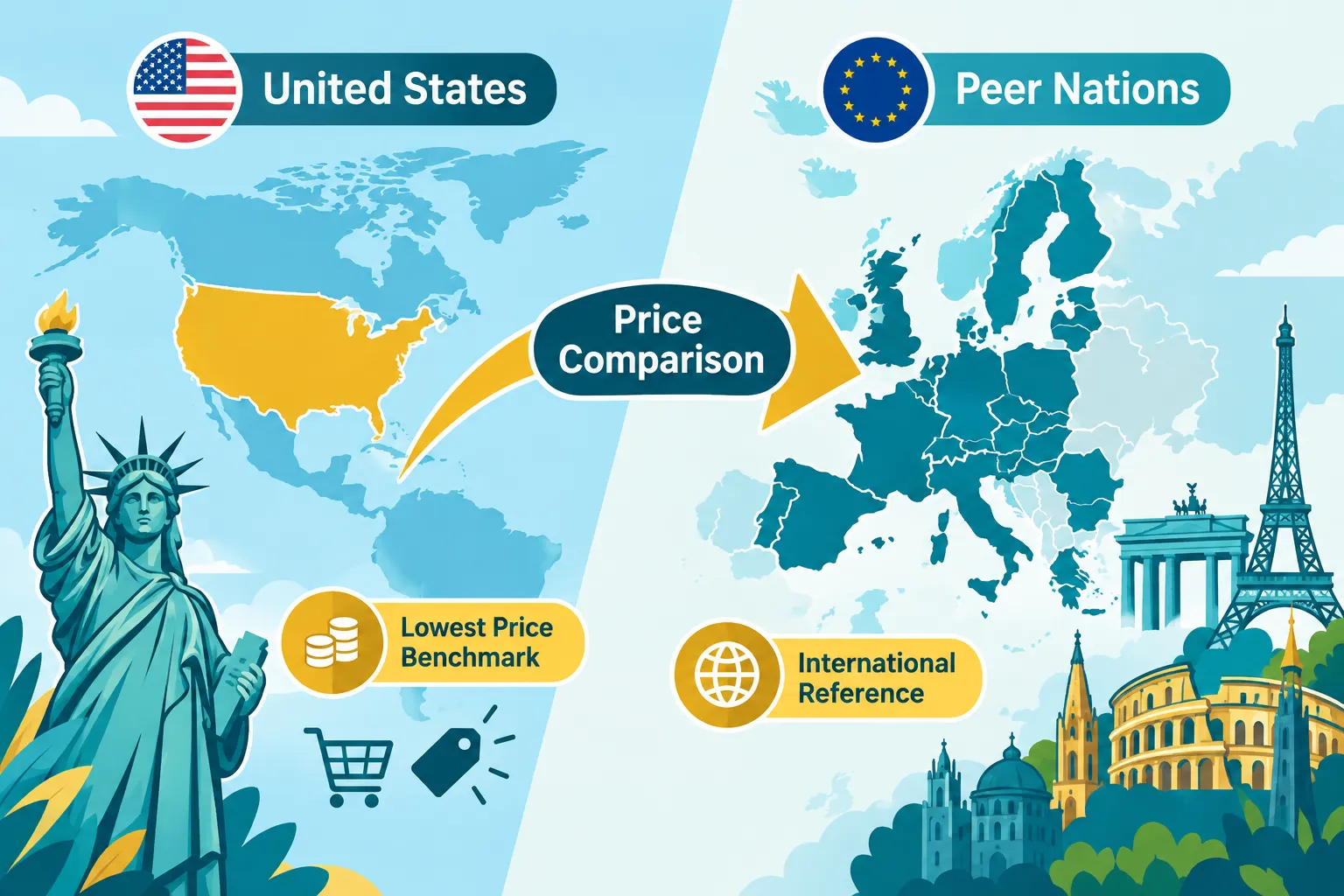
- Regulators or negotiators identify a basket of peer countries (typically wealthy, developed nations with national health systems).
- They find the lowest net price paid for a specific drug across that basket.
- US payers, such as Medicare, Medicaid, or private buyers under a voluntary deal, agree to pay that same lowest price or something close to it.
The underlying argument is that Americans have long paid more for identical brand-name drugs than patients in Germany, Canada, or the UK, partly because other countries negotiate prices directly and the US historically has not for most of the market [2][9].
How Does the Trump Drug Price Executive Order Work?
The Trump Drug Price Executive Order works by directing the Department of Health and Human Services and other agencies to pursue MFN pricing through negotiation, public pressure, and new payment models rather than a single binding price-control regulation. Executive Order 14297, “Delivering Most-Favored-Nation Prescription Drug Pricing to American Patients,” was signed on May 12, 2025 [2][4].
The order set several mechanisms in motion:
- HHS was told to communicate target MFN prices to manufacturers and give them a window to voluntarily align.
- CMS was directed to explore new models (which later became GLOBE and GUARD) that build MFN-style benchmarking into Medicare payment design.
- Trade and regulatory agencies were asked to address “foreign free-riding,” the idea that other countries underpay for drugs partly because US sales subsidize global research and development [2].
- The administration created avenues, including direct-to-consumer pricing platforms, for manufacturers to offer MFN prices outside the standard insurance-negotiated system [3][9].
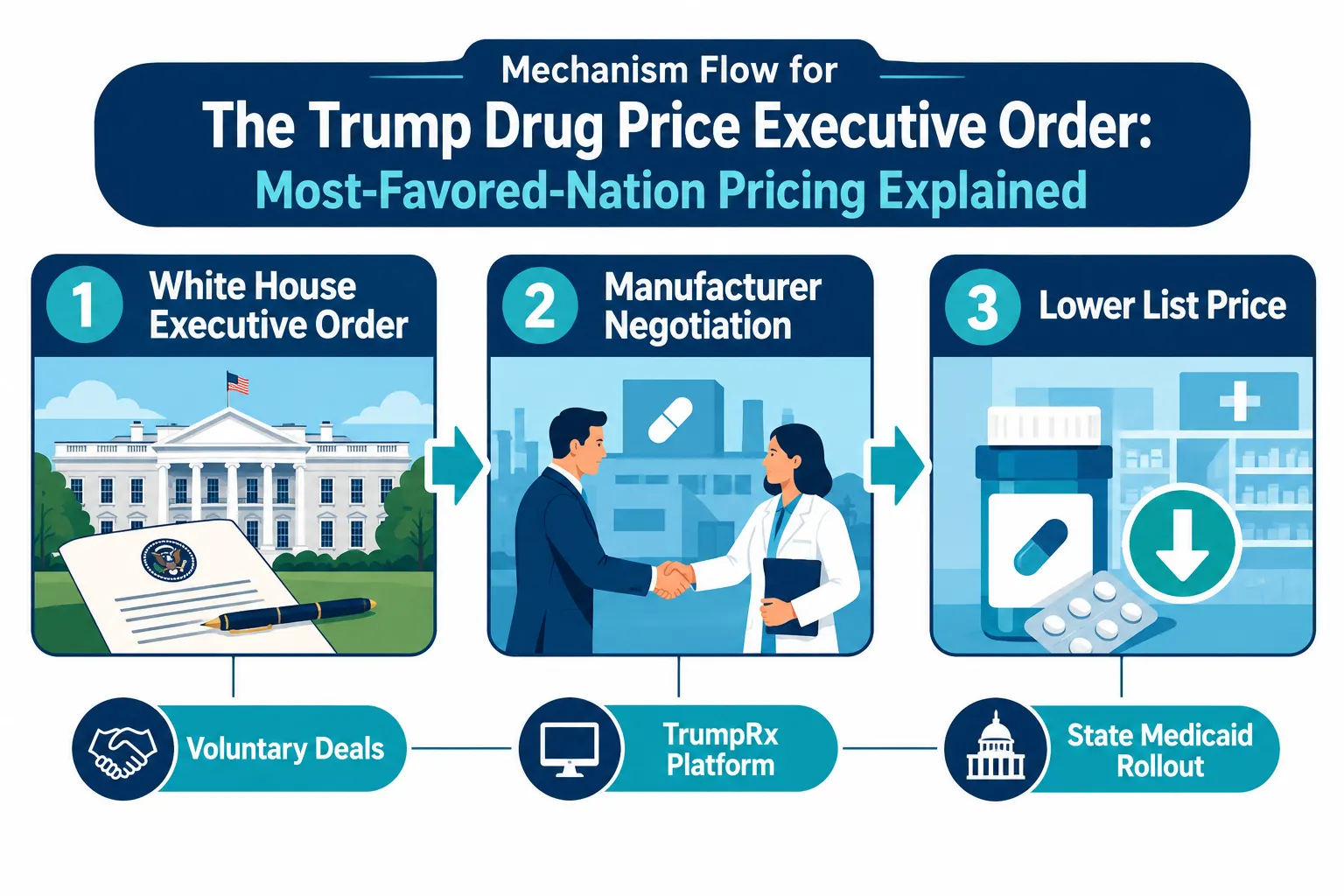
This structure gave the administration flexibility to announce deals company by company rather than waiting on a single rulemaking process, which is slower and more vulnerable to legal challenge.
Which Drugs Are Affected by the MFN Pricing Rule?
The MFN pricing push has focused on brand-name prescription drugs, especially high-cost specialty medications and widely used chronic-disease treatments, rather than generic or over-the-counter products. Coverage has expanded through individual manufacturer agreements rather than a fixed government list.
Drugs affected so far include treatments tied to the voluntary deals announced in 2025 and 2026, plus medications included in state Medicaid agreements finalized by September 2026 [1][3][5]. Categories most discussed in administration announcements include:
- Diabetes and weight-management drugs, including GLP-1 medications that have drawn public attention for their high list prices.
- Specialty biologics used for autoimmune and inflammatory conditions.
- Select cardiovascular and respiratory brand-name drugs.
Choose to pay attention to this list if you or a family member relies on a high-cost brand-name drug without a generic alternative; those are the medications most likely to see negotiated MFN pricing first. For broader context on how drug costs intersect with specific health needs, see our guides on weight loss treatment options and women’s health.
When Did Most-Favored-Nation Drug Pricing Go Into Effect?
There was no single effective date for MFN pricing nationwide; instead, it rolled out in stages starting with the May 2025 executive order and continuing through company-specific and state-specific agreements into 2026. The order itself took effect immediately upon signing on May 12, 2025, but it set deadlines and directives rather than instant price changes [2][4].
Key milestones:
- May 12, 2025: Executive Order 14297 signed, setting the MFN policy direction [2][4].
- July 2025: HHS announced further actions aimed at getting Americans “the best prices in the world” for prescription drugs [9].
- August, September 2026: The first major wave of manufacturer MFN pricing deals and related CMS model announcements became public [3][5].
- September 2026: The administration announced MFN-style pricing agreements extending to all 50 state Medicaid programs [1].
A common mistake is assuming MFN pricing applies uniformly and immediately across the entire drug market. In practice, each agreement has its own start date, product list, and payer scope.
How Much Will Drug Prices Drop Under MFN Pricing?
Price drops under MFN pricing vary by drug and by which deal or program applies, so there is no single universal percentage that applies to every medication. Administration announcements have cited specific savings tied to individual agreements and the Medicaid expansion, but these figures describe particular drugs or programs, not the entire pharmaceutical market [1][3][5].
What is verifiable:
- The White House has framed the Medicaid-wide MFN agreements announced in September 2026 as a major expansion of lower pricing access for state programs [1].
- Individual manufacturer deals announced in 2025 and 2026 targeted specific high-profile drugs, with the first deal highlighted as a model for future agreements [3].
- Independent reporting has tracked these deals as they were announced, noting that scope and discount size differ by manufacturer [5].
Because the program is voluntary and deal-based, a patient’s actual savings depends on their specific drug, insurance type, and whether their state Medicaid program or private plan has adopted an MFN agreement for that product.
Does MFN Pricing Apply to All Medications or Just Some?
MFN pricing does not apply to all medications. It applies only to drugs covered by a specific executive action, manufacturer agreement, state Medicaid deal, or CMS model, which together cover a growing but still limited slice of the overall prescription drug market.
Generics, which already make up the large majority of prescriptions filled in the US, are generally outside the scope of MFN negotiations because their prices are already driven down by market competition. The policy focuses on:
- Brand-name drugs without close generic competitors.
- High-list-price specialty and biologic drugs.
- Medications included in a signed MFN agreement or a Medicaid state plan amendment.
Edge case: a drug can have MFN pricing for Medicaid patients in one state while remaining at standard list price for commercially insured patients elsewhere, since each agreement is negotiated separately.
MFN Pricing vs Other Drug Price Controls: What’s the Difference?
MFN pricing differs from other US drug price control tools mainly in its legal basis and enforcement method. MFN pricing relies on voluntary agreements and executive directives, while the Inflation Reduction Act’s Medicare Drug Price Negotiation Program uses a statutory, mandatory negotiation process for a fixed list of Medicare Part D and Part B drugs [7].
| Policy | Legal Basis | Participation | Who It Covers |
|---|---|---|---|
| MFN Executive Order (2025-2026) | Executive action, agency directives | Voluntary manufacturer deals | Select drugs, growing Medicaid coverage |
| 2020 Mandatory MFN Medicare Model | CMS rulemaking | Mandatory for Part B drugs | Blocked by courts, never implemented [6][8] |
| IRA Drug Price Negotiation Program | Federal statute (IRA) | Mandatory for selected drugs | Specific Medicare Part D/B drugs [7] |
The 2020 version of mandatory MFN pricing for Medicare Part B drugs was struck down in litigation before it ever took effect, largely over procedural and statutory-authority objections [6][8]. That history is a major reason the current administration chose a voluntary, deal-based path instead of reissuing a similar mandatory rule.
Which Countries’ Drug Prices Does the US Compare To Under MFN?
Under MFN pricing, the US compares its drug prices to those paid by other wealthy, economically developed nations that typically negotiate prices through national health systems. The executive order and related fact sheets describe the goal as matching the lowest price among peer countries rather than naming one fixed comparison list for every drug [2][9].
In practice, the countries most frequently referenced in administration commentary include major European economies and other OECD nations with centralized drug price negotiation, since those systems tend to produce the lowest net prices for brand-name drugs. The exact comparison basket can shift by drug and by deal, since each manufacturer agreement is negotiated individually rather than through one fixed international index.
Will MFN Pricing Affect Drug Development and Innovation?
MFN pricing could affect drug development incentives, but the direction and size of that effect is not settled, and current evidence is limited because the policy is still in its early implementation phase. Industry groups have warned that compressing US prices toward international lows could reduce the revenue that funds early-stage research, while administration officials argue the policy targets “foreign free-riding” rather than US innovation itself [2].

Points worth weighing:
- The US has historically generated a disproportionate share of global pharmaceutical revenue, which some economists link to higher R&D investment.
- If MFN pricing meaningfully lowers US revenue for certain drug classes, companies may adjust how they prioritize future research pipelines, though this outcome remains an expectation rather than a confirmed trend as of late 2026.
- Alternatively, if other countries raise their prices in response to US pressure (a stated administration goal), the net effect on global R&D funding could be smaller than critics predict.
This is an area where expert predictions diverge, and readers should treat any specific innovation-loss or innovation-neutral forecast as an estimate, not a settled fact.
How Does MFN Pricing Impact Pharmaceutical Companies?
MFN pricing impacts pharmaceutical companies mainly through negotiation pressure, reputational exposure, and the need to manage different prices across Medicaid, Medicare-adjacent models, and voluntary commercial deals at the same time. Companies that reach agreements, such as the one highlighted in the administration’s September 2025 fact sheet, gain favorable publicity and a seat at the table for shaping how MFN pricing applies to their specific products [3].
Practical impacts include:
- Need to build pricing infrastructure that can apply different net prices by payer and by state Medicaid program.
- Exposure to public pressure campaigns naming companies that have not yet signed MFN agreements.
- New CMS payment models like GLOBE and GUARD, which build MFN-adjacent benchmarks directly into how Medicare pays for certain drugs, adding a layer manufacturers must navigate even outside formal deals.
Decision rule for manufacturers: companies with drugs facing little generic competition and high public price scrutiny have stronger incentive to negotiate early, since delaying risks regulatory and reputational pressure without the benefit of shaping deal terms.
Are There Exemptions to the Most-Favored-Nation Drug Pricing Rule?
Yes, exemptions exist in practice because MFN pricing is implemented through individual agreements rather than one universal rule, which means any drug, manufacturer, or payer without a signed deal or qualifying program is effectively outside current MFN pricing. Generics and widely available low-cost drugs are generally not targeted, since the policy focuses on high-price brand-name and specialty medications [2][9].
Common exemption patterns:
- Drugs not yet covered by a manufacturer’s MFN agreement.
- States that have not finalized a Medicaid MFN arrangement, though by September 2026 all 50 states had done so [1].
- Private commercial insurance plans that have not adopted MFN-linked pricing for a given drug.
For readers managing ongoing conditions, this is a good moment to review coverage details with a provider, particularly for chronic-care medications discussed on our men’s health and general wellness resources.
What Happens If Drug Companies Don’t Comply with MFN Pricing?
Because the current MFN framework is voluntary, there is no single automatic penalty for a manufacturer that declines to participate; instead, non-participating companies face political pressure, public naming, and the risk that future CMS payment models (such as GLOBE and GUARD) could make non-compliance commercially unattractive over time. The administration has used public fact sheets to highlight both participating companies and policy pressure aimed at others who have not yet signed agreements [2][3].
Realistically, consequences can include:
- Being named publicly as a holdout in administration communications.
- Facing less favorable treatment under new CMS Medicare payment models that build in MFN-style benchmarks.
- Continued exposure to broader legislative or regulatory proposals, including those discussed in congressional analysis of MFN-style policy options [6][10].
Is MFN Drug Pricing Legal, or Has It Been Challenged in Court?
The current voluntary MFN framework has not faced the same type of court-blocking litigation that stopped the 2020 mandatory Medicare MFN model, largely because it relies on negotiated agreements rather than a compulsory regulation. However, legal analysts have flagged open questions about statutory authority, trade law implications, and how future mandatory elements (if proposed) might be challenged [6][8][10].
Key legal context:
- The 2020 mandatory MFN model for Medicare Part B drugs was halted by federal courts before implementation, largely on procedural grounds related to how the rule was issued [6][8].
- Congressional Research Service analysis has noted that any shift back toward a mandatory MFN structure would likely face similar legal scrutiny [10].
- The voluntary, deal-based 2025-2026 approach sidesteps much of that risk by avoiding a single binding regulation, but experts note it could face challenges if any single element (such as a specific CMS model requirement) is later deemed to exceed agency authority [6].
How Does This Executive Order Compare to Other Countries’ Drug Pricing Policies?
The Trump Drug Price Executive Order borrows its core logic from how many other developed countries already set drug prices, but it applies that logic in reverse, pressuring other nations to pay more rather than only cutting US prices through direct government-run negotiation. Countries like the UK, Germany, and Canada typically use centralized health technology assessment bodies and single-payer negotiating power to secure low net prices [2][9].
The US approach under this executive order differs because:
- It does not create a single government negotiator with legal power to set one universal price, unlike many peer countries’ national health systems.
- It layers voluntary deals, Medicaid agreements, and new CMS models on top of the existing fragmented US payer system rather than replacing it.
- It explicitly aims to raise what other countries pay, not just lower what Americans pay, framing the issue as “foreign free-riding” on US-funded drug innovation [2].
This hybrid approach is one reason experts describe US MFN policy as a work in progress rather than a finished, internationally comparable model.
Conclusion
The Trump Drug Price Executive Order built most-favored-nation pricing into US health policy through executive action, voluntary manufacturer deals, Medicaid agreements covering all 50 states by September 2026, and new CMS payment models rather than one single mandatory price rule [1][2][3]. That design choice reflects lessons from the 2020 mandatory MFN model’s court defeat, and it means the real-world effect on any individual patient’s drug costs depends heavily on their specific medication, state, and insurance type [6][8].
If you want to know whether MFN pricing affects a drug you take, start with these steps:
- Check whether your state Medicaid program has a finalized MFN agreement for your medication.
- Ask your pharmacist or provider if the manufacturer has announced a direct MFN pricing deal for that drug.
- Watch for updates on new CMS models like GLOBE and GUARD, since these could change how Medicare prices the drug going forward.
- Follow credible government and news sources rather than assuming a flat, universal price cut applies.
Drug pricing policy is moving quickly, and I’d treat any specific savings claim as subject to change until it’s confirmed through an official agreement covering your exact medication and coverage type.
FAQ
What does most-favored-nation pricing mean for prescription drugs? It means the US price for a specific drug is tied to the lowest price that drug’s manufacturer charges in other wealthy, comparable countries, rather than being set independently by US market dynamics alone.
Is the Trump Drug Price Executive Order a law passed by Congress? No. It is Executive Order 14297, signed May 12, 2025, which directs federal agencies to pursue MFN pricing through negotiation and new programs, not a statute passed by Congress [2][4].
Does MFN pricing lower prices immediately for every patient? No. Price changes apply only once a specific manufacturer deal, state Medicaid agreement, or CMS model covering that drug and payer is finalized, so effects vary widely by medication and coverage.
How is this different from the 2020 MFN Medicare model? The 2020 model was a mandatory CMS rule for Medicare Part B drugs that courts blocked before it took effect. The 2025-2026 approach is voluntary and deal-based, which avoids that specific legal vulnerability [6][8].
Which drugs are most likely to be covered by MFN deals? High-cost brand-name and specialty drugs without close generic competition, including diabetes, weight-management, and biologic medications, have been the main focus so far [1][3][5].
Do all 50 states participate in MFN-style Medicaid pricing? As of the administration’s September 2026 announcement, all 50 state Medicaid programs had agreements tied to the MFN pricing push [1].
Will MFN pricing reduce funding for new drug research? This is debated. Industry groups warn of reduced R&D incentives, while administration officials argue the policy targets unfair foreign pricing rather than US innovation funding. Neither outcome is confirmed yet.
Can a drug company be forced to accept MFN pricing? Under the current framework, participation is voluntary, though companies face public pressure and potential disadvantages under new CMS payment models if they decline to negotiate [2][3].
Has MFN pricing been challenged in court? The current voluntary framework has not faced the kind of lawsuit that stopped the 2020 mandatory model, but legal experts say future mandatory elements could face similar challenges [6][8][10].
How does US MFN pricing compare to how other countries price drugs? Other developed countries typically use a single national negotiator to secure low prices directly. The US approach instead layers voluntary deals and new payment models onto its existing multi-payer system while also pressuring other countries to pay more [2][9].
References
[1] Fact Sheet President Donald J Trump Announces Lower Drug Prices For All 50 State Medicaid Programs – https://www.whitehouse.gov/fact-sheets/2026/09/fact-sheet-president-donald-j-trump-announces-lower-drug-prices-for-all-50-state-medicaid-programs/ [2] Fact Sheet President Donald J Trump Announces Actions To Put American Patients First By Lowering Drug Prices And Stopping Foreign Free Riding On American Pharmaceutical Innovation – https://www.whitehouse.gov/fact-sheets/2025/05/fact-sheet-president-donald-j-trump-announces-actions-to-put-american-patients-first-by-lowering-drug-prices-and-stopping-foreign-free-riding-on-american-pharmaceutical-innovation/ [3] Fact Sheet President Donald J Trump Announces First Deal To Bring Most Favored Nation Pricing To American Patients – https://www.whitehouse.gov/fact-sheets/2025/09/fact-sheet-president-donald-j-trump-announces-first-deal-to-bring-most-favored-nation-pricing-to-american-patients/ [4] Dcpd 202500591 – https://www.govinfo.gov/content/pkg/DCPD-202500591/pdf/DCPD-202500591.pdf [5] Trump Drug Pricing Deals – https://www.cnbc.com/2026/08/31/trump-drug-pricing-deals.html [6] Lsb11319 – https://www.congress.gov/crs-product/LSB11319 [7] Pmc13119479 – https://pmc.ncbi.nlm.nih.gov/articles/PMC13119479/ [8] Lsb11319 – https://www.congress.gov/crs_external_products/LSB/HTML/LSB11319.html [9] Fact Sheet President Donald J Trump Announces Actions To Get Americans The Best Prices In The World For Prescription Drugs – https://www.whitehouse.gov/fact-sheets/2025/07/fact-sheet-president-donald-j-trump-announces-actions-to-get-americans-the-best-prices-in-the-world-for-prescription-drugs/ [10] Lsb11319.1 – https://www.congress.gov/crs_external_products/LSB/PDF/LSB11319/LSB11319.1.pdf