Trump Drug Prices Explained: Costs, Discounts, and What You Pay Out-of-Pocket
Last updated: October 17, 2026
Quick Answer
The second Trump administration’s 2026 drug pricing push combines Most Favored Nation (MFN) pricing rules, a new direct-to-consumer portal called TrumpRx.gov, and expanded Medicaid price matching. Trump Drug Prices Explained: Costs, Discounts, and What You Pay Out-of-Pocket comes down to this: some patients, especially those buying GLP-1 drugs, insulin, or other high-cost medications outside insurance, are seeing real discounts, while Medicare beneficiaries largely rely on separate, older negotiation rules that work differently from the TrumpRx program [3][4].
Key Takeaways
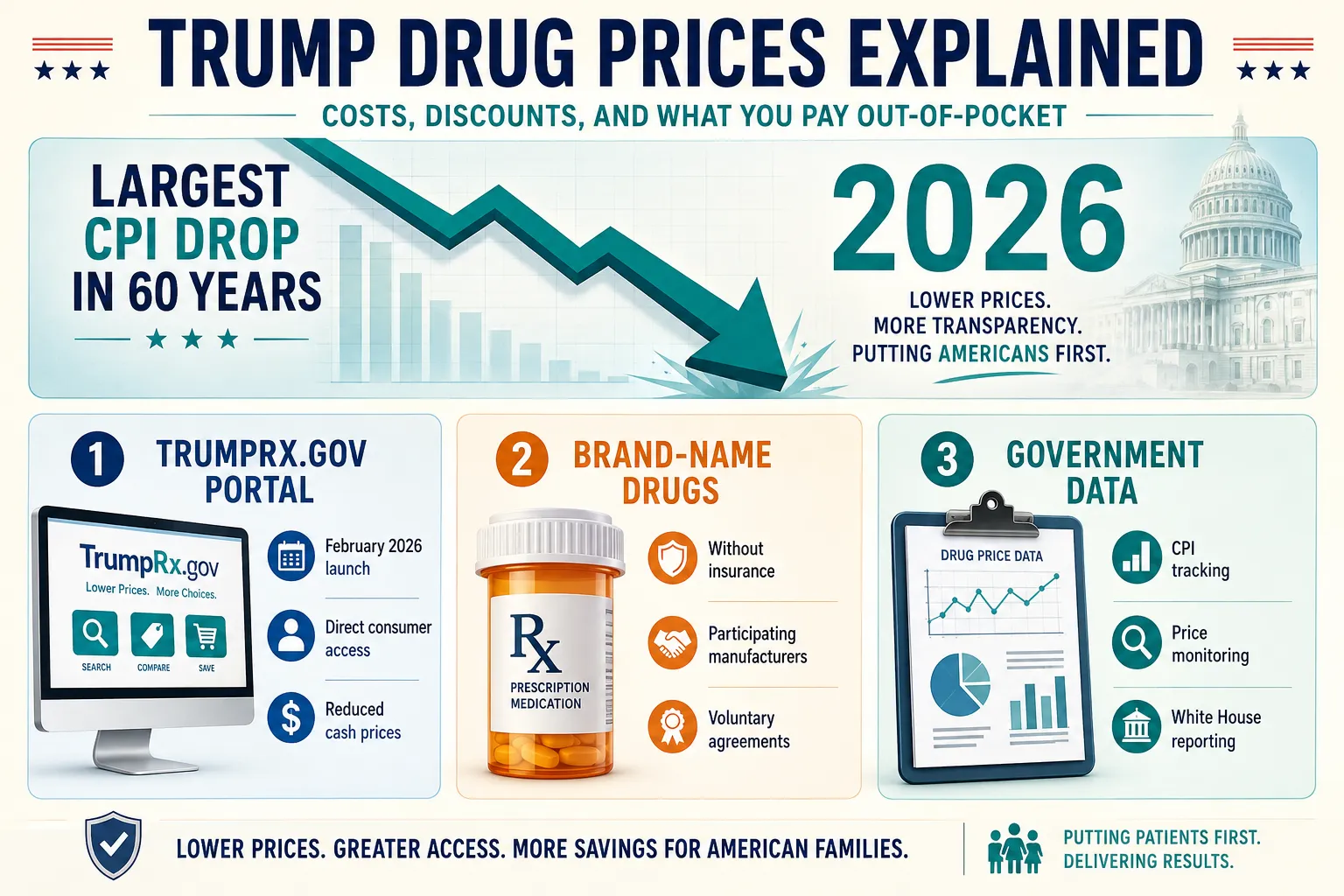
- The White House reported the largest prescription drug price drop in roughly 60 years based on CPI data released in 2026 [2][8].
- TrumpRx.gov launched in February 2026 as a direct-to-consumer site letting Americans buy certain brand-name drugs at reduced cash prices without using insurance [3][5].
- Medicaid programs nationwide began using Most Favored Nation pricing starting September 2026, which ties U.S. prices to the lowest price paid in other wealthy countries [4].
- Promotional materials cite discounts “up to 80%” on some drugs, but independent reviews show savings vary widely by drug and pharmacy [7][9].
- Medicare’s existing negotiation program runs on a separate legal track from TrumpRx, so not every Medicare drug benefit automatically reflects the new consumer-facing prices [9][10].
- Out-of-pocket costs depend heavily on whether you have insurance, which pharmacy you use, and whether your specific drug is on the discount list.
- Critics point to Medicare exemptions and questions about company-specific deals as reasons to read the discount claims carefully [9][10].
What Is Trump Drug Pricing Policy?
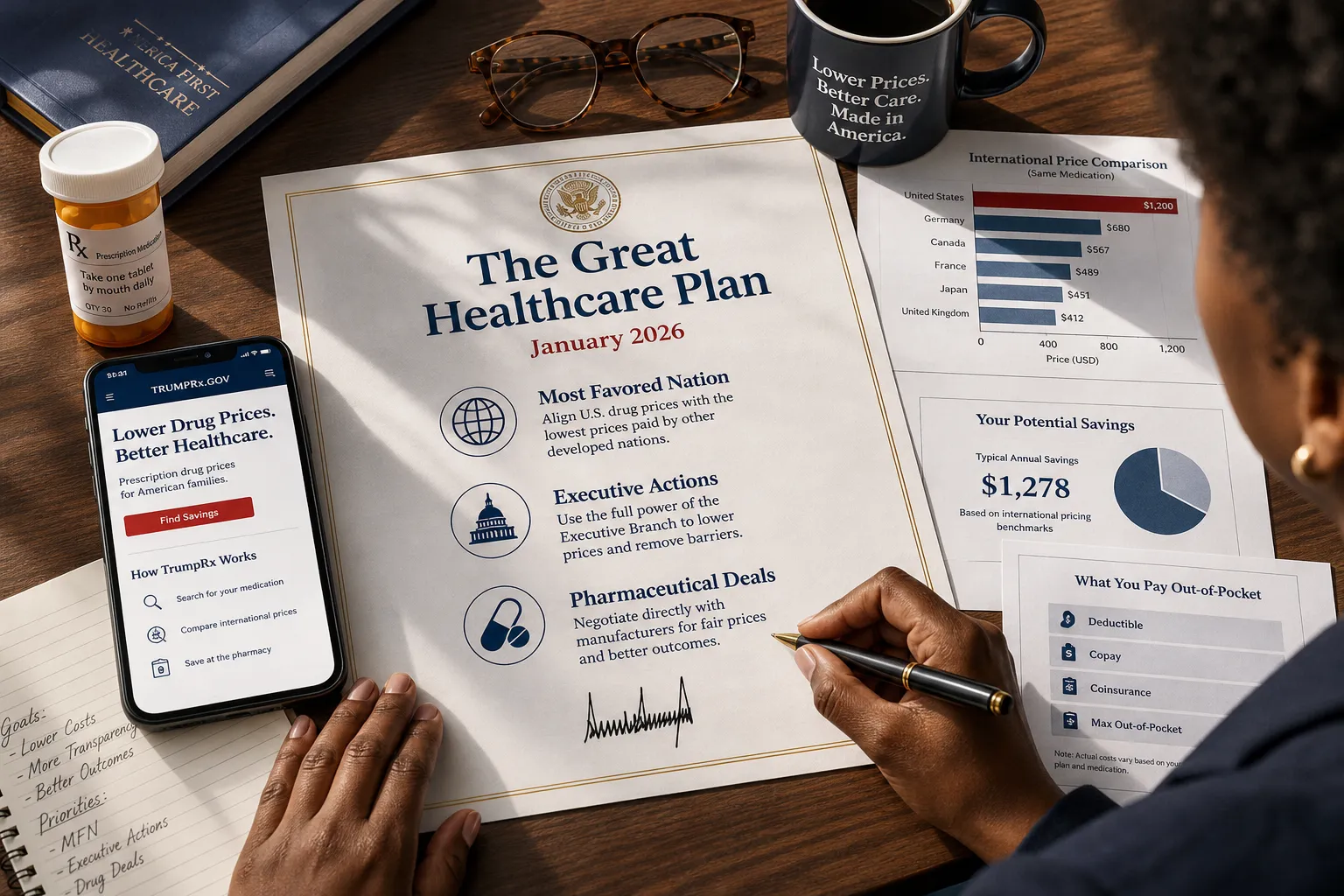
Trump drug pricing policy in 2026 is a bundle of executive actions and pharmaceutical deals designed to lower list prices and cash prices for prescription drugs, anchored by what the administration calls “The Great Healthcare Plan,” unveiled in January 2026 [1][6]. The plan combines Most Favored Nation pricing commitments from drug manufacturers, a new government-run purchasing portal, and expanded Medicaid pricing rules.
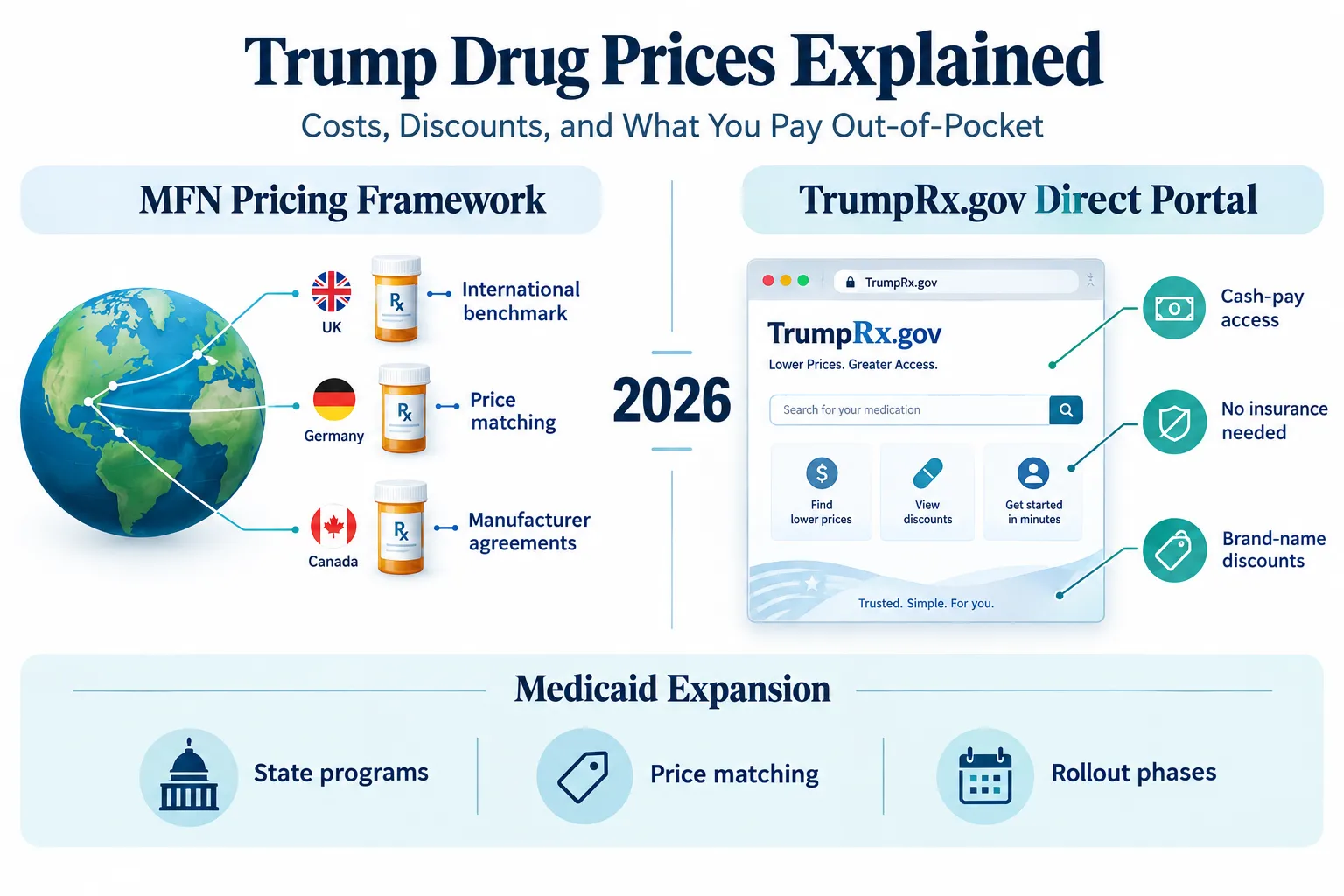
The policy rests on three main pillars:
- Most Favored Nation (MFN) pricing, pushing U.S. prices for certain drugs closer to the lowest price charged in other developed countries [1][4].
- TrumpRx.gov, a direct-to-consumer site where Americans can buy select drugs at negotiated cash prices, bypassing some insurance markups [3][5].
- Medicaid MFN expansion, extending favored-nation pricing to every state Medicaid program as of September 2026 [4].
Choose to pay attention to this policy if you buy maintenance medications without strong insurance coverage, or if you’re on Medicaid. If you’re on Medicare, the rules work through a different, older negotiation framework that predates this plan [9].
How Did Trump’s Drug Price Negotiation Work?
The negotiation process relied on direct deals between the White House and individual drug manufacturers, where companies agreed to MFN pricing and participation in TrumpRx in exchange for regulatory and trade considerations [1][3]. This is different from a single universal law capping every drug price.
Here’s the general sequence reported through 2026:
- The administration identified high-cost drug categories, including GLP-1 weight-loss drugs, insulin, fertility treatments, and inhalers [5][6].
- Officials negotiated with manufacturers company by company, securing commitments to list certain drugs at or near the lowest price charged internationally [1][7].
- Participating companies agreed to list their discounted cash prices on TrumpRx.gov starting February 2026 [3][5].
- Separately, Medicaid programs were told to apply MFN-style pricing starting in September 2026, broadening the policy beyond the voluntary company deals [4].
A common misunderstanding is assuming every drug maker participated. In reality, the discounts apply to companies and drugs that signed on, not the entire pharmaceutical market [9][10].
Trump Drug Prices vs Biden Drug Prices Comparison
The Biden-era approach relied on a legally mandated Medicare negotiation program under the Inflation Reduction Act, covering a short list of high-spend Medicare drugs with price ceilings phased in over several years. The Trump 2026 approach is broader in scope but more voluntary and deal-based, reaching beyond Medicare into cash-pay and Medicaid markets through TrumpRx and MFN commitments [1][4][9].
| Feature | Biden-era approach | Trump 2026 approach |
|---|---|---|
| Legal basis | Inflation Reduction Act mandate | Executive deals plus Medicaid MFN rule |
| Who benefits first | Medicare Part D enrollees on listed drugs | Cash-pay consumers, Medicaid enrollees |
| Drug list size | Small, phased list of top-spend drugs | Broader categories (GLP-1s, insulin, fertility, inhalers) |
| Price mechanism | Negotiated ceiling prices | Most Favored Nation benchmark pricing |
| Consumer access point | Medicare Part D plan | TrumpRx.gov direct purchase |
Choose the Biden framework as your reference point if you want guaranteed, legally binding Medicare price caps. Choose to track the 2026 TrumpRx framework if you’re uninsured, underinsured, or paying cash for a drug on the participating list [9].
Does Trump Drug Pricing Actually Lower Out-of-Pocket Costs?
Yes, for a meaningful share of consumers buying specific drugs through TrumpRx or at Medicaid pharmacies, but the savings are not universal across every medication or every patient. Government data cited a large CPI drop in prescription drug prices during 2026, while independent journalists found the real-world experience varies by drug, pharmacy, and insurance status [2][8][9].
What actually determines your savings:
- Whether your specific drug and manufacturer signed onto the MFN or TrumpRx program.
- Whether you’re paying cash versus running the purchase through insurance.
- Whether your state Medicaid program has implemented the September 2026 MFN expansion.
- Whether your pharmacy has integrated TrumpRx pricing into its checkout system.
A common edge case: someone with employer insurance and a $10 copay may see no change at all, because their out-of-pocket cost was already low before the policy, and the insurer, not the patient, absorbed the old price difference [9][10].
What Drugs Are Covered Under Trump Price Controls?
The drugs most consistently mentioned in 2026 announcements include GLP-1 weight-loss and diabetes medications, insulin products, fertility drugs, inhalers for asthma and COPD, and certain cholesterol treatments [5][6]. Coverage is driven by which manufacturers signed MFN or TrumpRx agreements, not by a single government-wide list covering every prescription drug in America.
Drug categories most frequently cited:
- GLP-1 weight-loss and diabetes drugs, among the highest-profile discounts, with new TrumpRx cash prices reported well below prior list prices [7].
- Insulin, long a target of affordability complaints, now included in several MFN deals [5][6].
- Fertility medications, historically expensive and rarely covered by insurance, now part of the discount push [5][6].
- Inhalers and cholesterol drugs, chronic-condition medications added to reduce long-term out-of-pocket burden [5][6].
If you manage a chronic condition, it’s worth checking the current discount list directly, since manufacturers have added and adjusted participation throughout 2026.
How Much Can You Save With Trump Drug Pricing?
Savings estimates reported by the administration and in press coverage describe discounts of “up to 80%” off prior cash prices for some GLP-1 and specialty drugs, though independent analysts note that figure represents a best-case scenario, not a typical result for every buyer [7][9][10]. Your actual savings depend on the specific drug, your previous price, and whether you qualify for the new rate.
Factors that shrink or grow your savings:
- Drugs with high list prices and strong international price gaps show the largest cuts.
- Generic and already-cheap drugs show smaller dollar savings, even if the percentage sounds similar.
- Cash-pay buyers often see bigger visible discounts than insured buyers, because insurance already negotiates separate rebates.
Choose to compare your pharmacy receipt against the TrumpRx listed price before assuming you’re getting the advertised discount. Independent reporting found gaps between headline claims and some patients’ actual checkout prices [9][10].
Trump Drug Price Caps Explained
Most Favored Nation pricing works as a benchmark, not a hard legal price cap enforced on every transaction. It ties the U.S. price of a participating drug to the lowest price that manufacturer charges in a comparable wealthy country, rather than setting one fixed national price for all buyers [1][4].
Key distinctions:
- MFN pricing applies drug-by-drug and company-by-company, based on signed agreements.
- Medicaid’s September 2026 expansion applies MFN pricing more broadly across state programs, but timing and rollout varied by state [4].
- TrumpRx prices reflect negotiated cash rates, which can differ from what you pay through insurance or Medicare Part D.
A common mistake is assuming “price cap” means the same final price everywhere. In practice, your pharmacy, your insurance plan, and your state’s Medicaid rules all still affect your actual bill [9][10].
Which Insurance Plans Use Trump Drug Pricing, and Does It Apply to Medicare?
Medicaid programs across the country began applying MFN-style pricing in September 2026, while TrumpRx.gov primarily serves cash-pay consumers outside the insurance system entirely. Medicare operates on a separate, earlier negotiation track, so the 2026 TrumpRx discounts don’t automatically apply inside Medicare Part D the same way they apply at TrumpRx checkout [4][9][10].
Breakdown by plan type:
- Medicaid, covered under the September 2026 MFN expansion nationwide [4].
- Medicare Part D, governed mostly by its own prior negotiation program; some overlap exists but it’s not identical to TrumpRx [9][10].
- Employer and marketplace insurance, not directly part of the TrumpRx program; savings depend on whether your plan’s formulary reflects lower negotiated rates.
- Cash-pay, uninsured, the primary audience for TrumpRx.gov discounts [3][5].
Critics have flagged the Medicare exemption as a gap in the plan, since many seniors on fixed incomes don’t automatically benefit from the same consumer-facing discounts [9][10]. If you manage care for an older family member, check our men’s health resources or women’s health resources for guidance on chronic condition management alongside medication costs.
Who Qualifies for Trump Drug Price Discounts?
Qualification depends on the drug you need, not your income or insurance status in most cases, since TrumpRx functions as an open cash-price portal rather than a means-tested assistance program. Anyone can generally use TrumpRx.gov to check pricing on a participating drug, regardless of insurance coverage [3][5].
Who tends to benefit most:
- Uninsured or underinsured patients paying full cash price for an eligible drug.
- Medicaid enrollees in states that have implemented the September 2026 MFN rule [4].
- Patients taking drugs in the specifically targeted categories (GLP-1s, insulin, fertility, inhalers, cholesterol drugs) [5][6].
Who may see little change:
- Medicare Part D enrollees relying on the older negotiation framework.
- Patients with low-copay employer insurance where the plan already negotiates separately.
- Patients taking drugs from manufacturers that haven’t signed MFN or TrumpRx agreements.
What Happens if Your Pharmacy Doesn’t Accept Trump Pricing?
If your local pharmacy hasn’t integrated TrumpRx pricing or your state’s Medicaid MFN rules into its system, you may still pay the old list price at checkout, even though the drug technically qualifies for a discount elsewhere. This is a real implementation gap reported during the 2026 rollout [9][10].
Steps to take if this happens:
- Ask the pharmacist directly whether they participate in TrumpRx.gov pricing for your specific drug.
- Compare the quoted price against the listed TrumpRx cash price online before paying.
- Ask about ordering directly through TrumpRx.gov for home delivery if your local pharmacy can’t match the price.
- Contact your state Medicaid office if you believe your pharmacy should be applying MFN pricing but isn’t.
A common edge case: chain pharmacies in different regions sometimes roll out system updates at different speeds, so two locations of the same chain may quote different prices for a short period during implementation.
Are Generic Drugs Cheaper Under Trump Pricing?
Generic drugs were already inexpensive before this policy, so the MFN and TrumpRx framework produces smaller visible changes for most generics compared to brand-name specialty drugs. The biggest headline discounts in 2026 coverage focus on brand-name drugs like GLP-1 injections, not generic pills that already cost just a few dollars a month [5][7].
What this means in practice:
- If you already take a low-cost generic, don’t expect a dramatic new discount.
- If you take a brand-name drug without a generic equivalent, you’re more likely to see meaningful savings.
- Some generic manufacturers may still adjust prices indirectly as brand-name competitors cut their own prices.
Choose to focus your attention on brand-name, high-cost prescriptions when checking TrumpRx, since that’s where the policy’s design concentrates its impact.
How to Find Out if Your Medication Qualifies for Trump Pricing
The fastest way to check is to search your exact drug name directly on TrumpRx.gov and compare the listed price against your current pharmacy receipt. The site was built specifically as a lookup and purchase tool for consumers [3][5].
A simple checklist:
- Search your medication by name on TrumpRx.gov, including dosage and brand.
- Compare the TrumpRx cash price against your pharmacy’s current quoted price.
- Ask your pharmacist whether your state’s Medicaid program (if applicable) has implemented MFN pricing as of September 2026 [4].
- Check news coverage or manufacturer press releases for updates, since participation has expanded over the course of 2026 [9][10].
- If your drug isn’t listed, check back periodically, since more manufacturers have joined the program over time.
Common Mistakes With Trump Drug Pricing
The most frequent mistake is assuming the advertised “up to 80%” discount applies to every drug and every patient, when in reality the figure reflects the best-case outcome for specific high-cost drugs under specific conditions [7][9]. Treating a promotional headline as a guaranteed personal price is the single biggest source of confusion.
Other common mistakes:
- Assuming Medicare automatically applies TrumpRx pricing, when it largely runs on a separate track [9][10].
- Not checking whether your specific manufacturer signed an MFN agreement before assuming your drug is discounted.
- Skipping a direct price comparison at the pharmacy counter and assuming the lower price applies automatically.
- Overlooking that political messaging around the policy can be simpler than the underlying implementation, which involves separate rules for Medicaid, Medicare, and cash-pay consumers [9].
If you’re also managing weight or metabolic health alongside medication costs, our weight loss guidance and wellness resources can help you think through lifestyle factors that work alongside any GLP-1 or diabetes treatment plan. For broader context on managing household health decisions, see the Health Trust MD home page.
FAQ
What is Trump drug pricing policy in simple terms? It’s a 2026 set of deals and rules, including Most Favored Nation pricing and the TrumpRx.gov portal, meant to lower U.S. drug prices closer to what other wealthy countries pay [1][3].
Does Trump drug pricing apply to Medicare? Not directly in most cases. Medicare runs on its own earlier negotiation program, separate from the TrumpRx consumer portal, which has drawn criticism from some analysts [9][10].
How do I access TrumpRx pricing? Visit TrumpRx.gov directly, search your medication, and compare the listed cash price against your pharmacy’s quote [3][5].
Are the “80% off” claims accurate? That figure applies to specific drugs under specific conditions, not universally. Independent reviews found actual savings vary by drug and pharmacy [7][9].
Is Medicaid included in this policy? Yes. Most Favored Nation pricing extended to every state Medicaid program starting September 2026 [4].
Will my pharmacy automatically give me the discount? Not always. Some pharmacies haven’t fully integrated the new pricing systems, so it’s worth asking directly and comparing prices [9][10].
Do generic drugs get cheaper under this plan? Only marginally in most cases, since the policy targets high-cost brand-name drugs more than already-inexpensive generics [5][7].
Who benefits most from this policy? Cash-pay and underinsured patients taking targeted brand-name drugs, plus Medicaid enrollees in states that implemented the September 2026 expansion [3][4].
Conclusion
Trump Drug Prices Explained: Costs, Discounts, and What You Pay Out-of-Pocket ultimately depends on three things: which drug you take, how you pay for it, and whether your insurance or state program has caught up with the new rules. The 2026 framework delivers real savings for many cash-pay patients and Medicaid enrollees buying specific high-cost drugs, but it doesn’t rewrite pricing for every medication or every insurance plan overnight [2][4][9].
Your next step is practical: look up your exact medication on TrumpRx.gov, compare that price against your current pharmacy receipt, and ask your pharmacist directly whether your plan or state program reflects the new rates. Don’t rely on headline percentages alone. Check the actual number for your specific drug, because that’s the only figure that affects your wallet.
References
[1] President Trump Unveils The Great Healthcare Plan To Lower Costs And Deliver Money Directly To The People – https://www.whitehouse.gov/releases/2026/01/president-trump-unveils-the-great-healthcare-plan-to-lower-costs-and-deliver-money-directly-to-the-people/ [2] President Trump Delivers Largest Prescription Drug Price Drop In Over 60 Years – https://www.whitehouse.gov/releases/2026/08/president-trump-delivers-largest-prescription-drug-price-drop-in-over-60-years/ [3] President Trump Launches Trumprx Gov Delivering Massive Immediate Savings To Millions Of Americans – https://www.whitehouse.gov/releases/2026/02/president-trump-launches-trumprx-gov-delivering-massive-immediate-savings-to-millions-of-americans/ [4] President Trump Extends Most Favored Nation Pricing To Every Medicaid Program In America – https://www.whitehouse.gov/releases/2026/09/president-trump-extends-most-favored-nation-pricing-to-every-medicaid-program-in-america/ [5] Fact Sheet President Donald J Trump Launches Trumprx Gov To Bring Lower Drug Prices To American Patients – https://www.whitehouse.gov/fact-sheets/2026/02/fact-sheet-president-donald-j-trump-launches-trumprx-gov-to-bring-lower-drug-prices-to-american-patients/ [6] The Great Healthcare Plan – https://www.whitehouse.gov/wp-content/uploads/2026/01/The-Great-Healthcare-Plan.pdf [7] Millions Set To Get 80 Off Prescription Drugs As White House Rolls Out TrumpRx Plan – https://economictimes.indiatimes.com/news/international/us/millions-set-to-get-80-off-prescription-drugs-as-white-house-rolls-out-trumprx-plan/printarticle/124261653.cms [8] Prescription Drug Prices Trump Mfn Cpi – https://apnews.com/article/prescription-drug-prices-trump-mfn-cpi-75272c1a6eeac615014b3252971460da [9] Midterms Election Trump Drug Prices Affordability – https://www.nytimes.com/2026/10/16/business/midterms-election-trump-drug-prices-affordability.html [10] Trump Lowest Drug Prices Trumprx Discounts Report – https://www.nbcnews.com/health/health-news/trump-lowest-drug-prices-trumprx-discounts-report-rcna600716