Can Trump Lower Drug Prices? How New Initiatives Work for Patients
Last updated: October 17, 2026
Quick Answer
Yes, to a measurable degree. Through Most Favored Nation (MFN) pricing agreements, direct manufacturer deals, and a new TrumpRx purchasing platform, the Trump administration has pushed several large drug makers to cut US prices on specific brand-name medications, including GLP-1 diabetes and weight-loss drugs [3][6]. Whether this becomes a lasting, economy-wide fix depends on how many manufacturers sign on, how Medicaid and Medicare rules get finalized, and whether Congress adds permanent legal teeth to what are currently voluntary agreements.
Key Takeaways
- Trump’s core strategy is Most Favored Nation pricing: tying US drug prices to the lowest price paid by comparable wealthy countries [2][3].
- Pfizer was the first manufacturer to sign an MFN deal and help launch TrumpRx, a direct-to-consumer discount platform, in September 2025 [6][9].
- By December 2025, the White House described MFN agreements as reaching their largest scale yet, covering more manufacturers and drug categories [3].
- Medicaid programs in all 50 states gained new lower-price provisions tied to this effort by September 2026 [7].
- The plan differs from Biden’s Inflation Reduction Act negotiation model mainly in legal mechanism: Trump relies on voluntary deals and executive pressure, Biden’s approach used a statute forcing Medicare negotiation on a fixed drug list.
- Brand-name and specialty drugs, especially GLP-1 medications, have seen the most visible price cuts so far; most generics were already cheap and see little change.
- Patients with chronic conditions on expensive brand-name drugs, and state Medicaid enrollees, stand to benefit the most in the near term.
- Pharmaceutical companies have pushed back on broad negotiation mandates but have shown more willingness to negotiate direct MFN deals in exchange for tariff relief and faster approvals [4][6].
- Critics warn that aggressive price controls could reduce funding for new drug research, though this remains a projection, not a confirmed outcome.
Can Trump Lower Drug Prices? How New Initiatives Work for Patients Today
Trump’s administration has already lowered prices on a specific set of brand-name drugs through direct deals with manufacturers, not through a single sweeping law. The strategy relies on executive orders, public pressure on pharmaceutical CEOs, and a pricing benchmark called Most Favored Nation status [1][2].
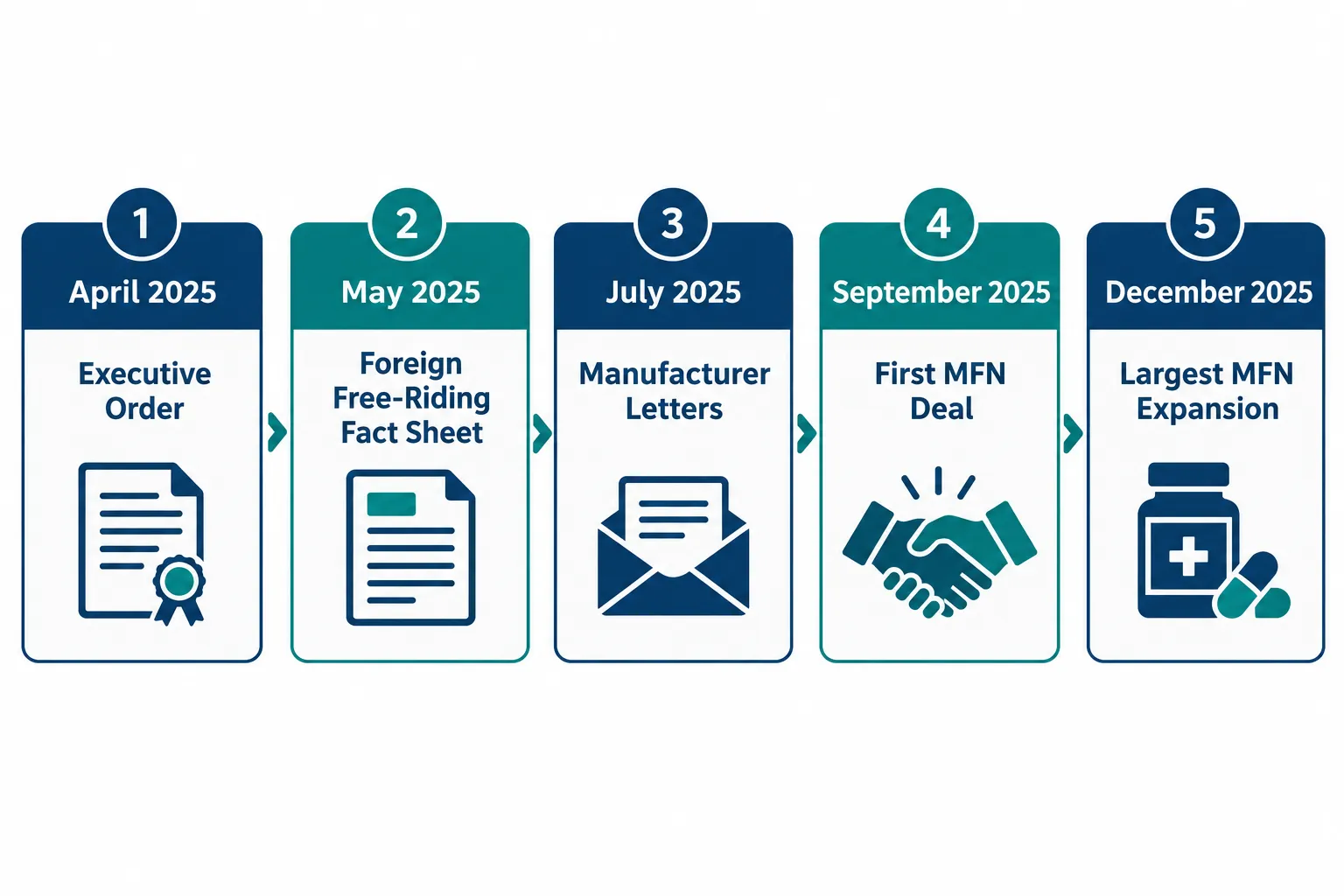
The policy rollout happened in stages rather than all at once:
- April 2025: An executive order directed federal agencies to pursue multiple fronts for lowering prescription drug costs, including Medicare payment reform and site-of-care rules [1].
- May 2025: A follow-up fact sheet framed the effort around stopping “foreign free riding,” arguing that other wealthy countries pay less for the same drugs because US prices effectively subsidize global pharmaceutical research [2].
- July 2025: The administration sent formal letters to major drug manufacturers asking them to commit to MFN pricing and offering incentives like streamlined FDA review in exchange [4].
- September 2025 onward: Manufacturers began signing individual deals, starting with Pfizer, which also helped launch TrumpRx [6][9].
A pull-quote worth noting: the administration’s own framing calls this part of a broader “Great Healthcare Plan,” which pairs drug pricing with price transparency rules for hospitals and insurers, not just pharmacy counters [1].
Decision rule: If you take a brand-name specialty drug from a manufacturer that has already signed an MFN deal, you are far more likely to see a price change soon. If your prescription is generic or from a manufacturer that hasn’t signed on, expect little to no shift from this specific policy.
How Does Trump’s Drug Price Negotiation Plan Work?
Trump’s plan does not negotiate prices the way Medicare now does under separate legislation. Instead, it ties US prices to a benchmark: the lowest price that a drug’s manufacturer charges in other wealthy, developed countries, known as Most Favored Nation pricing [2][3].
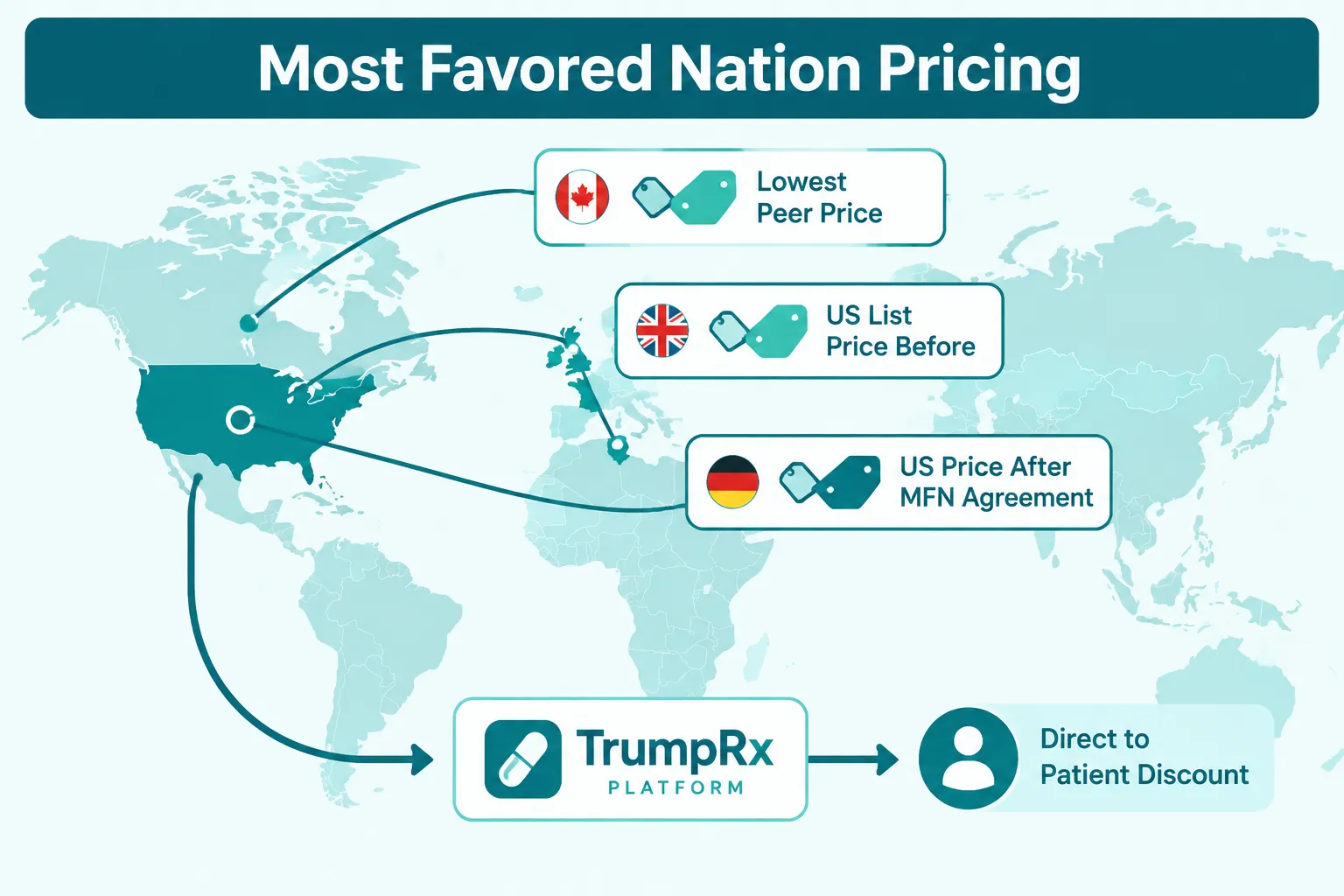
Here’s the mechanical sequence, in plain terms:
- The administration identifies a drug and compares its US list price to prices in peer nations (often in Europe, Japan, or Canada).
- The manufacturer is asked to voluntarily commit to charging Americans no more than the lowest price charged abroad for that same drug.
- In exchange, manufacturers often receive incentives: tariff exemptions, faster FDA review timelines, or expanded access to federal purchasing programs like TrumpRx [4][6].
- Agreements get formalized and announced through White House and HHS fact sheets, then phased into Medicaid, Medicare, and direct-to-consumer channels [3][5][7].
This is fundamentally a deal-by-deal, manufacturer-by-manufacturer process, not a blanket price cap written into federal law. By late 2025, the White House described the agreements as reaching their “largest developments to date,” signaling an expanding list of participating drug makers rather than a single finished policy [3].
Common mistake: Assuming MFN pricing automatically applies to every drug a company sells. In practice, agreements have been negotiated drug-by-drug or category-by-category, so coverage is uneven across a manufacturer’s full product line.
Can the Government Actually Negotiate Drug Prices With Pharmaceutical Companies?
Yes, but the legal basis matters. Medicare has had limited, legally mandated negotiation power on a small list of drugs since 2023 under separate legislation, while Trump’s MFN approach relies on executive pressure and voluntary manufacturer agreements rather than a congressional negotiation mandate [1][2].
This distinction explains a lot of the policy debate:
- Statutory negotiation (the Medicare drug negotiation program) forces manufacturers to negotiate a small number of high-spend drugs each year or face steep tax penalties. It applies only to Medicare, not the broader commercial market.
- MFN agreements are not legally required. Manufacturers choose to sign on, usually because the administration pairs the ask with tariff relief, faster reviews, or Medicaid/TrumpRx access [4][6].
Edge case: A manufacturer can refuse to sign an MFN deal entirely. Nothing in the current structure compels participation, which is why coverage has expanded deal-by-deal rather than becoming universal overnight [3][5].
Because the MFN framework depends on voluntary commitments, its durability is also political. A future administration could choose not to enforce the same incentives, which is a key reason some policy analysts view it as less permanent than a law passed by Congress.
Trump’s Drug Price Plan vs Biden’s: What’s the Difference?
The biggest difference is mechanism, not goal: both administrations wanted lower drug prices, but Biden’s Inflation Reduction Act used a legal mandate forcing Medicare to negotiate a fixed list of drugs, while Trump’s approach uses Most Favored Nation benchmarks negotiated voluntarily with manufacturers across a wider set of channels, including Medicaid and direct consumer sales [2][3][7].
Here’s a side-by-side look:
| Feature | Trump’s MFN Approach | Biden’s IRA Negotiation |
|---|---|---|
| Legal basis | Executive orders, voluntary deals | Statute (Inflation Reduction Act) |
| Who it covers | Medicaid, TrumpRx, select Medicare drugs | Medicare Part B/D only |
| Drug selection | Deal-by-deal with manufacturers | Fixed annual list of high-spend drugs |
| Enforcement | Incentives (tariffs, FDA review speed) | Tax penalties for non-compliance |
| Speed of rollout | Phased deals starting 2025 | Phased price effective dates starting 2026 |
Earlier presidential efforts, including proposals floated during Trump’s first term and various Medicare demonstration projects, mostly stalled in rulemaking or courts. The current MFN push differs because it pairs price asks with tangible manufacturer incentives rather than relying on regulation alone, which appears to be why more companies have signed on faster this time [4][6].
Choose to watch the MFN approach if you care about brand-name specialty drug pricing and Medicaid; watch the IRA negotiation program if you’re a Medicare beneficiary tracking a specific high-cost drug on the federal negotiation list.
Which Drugs Would Be Affected by Trump’s Price Reduction Initiatives?
Brand-name and specialty drugs, particularly GLP-1 diabetes and weight-loss medications, have seen the clearest price action so far, while most generic drugs remain largely unaffected because they were already inexpensive [6][9].
A few patterns worth knowing:
- Brand-name specialty drugs: These are the primary target. Manufacturers with MFN deals have cut prices on select high-profile products, including GLP-1 drugs used for diabetes and weight management [6].
- Generic drugs: Generics already operate in a competitive market with multiple manufacturers, so MFN pricing has minimal practical effect here. If your prescription is generic, don’t expect a noticeable change from this specific policy.
- Medicaid formulary drugs: Expanded lower-price provisions reached all 50 state Medicaid programs by September 2026, affecting drugs commonly prescribed to low-income patients [7].
If you or a family member uses a GLP-1 medication for weight management, it’s worth checking current program eligibility; related lifestyle and treatment context is covered in our weight loss resource hub.
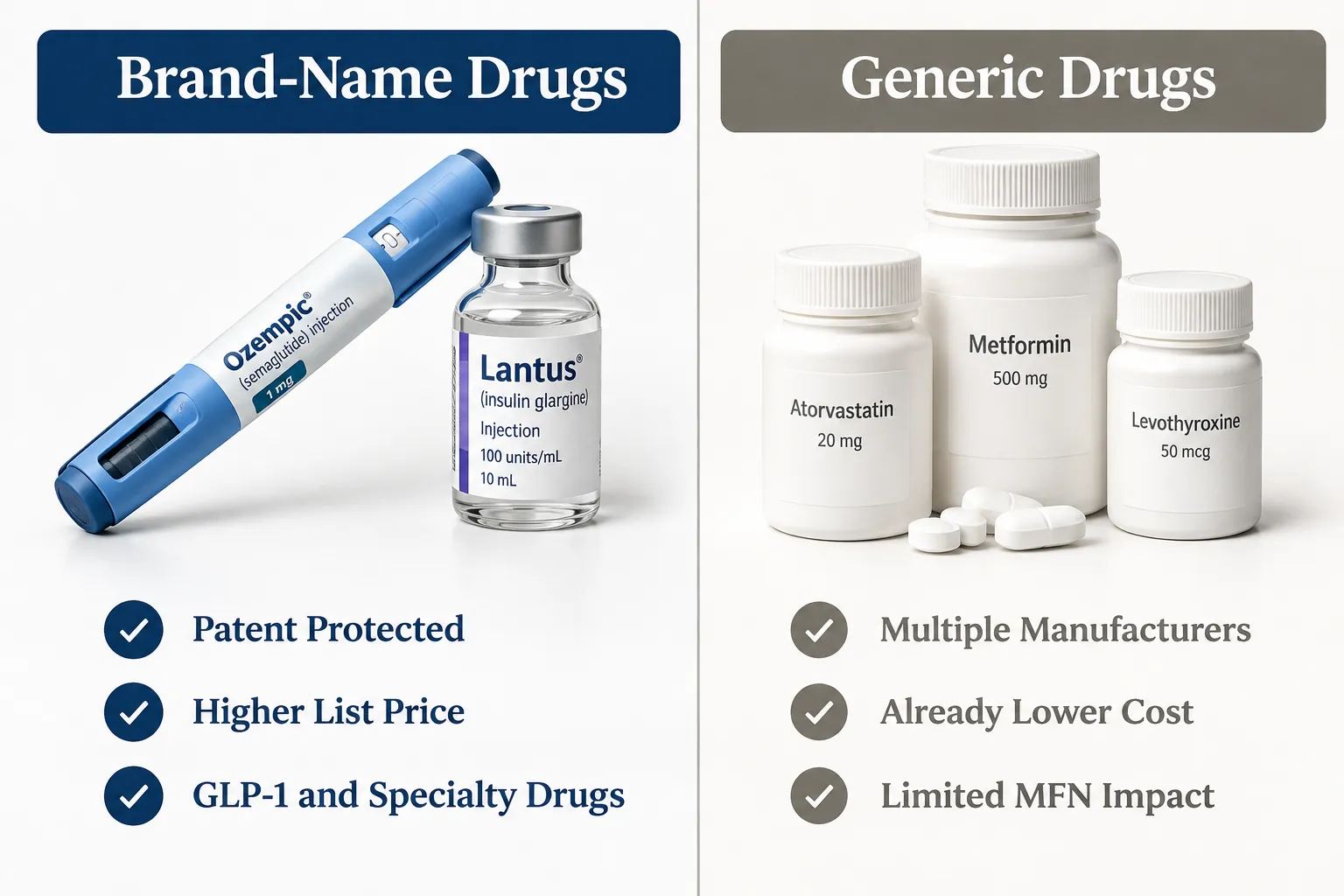
Quick example: A patient on a brand-name GLP-1 drug from a manufacturer with a signed MFN deal may see a direct price cut through TrumpRx, while a patient on a generic cholesterol medication from an unrelated manufacturer likely sees no change at all.
How Long Would It Take to See Lower Drug Prices Under Trump’s Plan?
Some patients are already seeing changes, but full rollout is happening in phases across 2025 and 2026, with Medicaid and direct-purchase discounts arriving faster than broad market-wide effects. The first concrete deal and TrumpRx launch came in September 2025, with expanded Medicaid provisions following roughly a year later in September 2026 [6][7][9].
A rough phased timeline:
| Phase | Approximate Timing | What Happens |
|---|---|---|
| Framework announced | April to July 2025 | Executive orders and manufacturer letters sent [1][2][4] |
| First deal signed | September 2025 | Pfizer agreement, TrumpRx launches [6][9] |
| Expansion | November to December 2025 | More manufacturers and drug categories added [3][5] |
| Savings analysis | May 2026 | White House research estimates program-wide savings [8] |
| Medicaid rollout | September 2026 | All 50 states gain lower-price provisions [7] |
Which patients benefit most right now? Medicaid enrollees, patients on specific GLP-1 or specialty brand-name drugs from participating manufacturers, and uninsured or underinsured patients using TrumpRx for direct cash-pay discounts. Patients managing chronic conditions tied to these drug categories may want to review broader condition management resources, including guidance for men’s health and women’s health, alongside pricing updates, since medication cost is only one part of managing a chronic condition well.
Common mistake: Expecting an immediate, across-the-board price drop at every pharmacy. The rollout is uneven: it depends heavily on which manufacturer makes your specific drug and whether your plan is Medicaid, Medicare, or commercial.
What Do Pharmaceutical Companies Say About Trump’s Drug Pricing Policies?
Pharmaceutical companies have generally resisted mandatory price controls but have shown more openness to voluntary MFN deals when paired with incentives like tariff relief and faster FDA review timelines [4][6]. Pfizer’s willingness to be the first mover suggests at least some manufacturers see strategic value in getting ahead of tougher future mandates.
Key industry positions, based on public statements tied to the deal announcements:
- Manufacturers have emphasized that voluntary agreements, not blanket price caps, preserve their ability to set prices differently across drug categories [6].
- Industry messaging around these deals frequently ties participation to continued US investment in drug research and manufacturing, suggesting companies view the trade-off (lower prices in exchange for faster approvals or tariff relief) as workable only within limits [4].
- Some companies have been slower to sign on, which the administration has addressed through continued public pressure and additional manufacturer letters [5].
Edge case: A manufacturer can partially comply, agreeing to MFN pricing on one drug category while holding firm on others, which is part of why price cuts have rolled out unevenly across a single company’s product catalog.
Are There Downsides to Government Drug Price Negotiation?
Yes, the most commonly cited concern is that aggressive price controls could reduce the capital available for new drug research and development, since lower US prices historically have subsidized a large share of global pharmaceutical innovation. This remains a projected risk discussed by industry and policy analysts, not a confirmed outcome from the current MFN deals.
Other downsides worth weighing:
- Access versus incentive tradeoff: Lower prices help patients today but could, in theory, slow investment in next-generation treatments if margins shrink too much industry-wide.
- Uneven coverage: Because MFN deals are voluntary and negotiated drug-by-drug, patients on non-participating manufacturers’ drugs see no benefit, creating inconsistency across the market.
- Durability risk: Since the framework rests on executive action and incentives rather than a binding statute, a future administration or court challenge could unwind parts of it.
- What’s currently limiting broader price drops: The main constraints are the voluntary nature of MFN agreements, the limited number of manufacturers that have signed deals so far, and the absence of a single comprehensive law requiring participation across the entire industry [3][5].
Decision rule: If a policy change depends on manufacturer willingness rather than legal mandate, expect gradual, uneven results rather than an overnight fix.
What Countries Have Successfully Negotiated Drug Prices With Pharma?
Several wealthy countries, including those in Western Europe, Canada, and Japan, already negotiate drug prices directly with manufacturers as a condition of market access, which is precisely why their prices are often lower than US list prices and why the MFN benchmark uses them as a reference point [2]. These countries typically combine government-run or heavily regulated health systems with centralized price-setting authority, giving them leverage that the more fragmented US system historically lacked.
This comparison is central to the administration’s “foreign free riding” argument: the claim that Americans have effectively paid more to offset lower prices negotiated abroad [2]. The MFN strategy attempts to flip that dynamic by requiring US prices to match the best deal a manufacturer offers anywhere else, rather than letting other countries get the advantage while the US pays full price.
Quick example: If a diabetes drug costs significantly less in Germany than in the US due to Germany’s national negotiation process, an MFN agreement would aim to bring the US price down toward that German benchmark for the same drug.
Conclusion: What Patients Should Do Next
Trump’s drug pricing initiatives have produced real, verifiable price cuts on specific brand-name and specialty drugs through MFN deals, Medicaid expansion, and the TrumpRx platform, but the approach is still incomplete and voluntary rather than a universal legal mandate [3][6][7]. The honest answer to “can Trump lower drug prices” is: yes, for a growing but still limited set of medications and patients, with more changes still phasing in through 2026 and beyond.
Here’s what I’d recommend if you’re trying to actually use this information:
- Check your specific drug and manufacturer. Price changes depend on whether your drug’s maker has signed an MFN deal.
- Ask your pharmacist about TrumpRx eligibility if you’re uninsured or paying cash for a brand-name prescription.
- If you’re on Medicaid, ask your state program whether your medication is covered under the newer lower-price provisions effective from 2026 [7].
- Don’t assume generics changed. Most of the visible movement so far is in brand-name and specialty categories, not generics.
- Follow updates, since this policy is rolling out in phases and more manufacturer deals are expected.
For broader context on managing chronic conditions while drug costs shift, explore our wellness resources or return to the Health Trust MD homepage for continued coverage of health policy and patient guidance.
FAQ
Can Trump actually lower drug prices for everyone? Not for everyone immediately. Price cuts currently apply to specific brand-name and specialty drugs from manufacturers that have signed Most Favored Nation agreements, plus expanded Medicaid provisions, not a universal across-the-board reduction [3][7].
What is Most Favored Nation pricing in simple terms? It means a drug manufacturer agrees to charge Americans no more than the lowest price it charges in other wealthy countries for the same drug [2][3].
Is TrumpRx a government program or a private platform? TrumpRx launched alongside the first manufacturer MFN deal as a direct-to-consumer discount channel, created in coordination with the administration’s pricing initiative [6][9].
Do generic drugs get cheaper under this plan? Generally no. Generic drugs already have competitive, low pricing, so MFN agreements focus mainly on brand-name and specialty medications.
How is this different from what Biden did with Medicare drug negotiation? Biden’s approach used a legal mandate under the Inflation Reduction Act forcing negotiation on a fixed list of Medicare drugs. Trump’s approach uses voluntary MFN deals covering Medicaid, Medicare, and direct consumer sales.
Will lower drug prices mean fewer new drugs get developed? This is a debated risk, not a proven outcome. Critics argue lower US prices could reduce research funding; supporters argue manufacturers can absorb MFN pricing while still investing in new treatments.
Which patients benefit most right now? Medicaid enrollees, patients using TrumpRx for cash-pay discounts, and patients on specific brand-name drugs like GLP-1 medications from participating manufacturers see the clearest benefits today.
When will Medicaid patients see these price changes? Lower-price provisions reached all 50 state Medicaid programs by September 2026, though rollout timing can vary by state and drug [7].
References
[1] Fact Sheet President Donald J Trump Announces Actions To Lower Prescription Drug Prices – https://www.whitehouse.gov/fact-sheets/2025/04/fact-sheet-president-donald-j-trump-announces-actions-to-lower-prescription-drug-prices/ [2] Fact Sheet President Donald J Trump Announces Actions To Put American Patients First By Lowering Drug Prices And Stopping Foreign Free Riding On American Pharmaceutical Innovation – https://www.whitehouse.gov/fact-sheets/2025/05/fact-sheet-president-donald-j-trump-announces-actions-to-put-american-patients-first-by-lowering-drug-prices-and-stopping-foreign-free-riding-on-american-pharmaceutical-innovation/ [3] Fact Sheet President Donald J Trump Announces Largest Developments To Date In Bringing Most Favored Nation Pricing To American Patients – https://www.whitehouse.gov/fact-sheets/2025/12/fact-sheet-president-donald-j-trump-announces-largest-developments-to-date-in-bringing-most-favored-nation-pricing-to-american-patients/ [4] Fact Sheet President Donald J Trump Announces Actions To Get Americans The Best Prices In The World For Prescription Drugs – https://www.whitehouse.gov/fact-sheets/2025/07/fact-sheet-president-donald-j-trump-announces-actions-to-get-americans-the-best-prices-in-the-world-for-prescription-drugs/ [5] Fact Sheet President Donald J Trump Announces Major Developments In Bringing Most Favored Nation Pricing To American Patients – https://www.whitehouse.gov/fact-sheets/2025/11/fact-sheet-president-donald-j-trump-announces-major-developments-in-bringing-most-favored-nation-pricing-to-american-patients/ [6] Fact Sheet President Donald J Trump Announces First Deal To Bring Most Favored Nation Pricing To American Patients – https://www.whitehouse.gov/fact-sheets/2025/09/fact-sheet-president-donald-j-trump-announces-first-deal-to-bring-most-favored-nation-pricing-to-american-patients/ [7] Fact Sheet President Donald J Trump Announces Lower Drug Prices For All 50 State Medicaid Programs – https://www.whitehouse.gov/fact-sheets/2026/09/fact-sheet-president-donald-j-trump-announces-lower-drug-prices-for-all-50-state-medicaid-programs/ [8] Savings From Most Favored Nation Drug Pricing Policy – https://www.whitehouse.gov/research/2026/05/savings-from-most-favored-nation-drug-pricing-policy/ [9] Trump Announce Deal Pfizer Lower Drug Prices Rcna234679 – https://www.nbcnews.com/health/health-news/trump-announce-deal-pfizer-lower-drug-prices-rcna234679 [10] Cms Mfn Lower Us Drug Prices – https://www.hhs.gov/press-room/cms-mfn-lower-us-drug-prices.html