The Trump Drug Price Executive Order: Most-Favored-Nation Pricing Explained
Last updated: October 17, 2026
Quick Answer
The Trump Drug Price Executive Order: Most-Favored-Nation Pricing Explained comes down to one idea: U.S. drug prices should match the lowest price that manufacturers charge in other wealthy nations. Instead of forcing this through regulation, the administration built it through voluntary manufacturer agreements, direct-to-consumer sales on TrumpRx.gov, and a Medicaid-wide rollout called the GENEROUS Model. Projected savings reach $64.3 billion for Medicaid and up to $529 billion across U.S. markets over the next decade [2].
Key Takeaways
- Most-favored-nation (MFN) pricing ties U.S. drug prices to the lowest price charged in comparable high-income countries.
- The policy runs on voluntary deals with manufacturers rather than a binding 2020-style regulation, which was rescinded after legal challenges.
- As of September 2026, all 50 state Medicaid programs are covered under the GENEROUS Model [1][4].
- Projected savings: $64.3 billion for Medicaid and roughly $529 billion across U.S. drug markets over ten years [2][6].
- GLP-1 weight-loss and diabetes drugs were among the first products to get MFN pricing under direct deals [7][8].
- TrumpRx.gov lets consumers buy certain drugs directly at MFN-linked prices, bypassing some insurance markups [1].
- Drug makers that sign agreements get benefits like tariff relief and faster FDA review in exchange for lower list prices [8][10].
- Legal durability remains a question; the administration and lawmakers are working to codify agreements so they outlast one presidency [3][9].
What Is Most-Favored-Nation Pricing for Drugs?
Most-favored-nation pricing means a drug manufacturer agrees to sell a medicine in the United States for no more than the lowest price it charges in a group of comparable wealthy countries. The term borrows from trade law, where “most favored nation” status means a country gets the best terms offered to any trading partner.
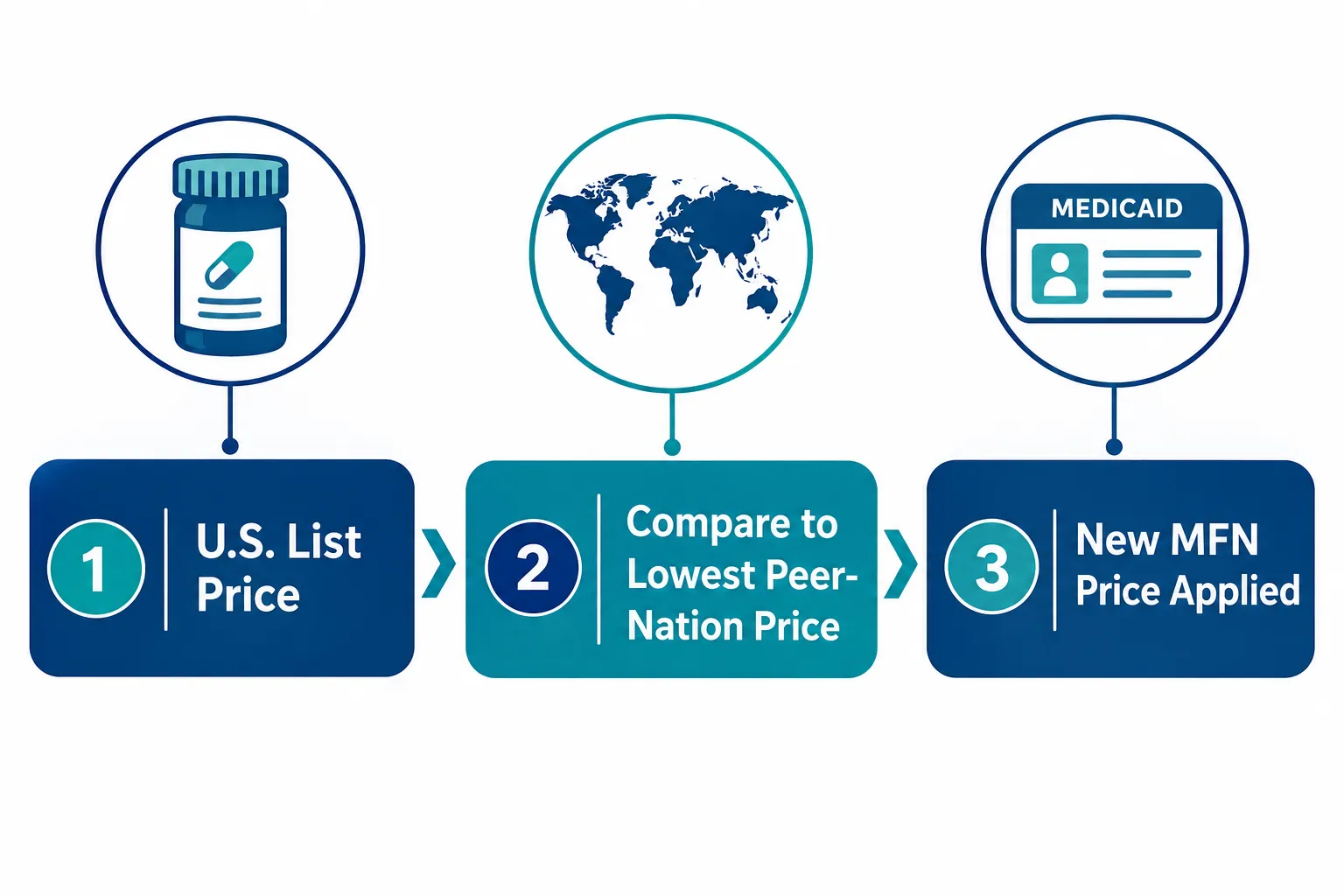
In practice, this works like a price floor set by other nations rather than by U.S. negotiators alone. If a manufacturer sells a drug for $200 a month in Germany, $180 in Japan, and $150 in the United Kingdom, the MFN price for that drug in the U.S. would land at or near $150, the lowest of the group.
A few things make this different from typical U.S. drug pricing:
- It benchmarks against actual foreign transaction prices, not list prices that nobody really pays.
- It applies per-drug, not as a blanket discount across a company’s whole portfolio.
- It can cover Medicare, Medicaid, and in some cases direct retail sales, depending on the specific agreement.
Choose to pay attention to MFN pricing if you take a brand-name drug with high list prices in the U.S. but sold cheaper abroad, such as GLP-1 medications, certain insulins, or specialty biologics. If your medication is a generic already priced near cost, MFN agreements will have little effect on you.
How Does the Trump Drug Price Executive Order Work?
The Trump Drug Price Executive Order: Most-Favored-Nation Pricing Explained in simple terms is a negotiation framework, not a price-control mandate. Rather than ordering manufacturers to lower prices by regulation, the 2025 executive order directed federal agencies to pursue voluntary agreements with drug companies, paired with incentives like tariff exemptions and regulatory speed.
The mechanics unfolded in stages:
- The order set the goal. It told manufacturers that the administration wanted U.S. prices matched to the lowest comparable international price, and warned of trade and import consequences for companies that did not participate.
- Manufacturers signed individual deals. Each agreement names specific drugs, specific price targets, and specific channels (Medicaid, Medicare, or direct consumer sales).
- Deals expanded over 2025 and 2026. What started as a handful of companies in late 2025 grew into a broader rollout covering more drug classes and more state programs by mid-2026 [7][8].
- Medicaid absorbed the framework through the GENEROUS Model, extending MFN pricing to all 50 states by September 2026 [1][4].
This voluntary-deal structure is the direct answer to why this looks different from a typical federal price control: it relies on companies choosing to participate in exchange for business benefits, rather than a law compelling them.
A common misunderstanding is assuming the executive order itself sets prices. It does not. The order creates pressure and incentives; the actual price numbers come from the signed agreements between the government and each manufacturer, reviewed through the Centers for Medicare & Medicaid Services’ drug pricing programs [3].
Which Drugs and Companies Are Affected by Most-Favored-Nation Pricing?
MFN pricing applies to drugs covered by signed manufacturer agreements, which so far concentrate on high-cost brand-name medications rather than low-cost generics. The first wave focused heavily on GLP-1 weight-loss and diabetes treatments, along with a growing list of other specialty drugs added through 2025 and 2026 [7][8].
Companies that have entered MFN-style agreements include major manufacturers of diabetes, obesity, and specialty medications, with the list expanding as the administration announced “largest developments to date” in bringing MFN pricing to patients in December 2025 [8]. By late 2026, press coverage described a broader pattern of deals across the pharmaceutical sector rather than isolated one-off agreements [10].
Quick example: A patient managing type 2 diabetes who uses a GLP-1 medication covered under an early MFN agreement may see that specific drug’s list price drop, while a different diabetes medication from a company that has not signed a deal stays at the old price. This is why checking the specific brand name matters more than assuming an entire drug category is covered.
For readers managing weight or metabolic health, it’s worth tracking which specific GLP-1 products are included in current agreements before assuming a price drop applies to your prescription, our weight loss resource hub covers how these medications fit into broader treatment plans.
When Did Most-Favored-Nation Drug Pricing Go Into Effect?
Most-favored-nation pricing under this administration began rolling out through individual manufacturer deals starting in September 2025, expanded through December 2025, and reached all 50 state Medicaid programs by September 2026. There was no single “effective date” for the whole policy; instead, it arrived in phases as agreements were signed.
Timeline of major milestones:
| Date | Milestone |
|---|---|
| September 2025 | First MFN pricing deal announced with a manufacturer [7] |
| December 2025 | Largest expansion to date in MFN agreements across more drugs and companies [8] |
| May 2026 | White House research projects savings figures tied to the deals reached so far [2][5] |
| September 2026 | GENEROUS Model extends MFN pricing to all 50 state Medicaid programs [1][4] |
A common edge case: if your state Medicaid program had not yet adopted the framework before September 2026, you would not have seen MFN pricing applied to your prescriptions through that channel, even if a federal deal existed for the drug itself.
How Much Will Drug Prices Drop Under Most-Favored-Nation Pricing?
Projected savings from the MFN framework total $64.3 billion for Medicaid specifically and roughly $529 billion across broader U.S. drug markets over a decade, according to White House research published in May 2026 [2][6]. A separate Reuters report on the same set of deals cited administration estimates of $643 billion in savings over ten years tied to the pricing agreements reached by that point [5].
These are aggregate, system-wide projections, not guarantees for any individual prescription. The actual discount on a specific drug depends on:
- Whether the manufacturer has signed an MFN agreement for that specific product.
- Which country’s price is used as the benchmark for that drug.
- Whether you’re purchasing through Medicaid, Medicare, private insurance, or direct-to-consumer channels like TrumpRx.gov.
Decision rule: if your medication is on a manufacturer’s published MFN list and you buy through Medicaid or the TrumpRx.gov platform, expect a meaningful price reduction. If your drug is not on a signed agreement, don’t expect a change yet, regardless of the headline savings numbers you see in the news.
What Countries Does Most-Favored-Nation Pricing Compare To?
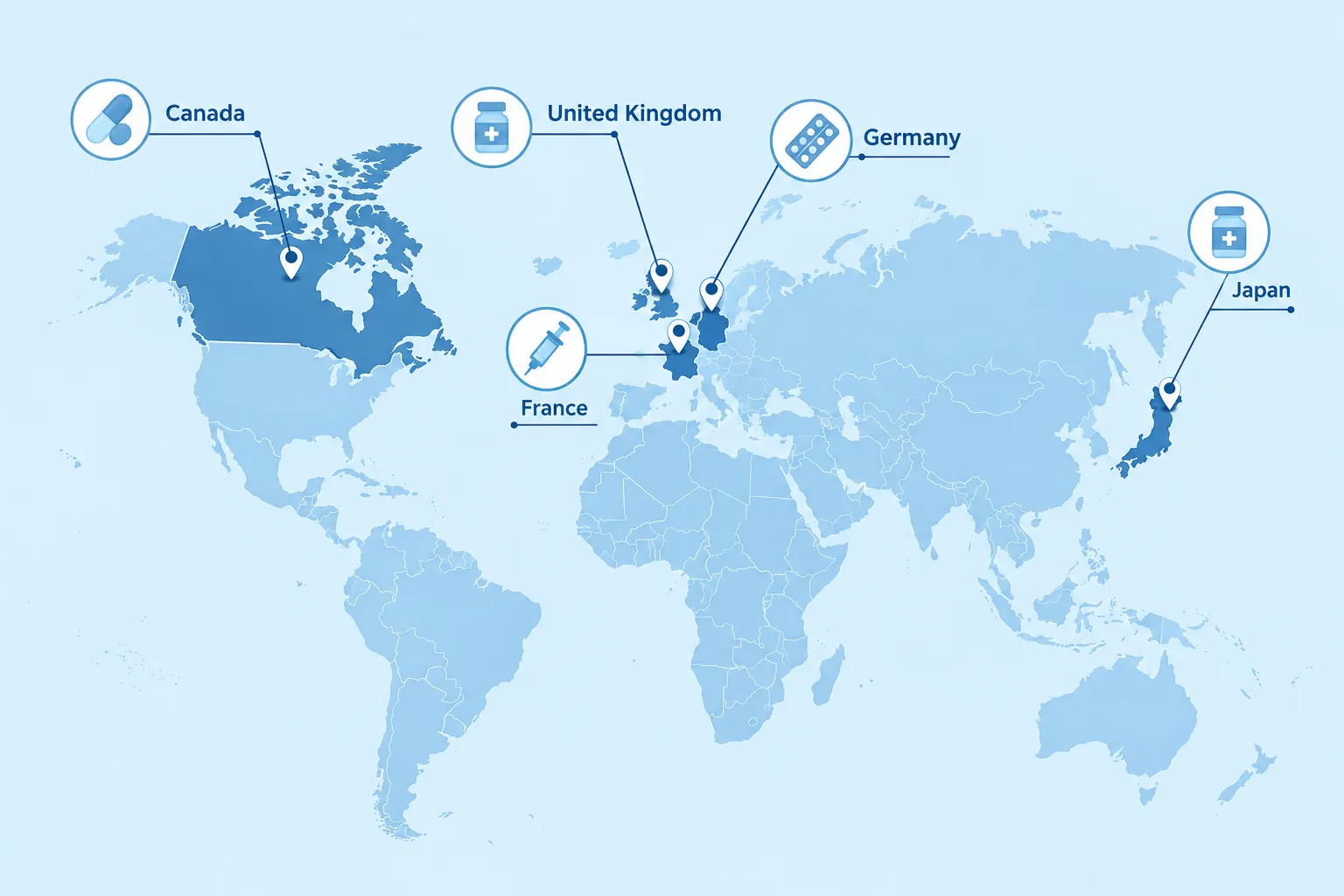
Most-favored-nation pricing compares U.S. drug prices against prices charged in other high-income countries with strong economies and established health systems, typically members of the Organisation for Economic Co-operation and Development (OECD). The exact comparison countries vary by agreement and are not always made fully public for every deal.
In general, these comparisons draw on nations where governments or national health systems negotiate drug prices directly, which tends to produce lower list prices than the relatively unregulated U.S. market. The logic: if a manufacturer can profitably sell a drug at a certain price in Germany, France, Japan, the United Kingdom, or Canada, it can likely sustain a similar price in the U.S. as well.
A mistake worth avoiding: assuming every MFN deal uses the same basket of comparison countries. Each manufacturer agreement can define its own reference set, so the “lowest price” benchmark for one drug might come from a different country than the benchmark for another drug made by a different company.
How Is Most-Favored-Nation Pricing Different From Other Drug Price Controls?
Most-favored-nation pricing differs from Medicare drug price negotiation and international reference pricing in how the price gets set and who has to agree to it. MFN pricing benchmarks against actual foreign transaction prices through voluntary deals, while other mechanisms rely on statutory negotiation authority or formula-based international baskets.

| Mechanism | How Price Is Set | Legal Basis |
|---|---|---|
| Most-Favored-Nation Pricing (2025-2026) | Voluntary manufacturer agreement tied to lowest foreign price | Executive order plus negotiated deals, not statute |
| Medicare Drug Price Negotiation Program | Federal negotiation with set maximum fair price per drug | Inflation Reduction Act, administered by CMS |
| International Reference Pricing (general concept) | Formula averaging or benchmarking across a defined country basket | Varies by country or proposed U.S. legislation |
| 2020 Medicare MFN Rule (rescinded) | Mandatory Medicare Part B reimbursement tied to foreign prices | Interim final rule, blocked by litigation and later rescinded |
The 2020 version of MFN pricing tried to mandate this through a binding Medicare Part B rule. Courts blocked it on procedural grounds before it took effect, and the rule was later formally rescinded [3]. The 2025-2026 approach learned from that failure by trading mandates for incentives, which is why it has moved faster but also why its legal durability remains an open question.
Will Most-Favored-Nation Pricing Actually Lower Your Prescription Costs?
For patients on drugs covered by a signed MFN agreement and purchasing through Medicaid or TrumpRx.gov, most-favored-nation pricing can lower out-of-pocket costs noticeably. For patients on drugs without an MFN agreement, or those relying mainly on private insurance formularies, the near-term effect may be minimal.
Here’s a practical way to check:
- Look up whether your specific drug brand appears on a published MFN agreement list.
- Check whether your purchase channel (Medicaid, TrumpRx.gov, or a participating pharmacy) is one covered by the deal.
- Compare your current copay or cash price against the published MFN price for that drug, where available.
“The savings exist on paper for the whole system, but the dollars only reach your pharmacy counter if your specific medication and your specific coverage line up with a signed agreement.”
Readers managing chronic conditions through general wellness strategies alongside prescription treatment should still verify individual drug coverage case by case rather than assuming system-wide savings apply automatically to every prescription.
What Do Drug Manufacturers Say About Most-Favored-Nation Pricing, and What Happens If They Refuse?
Manufacturers that have signed MFN agreements generally frame the deals as a trade-off: lower U.S. list prices in exchange for tariff relief, faster regulatory review, or protection from import competition, according to White House fact sheets describing the agreements [7][8]. Companies that decline to participate risk tariffs and other trade pressure the administration has signaled it will use against holdouts [10].
Manufacturer reactions have been mixed:
- Companies that signed early deals generally describe the agreements publicly as a path to pricing certainty and continued U.S. market access.
- Industry trade groups have historically raised concerns that foreign benchmark pricing could reduce the revenue that funds future drug research, a long-standing argument against international reference pricing generally.
- Some manufacturers appear to be waiting to see how durable the agreements prove before committing additional drugs to MFN pricing.
A realistic edge case: a manufacturer might agree to MFN pricing for one or two flagship drugs while keeping other products in its portfolio outside the agreement, limiting how much any single deal changes a patient’s total prescription spending.
Are There Exemptions, and Can Most-Favored-Nation Pricing Be Reversed or Challenged?
Yes, exemptions exist in practice because MFN pricing only applies to drugs and companies that have signed specific agreements; everything else is effectively exempt by default. The policy can also be reversed or challenged, since it currently rests on executive action and voluntary contracts rather than a durable statute.
Key points on durability:
- Exemptions are structural, not formal carve-outs. A drug is “exempt” simply because no agreement covers it yet, not because of an official waiver process.
- Legal challenge risk is lower than the 2020 rule faced, because this version does not force compliance through regulation, but agreements could still face scrutiny if a company tries to exit a deal early.
- Reversal risk ties to politics and legislation. Lawmakers have discussed codifying MFN agreements into law so they survive beyond one administration, with some members of Congress publicly commending the Medicaid extension and pushing for permanence [9].
- CMS regulatory guidance continues to evolve, meaning the technical rules around how agreements are implemented could still shift even if the core pricing commitments hold [3].
The honest bottom line: nothing here is permanently locked in yet. A future administration, a change in Congress, or a company deciding not to renew its agreement could all alter the current pricing landscape within a few years.
Conclusion
The Trump Drug Price Executive Order: Most-Favored-Nation Pricing Explained boils down to a practical trade: manufacturers accept U.S. prices closer to what they charge in other wealthy countries, and in return they get trade and regulatory benefits. The policy has moved faster than the blocked 2020 version because it runs on voluntary deals rather than mandates, and it has already reached all 50 state Medicaid programs as of September 2026 [1][4].
If you want to know whether this actually changes what you pay, don’t rely on the big national savings numbers alone. Check whether your specific drug brand appears on a signed MFN agreement, confirm your purchase channel is covered, and compare the published MFN price against your current copay. For ongoing prescriptions tied to weight management, diabetes, or chronic conditions, it’s worth revisiting this list every few months, since the number of covered drugs has grown steadily through 2025 and 2026 and is likely to keep expanding.
For broader context on managing health decisions alongside policy changes like this, you can explore related guidance on women’s health topics, men’s health topics, or return to the Health Trust MD homepage for more coverage of healthcare affordability and treatment options.
FAQ
What does most-favored-nation pricing mean in simple terms? It means a drug manufacturer agrees to charge the U.S. no more than the lowest price it charges in a comparable wealthy country for the same medication.
Is most-favored-nation pricing a law or a regulation? It is not a binding law right now. It runs through a 2025 executive order paired with voluntary agreements between the government and individual manufacturers [7].
Did most-favored-nation pricing already exist before 2025? A version existed as a 2020 Medicare Part B rule, but it was blocked by litigation and later formally rescinded before taking effect [3].
Which drugs got most-favored-nation pricing first? Early agreements focused heavily on GLP-1 weight-loss and diabetes medications, announced through fact sheets in September and December 2025 [7][8].
Does most-favored-nation pricing cover Medicaid in every state? Yes, as of September 2026, the GENEROUS Model extended most-favored-nation pricing to all 50 state Medicaid programs [1][4].
How much money is most-favored-nation pricing expected to save? White House research projects $64.3 billion in Medicaid savings and about $529 billion across U.S. drug markets over ten years, with a separate report citing $643 billion in total savings [2][5][6].
Can I buy drugs directly at most-favored-nation prices? In some cases, yes, through the TrumpRx.gov platform, which offers direct-to-consumer pricing tied to MFN agreements for select drugs [1].
What happens if a drug company won’t sign an most-favored-nation agreement? The administration has signaled it may use tariffs and trade pressure against manufacturers that decline to participate [10].
Can most-favored-nation pricing be undone by a future administration? Yes, because it currently relies on executive action and contracts rather than permanent legislation, though some lawmakers are pushing to codify it into law [9].
References
[1] President Trump Extends Most Favored Nation Pricing To Every Medicaid Program In America – https://www.whitehouse.gov/releases/2026/09/president-trump-extends-most-favored-nation-pricing-to-every-medicaid-program-in-america/ [2] Savings From Most Favored Nation Drug Pricing Policy – https://www.whitehouse.gov/research/2026/05/savings-from-most-favored-nation-drug-pricing-policy/ [3] Regulations Guidance Policy Documents – https://www.cms.gov/initiatives/medicare-prescription-drug-affordability/overview/medicare-drug-price-negotiation-program/regulations-guidance-policy-documents [4] Fact Sheet President Donald J Trump Announces Lower Drug Prices For All 50 State Medicaid Programs – https://www.whitehouse.gov/fact-sheets/2026/09/fact-sheet-president-donald-j-trump-announces-lower-drug-prices-for-all-50-state-medicaid-programs/ [5] Trump Administration Says Drug Pricing Deal Generate 643 Billion Savings Over 10 2026 05 05 – https://www.reuters.com/business/healthcare-pharmaceuticals/trump-administration-says-drug-pricing-deal-generate-643-billion-savings-over-10-2026-05-05/ [6] Savings From Mfn Drug Pricing Policy – https://www.whitehouse.gov/wp-content/uploads/2026/05/Savings-from-MFN-Drug-Pricing-Policy.pdf [7] Fact Sheet President Donald J Trump Announces First Deal To Bring Most Favored Nation Pricing To American Patients – https://www.whitehouse.gov/fact-sheets/2025/09/fact-sheet-president-donald-j-trump-announces-first-deal-to-bring-most-favored-nation-pricing-to-american-patients/ [8] Fact Sheet President Donald J Trump Announces Largest Developments To Date In Bringing Most Favored Nation Pricing To American Patients – https://www.whitehouse.gov/fact-sheets/2025/12/fact-sheet-president-donald-j-trump-announces-largest-developments-to-date-in-bringing-most-favored-nation-pricing-to-american-patients/ [9] Meuser Commends President Trump Extending Most Favored Nation Drug Pricing All – https://meuser.house.gov/media/press-releases/meuser-commends-president-trump-extending-most-favored-nation-drug-pricing-all [10] Trump Drug Pricing Deals – https://www.cnbc.com/2026/08/31/trump-drug-pricing-deals.html