Drug Prices Under Trump: Key Discounts, Reforms, and Savings Policies
Last updated: October 17, 2026
Quick Answer
Prescription drug prices fell 3.1% year-over-year as of mid-2026, the steepest annual drop since 1963, and the White House credits this to Most Favored Nation (MFN) pricing deals, the TrumpRx.gov portal, and Medicaid price agreements covering roughly 90% of the branded U.S. drug market [1][7]. Drug Prices Under Trump: Key Discounts, Reforms, and Savings Policies now include executive orders, direct-to-consumer discount pricing, and Medicare payment reforms, though independent analysts say it’s too early to credit these policies alone for the full decline [7].
Key Takeaways
- Drug prices fell 3.9% since Trump took office, according to an August 2026 White House release calling it the largest drop in over 60 years [4].
- The May 2025 executive order on Most Favored Nation pricing directs manufacturers to match the lowest prices paid by other wealthy nations or face federal rulemaking [5].
- TrumpRx.gov, launched in February 2026, lets patients buy popular medicines directly at MFN-level discount pricing [6].
- By September 2026, 26 major drugmakers covering about 90% of the branded U.S. market agreed to MFN pricing across all 50 state Medicaid programs [1][2].
- Medicare payment reforms aligned certain drug reimbursements with hospital acquisition costs, which officials say can cut prices up to 60% for some cancer treatments [3].
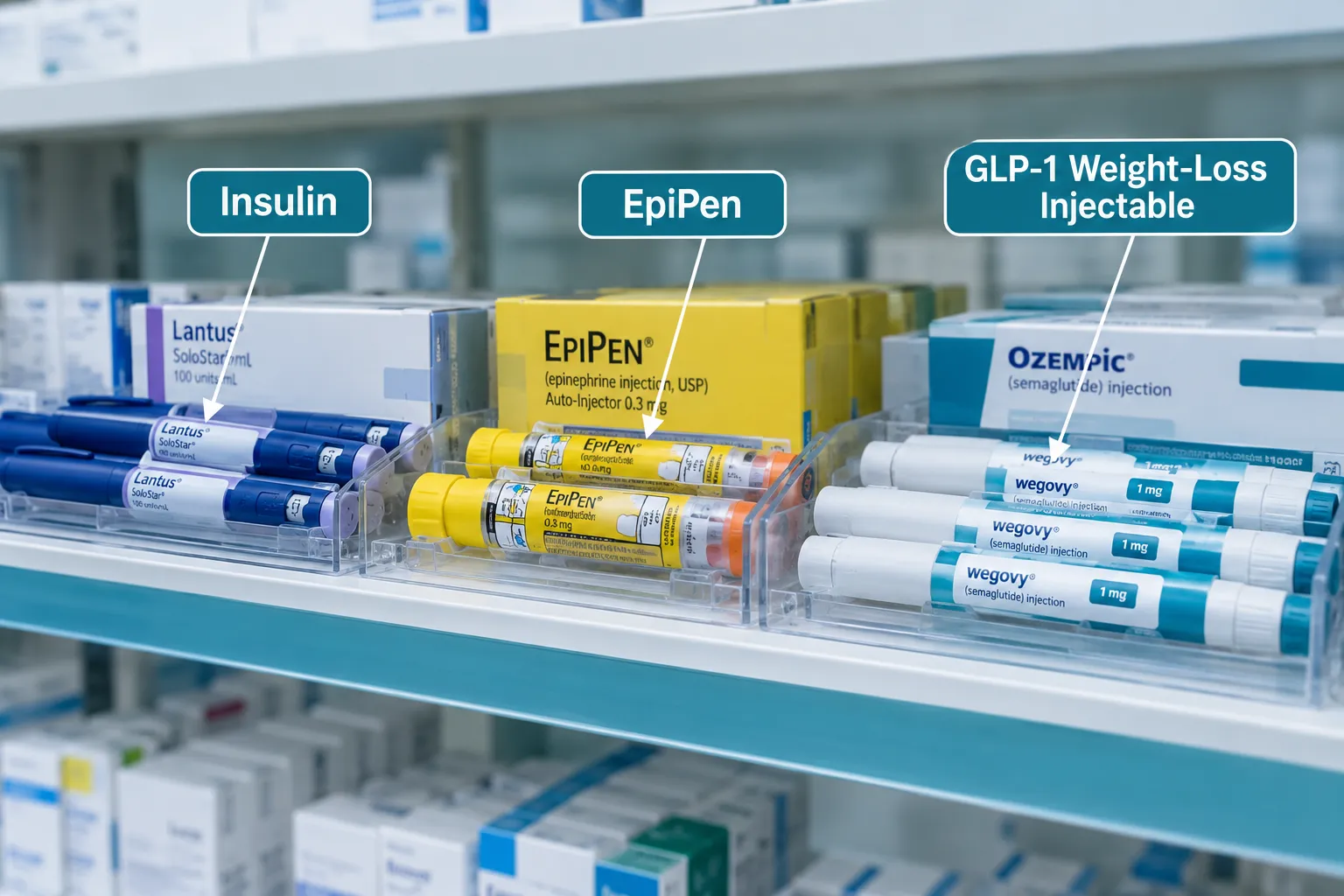
- Federal community health centers must pass insulin and EpiPen manufacturer discounts directly to patients [5].
- GLP-1 weight-loss drug discounts for eligible Medicare enrollees may be contributing to the broader CPI drug-price decline [7].
- Critics and independent reporters caution that out-of-pocket costs remain high for many patients despite headline price drops [7].
What Drug Price Reforms Did Trump Implement
Trump’s drug pricing agenda centers on Most Favored Nation pricing, direct-to-consumer discount sales through TrumpRx.gov, and Medicare/Medicaid payment restructuring. These three pillars work together: MFN sets the price target, TrumpRx delivers it to consumers, and Medicaid/Medicare reforms extend it into federal health programs.
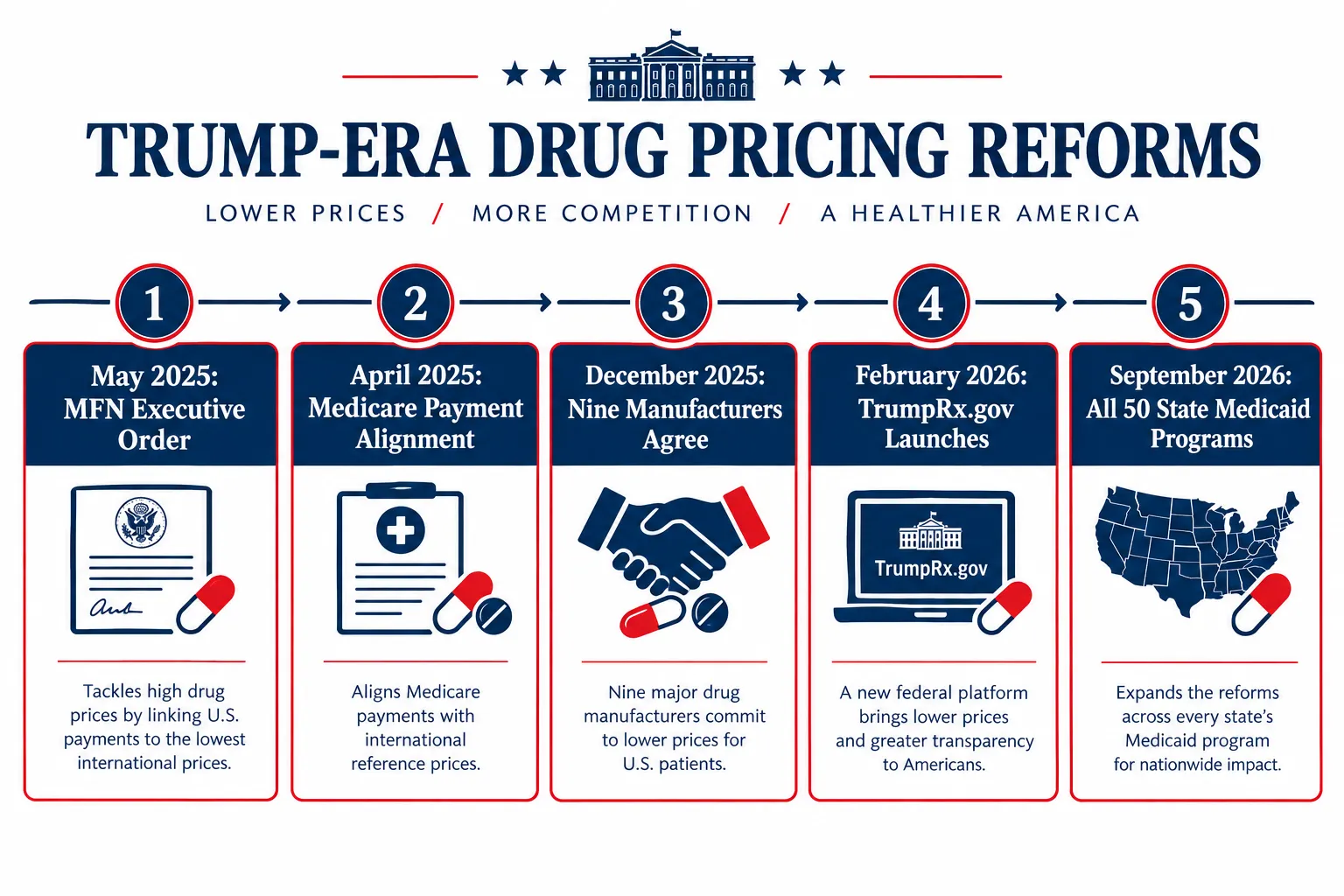
Key reform components include:
- Most Favored Nation pricing agreements: Manufacturers commit to charging the United States no more than the lowest price paid by comparable developed nations [1][5].
- TrumpRx.gov: A government-run portal where patients buy high-priced brand medicines at MFN-level discounts [6].
- Medicaid-wide MFN rollout: All 50 state Medicaid programs now receive MFN pricing from 26 major drugmakers [1][2].
- Medicare payment alignment: Certain drug reimbursements now mirror hospitals’ actual acquisition costs, which can run up to 35% lower than prior Medicare payment rates [3].
- Site-of-care payment standardization: Pricing is consistent regardless of where a patient receives treatment, which officials estimate can lower costs as much as 60% for therapies like cancer infusions [3].
A common mistake is assuming these reforms are a single law. They are a mix of executive orders, agency rules, and voluntary manufacturer agreements layered over several years, not one piece of legislation.
How Much Did Drug Prices Change Under the Trump Administration
Federal inflation data show prescription drug prices dropped 0.8% in July 2026 alone and were down 3.1% from a year earlier, the sharpest annual decline recorded since 1963 [7]. The White House frames this as proof the reforms are working, citing a 3.9% overall decline since Trump took office and month-over-month drops throughout 2026 [4].
Here’s the nuance that matters for anyone evaluating the claim: multiple factors likely contribute to this trend at once.
| Factor | Role in Price Decline |
|---|---|
| MFN pricing deals | Lower list prices on brand medicines sold through Medicaid and TrumpRx [1][2] |
| GLP-1 Medicare policy | New coverage rules lowering costs for eligible weight-loss drug users [7] |
| Generic/biosimilar competition | Broader market dynamics unrelated to any single administration policy [7] |
| Medicare payment reform | Lower reimbursement rates on select hospital-administered drugs [3] |
Independent reporting from the Associated Press notes that experts “caution” it remains unclear exactly how much of the drop traces directly to Trump’s MFN deals versus broader market forces already in motion [7]. If you’re comparing claims online, treat the 3.1% CPI figure as verified government data, but treat attribution claims about why prices fell as contested.
What Is the Trump Drug Pricing Executive Order
The core executive order is “Delivering Most-Favored-Nation Prescription Drug Pricing to American Patients,” signed May 12, 2025. It instructs federal agencies to set MFN price targets, build mechanisms for direct consumer purchasing, expand drug importation, and promote generics and biosimilars [5].
The order also contains an enforcement mechanism that sets it apart from earlier proposals: if manufacturers refuse to offer MFN pricing voluntarily, the administration is directed to impose it through rulemaking and other “aggressive measures” [5]. This threat of regulatory action is widely viewed as the leverage that pushed dozens of drugmakers to the negotiating table over the following year.
Choose to pay attention to this order if you want to understand the legal basis behind TrumpRx and the Medicaid MFN rollout, nearly every later announcement traces back to this single directive.
Which Medications Got Cheaper Under Trump Policies
Medications most affected include high-cost brand-name drugs sold through Medicaid, insulin and EpiPens distributed via community health centers, and GLP-1 weight-loss injectables covered under new Medicare rules. Cancer therapies administered in hospital settings also saw payment-driven price reductions [3][5][7].
Specific categories worth tracking:
- Insulin and EpiPens: Federal community health centers are required to pass manufacturer discounts straight to patients, a policy aimed at helping low-income individuals in particular [5].
- GLP-1 weight-loss drugs: A new Medicare policy lowers costs for certain eligible enrollees, which analysts say is one driver behind the broader CPI drop [7]. If you’re exploring these options, our weight loss resources outline what to expect from treatment and cost planning.
- Hospital-administered cancer drugs: Payment alignment with acquisition costs can reduce prices by up to 60% for some infusion therapies [3].
- Branded Medicaid drugs: Nearly 90% of the branded U.S. market is now covered by MFN agreements through Medicaid [1].
Edge case to note: these discounts mostly apply within Medicaid, Medicare, or TrumpRx purchasing channels. A patient buying the same drug through standard commercial insurance may not see the identical discount unless their plan or pharmacy participates.
How Does Trump Drug Pricing Compare to Biden-Era Policy
Trump’s approach relies on manufacturer agreements and MFN price-matching, while the Biden administration’s Inflation Reduction Act used direct Medicare price negotiation on a limited list of drugs. Both aim to lower costs, but the mechanisms and scope differ substantially.
| Feature | Trump Approach (MFN) | Biden Approach (IRA Negotiation) |
|---|---|---|
| Legal basis | Executive order plus voluntary manufacturer deals [5] | Statute (Inflation Reduction Act) |
| Scope | Broad, targets ~90% of branded market via Medicaid/TrumpRx [1] | Narrow, a set list of Medicare Part D/B drugs |
| Enforcement | Rulemaking threat if companies refuse MFN terms [5] | Mandatory negotiation with statutory penalties |
| Consumer access | TrumpRx.gov direct purchase portal [6] | Negotiated prices applied through existing Medicare plans |
Choose to view these as complementary rather than identical: MFN pricing pushes broad, market-wide price alignment, while IRA negotiation targets a smaller set of high-spend drugs with legally mandated price caps. Both can operate simultaneously within Medicare.
Who Qualifies for Trump Drug Discount Programs, Including Seniors on Medicare
Eligibility depends on the specific program: Medicaid enrollees in any of the 50 states automatically benefit from MFN pricing agreements, TrumpRx.gov is open to any consumer purchasing eligible medicines directly, and Medicare enrollees qualify for GLP-1 and certain drug-payment discounts based on plan rules [1][6][7].
Breakdown by program:
- Medicaid recipients: Covered automatically since MFN pricing now applies in all 50 state Medicaid programs [1][2].
- General consumers: Anyone can use TrumpRx.gov to shop for discounted brand medicines without needing special enrollment [6].
- Medicare Part D/B enrollees: Qualify for select drug savings tied to payment reform and GLP-1 coverage changes, though specifics vary by plan [3][7].
- Low-income patients at community health centers: Receive passed-through insulin and EpiPen discounts directly at the point of care [5].
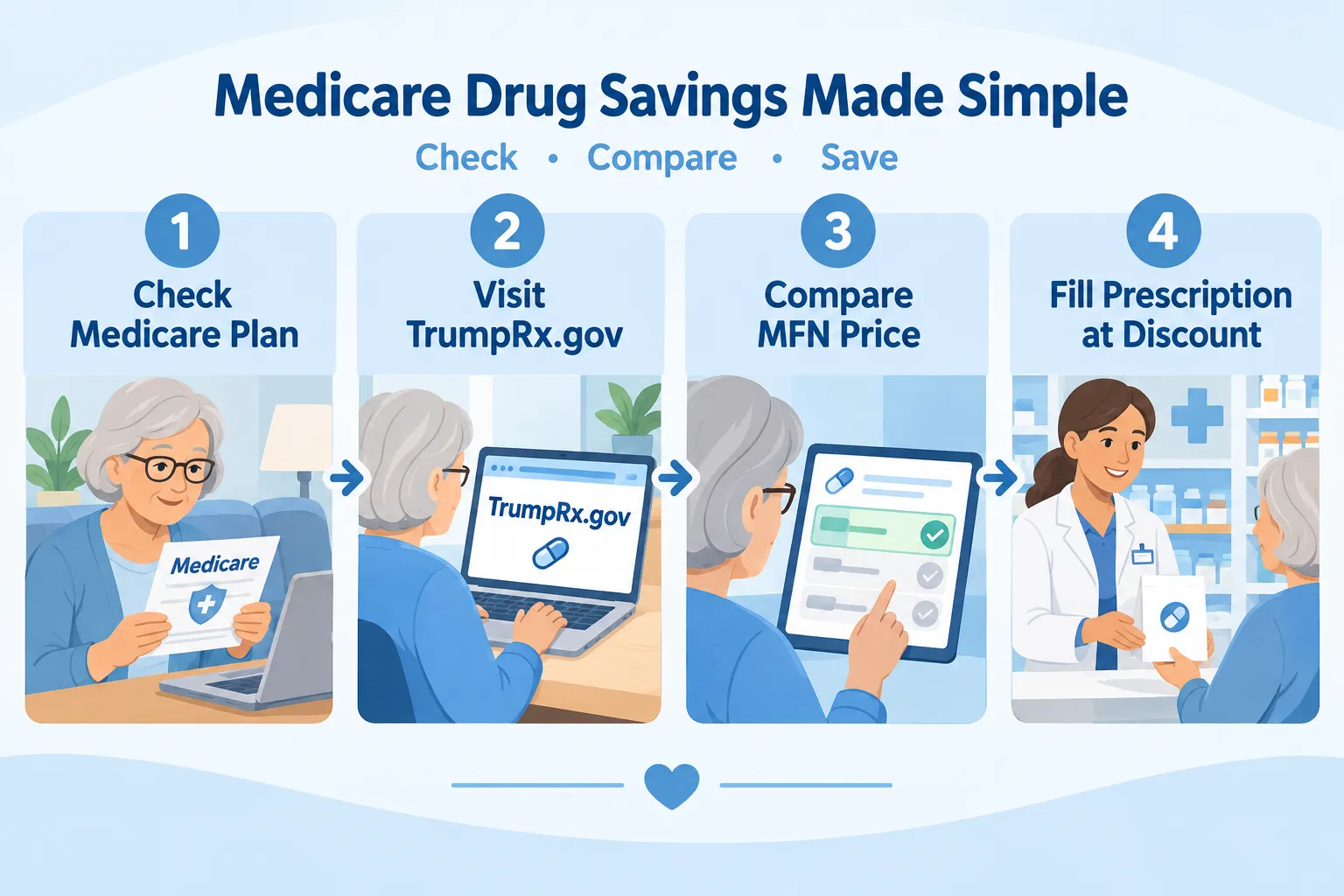
Common mistake: assuming TrumpRx.gov replaces insurance. It functions as a direct-purchase discount channel, not a substitute for Medicare, Medicaid, or private coverage, patients still need to compare it against their existing plan’s pricing before switching how they buy a medication.
What Is the Difference Between Trump and Previous Drug Pricing Policies
Trump’s current-term policy differs from his first-term approach mainly in scale and enforcement speed. The first-term MFN rule, finalized near the end of his initial administration, was projected to save about $85 billion over seven years, including $30 billion in reduced out-of-pocket costs, but it moved more slowly and covered a narrower set of drugs [10].
The second-term version, built on the May 2025 executive order, moved faster and expanded reach:
- First term: MFN rule estimated at $85 billion in savings over seven years [10].
- Second term: MFN agreements with 26 drugmakers covering 90% of the branded market within about 16 months of the executive order [1][5][6].
- First term: Primarily a Medicare Part B rule.
- Second term: Extends to all 50 state Medicaid programs plus a consumer-facing purchase portal [1][6].
If you’re comparing eras, the core idea (price-matching to other developed nations) stayed the same, but the second-term rollout used manufacturer agreements and a consumer portal rather than relying solely on a single federal rule.
Did Trump Actually Lower Drug Prices or Just Promise It
Government inflation data confirm real price declines, including a 3.1% year-over-year drop reported mid-2026, so the claim is not purely promotional [7]. However, independent analysts note it’s difficult to isolate how much of that decline comes specifically from MFN deals versus broader market trends like generic competition and new GLP-1 coverage rules [7].
What’s verified versus what’s contested:
- Verified: Prescription drug CPI fell 3.1% year-over-year and 0.8% in July 2026 alone, per federal data reported by major news outlets [7].
- Verified: 26 drugmakers signed MFN agreements covering Medicaid programs nationwide [1][2].
- Contested: The White House’s framing that these specific deals caused the “largest drop in 60 years” is disputed by experts who point to multiple overlapping causes [4][7].
Edge case: a national average price drop doesn’t guarantee every individual patient pays less. Someone without Medicaid, Medicare, or TrumpRx access may see no change at their local pharmacy counter.
What Are Common Misconceptions About Trump Drug Pricing
The biggest misconception is that TrumpRx.gov or MFN pricing automatically lowers the price of every prescription for every American. In reality, these savings mechanisms apply to specific channels, Medicaid, direct TrumpRx purchases, and certain Medicare-covered drugs, not universally across all insurance and pharmacy types [1][6].
Other frequent misunderstandings:
- “MFN pricing is a law.” It’s primarily an executive order plus voluntary manufacturer agreements, not standalone legislation [5].
- “TrumpRx replaces insurance.” It’s a direct-purchase discount portal, separate from Medicare or Medicaid enrollment [6].
- “All drug companies signed on immediately.” Agreements rolled out in stages, nine manufacturers in December 2025, expanding to 26 by September 2026 [1][9].
- “The price drop is entirely due to MFN deals.” Experts attribute part of the decline to competition and GLP-1 Medicare policy changes as well [7].
How Do Trump Drug Discounts Work for Seniors on Medicare
Seniors on Medicare benefit primarily through payment reforms that lower what Medicare pays for certain hospital-administered drugs, plus new coverage rules for GLP-1 weight-loss medications. These changes can reduce what seniors owe in coinsurance, since Medicare cost-sharing is often tied to the underlying drug price [3][7].
Practical breakdown:
- Medicare aligns payments for select drugs with actual hospital acquisition costs, which can be up to 35% lower than prior rates [3].
- Lower acquisition-based pricing can reduce the patient’s coinsurance share for that treatment.
- Eligible enrollees using GLP-1 drugs may see reduced out-of-pocket costs under the newer Medicare policy [7].
- Seniors can also compare TrumpRx.gov pricing against their Part D plan’s cost for the same medicine [6].
Choose to check TrumpRx.gov if your Medicare Part D copay for a brand drug still feels high, comparing both prices before refilling a prescription is a reasonable habit under the current system.
What Happened to Insulin Prices Under Trump
Insulin pricing policy centers on a requirement that federal community health centers pass manufacturer discounts directly to patients rather than keeping the markup. This was formalized through a 2020 executive order and reaffirmed within the broader 2025 drug pricing agenda [5].
Key details:
- The policy targets insulin and EpiPens specifically, aiming to deliver savings mainly to low-income patients who use these community health centers [5].
- It does not set a universal insulin price cap nationwide; it applies to the discount pass-through at qualifying health centers.
- Broader MFN pricing deals, which now cover roughly 90% of the branded drug market through Medicaid, can also touch insulin products sold under Medicaid programs [1].
If you manage diabetes and rely on a community health center, ask directly whether your clinic participates in the discount pass-through program, since participation varies by location.
Are Trump Drug Pricing Policies Still in Effect
Yes. As of the most recent White House update in September 2026, MFN pricing is active across all 50 state Medicaid programs, TrumpRx.gov remains operational, and Medicare payment reforms from 2025 continue to apply [1][6]. These are current, ongoing programs rather than expired or one-time initiatives.
Status snapshot:
- TrumpRx.gov: Live since February 2026, still functioning as a direct-purchase discount portal [6].
- Medicaid MFN agreements: Active nationwide as of September 2026, with 26 manufacturers participating [1][2].
- Medicare payment alignment: In effect since the 2025 reforms, with officials projecting continued savings [3].
Mistake to avoid: assuming these programs are permanent law immune to reversal. Because much of the framework rests on executive orders and voluntary agreements, future administrations or court challenges could alter specific terms.
Which Drug Companies Benefited Most From Trump Policies
Large multinational pharmaceutical manufacturers that already sold medicines across multiple developed countries benefited most, since MFN agreements gave them a clear, predictable path to continued U.S. market access without facing unilateral price controls. The administration counts 26 of the world’s largest drugmakers among signed MFN participants as of September 2026 [1][2].
Why bigger companies gained relatively more:
- They had existing international pricing data, making it easier to calculate and commit to an MFN benchmark [1].
- Nine major manufacturers moved first in December 2025, agreeing to Medicaid-wide MFN terms and gaining early, favorable framing in federal communications [9].
- Participation helped these companies avoid the threatened rulemaking and “aggressive measures” promised for holdouts under the May 2025 executive order [5].
Smaller generic and biosimilar makers were less central to these specific deals, though the broader policy framework also promotes expanding generic and biosimilar competition [5].
What Criticisms Exist About Trump Drug Pricing Reforms
The main criticism is that national average price drops don’t always translate into lower bills for individual patients, since coverage gaps and high out-of-pocket costs persist for many people despite favorable CPI data [7]. Critics also argue the administration’s framing overstates how much of the price decline is directly attributable to its specific policies.
Common critiques summarized:
- Attribution uncertainty: Analysts say it’s “too soon to know” how much credit MFN deals and TrumpRx deserve versus market-wide competition and GLP-1 coverage changes [7].
- Uneven patient impact: Many patients, especially those outside Medicaid or TrumpRx purchasing channels, may not feel the advertised savings [7].
- Reliance on voluntary agreements: Because MFN pricing depends partly on manufacturer cooperation rather than binding statute, future compliance isn’t guaranteed [5].
- Scope limits: Programs like the community health center insulin pass-through help specific populations but don’t set a nationwide price cap [5].
If you’re a patient evaluating these reforms for your own household, the practical takeaway is to check whether your specific drug, pharmacy, and coverage type is actually included in an MFN or TrumpRx discount channel before assuming a broad price cut applies to you.
Frequently Asked Questions
Is TrumpRx.gov free to use? Yes, TrumpRx.gov is a government-run website that any consumer can browse to compare MFN-level discount pricing on eligible brand medicines [6].
Does Most Favored Nation pricing apply to generic drugs? MFN agreements primarily target branded medicines; generic and biosimilar competition is addressed through a separate part of the broader policy framework [5].
Will my Medicare Part D copay automatically drop because of these reforms? Not automatically. Some Medicare drug costs are affected by payment alignment and GLP-1 coverage changes, but copay impact depends on your specific plan and drug [3][7].
How many drug companies have signed MFN agreements? As of September 2026, 26 major drugmakers, covering about 90% of the branded U.S. market, had signed MFN pricing agreements [1][2].
Did drug prices really fall, or is this just a political claim? Federal inflation data confirm a real 3.1% year-over-year decline in prescription drug prices as of mid-2026, though experts debate how much credit belongs to specific Trump policies versus other market factors [7].
Are insulin prices capped nationwide under this policy? No. The insulin discount policy applies to pass-through discounts at federal community health centers, not a universal nationwide price cap [5].
Can non-Medicaid patients use MFN pricing? Yes, through TrumpRx.gov, which is open to general consumers independent of Medicaid enrollment [6].
Are these policies permanent? They rest largely on executive orders and voluntary manufacturer agreements rather than permanent statute, so they remain subject to future policy changes [5].
Conclusion
Drug Prices Under Trump: Key Discounts, Reforms, and Savings Policies represent a real, measurable shift in how the federal government negotiates and distributes medicine costs, backed by verified CPI data showing a 3.1% year-over-year price drop [7]. The combination of MFN agreements, TrumpRx.gov, and Medicare/Medicaid payment reform has expanded discount access well beyond what existed before 2025, though the benefits are not evenly distributed across every patient or insurance type.
If you want to act on this today, I’d suggest three steps: check TrumpRx.gov for any brand medication you currently take, ask your community health center whether it passes through insulin or EpiPen discounts, and compare your Medicare Part D plan’s pricing against MFN benchmarks before your next refill. For broader guidance on managing related health costs and treatment options, explore our wellness resources, men’s health guidance, and women’s health information, or start from our home page to find the resource that fits your situation.
References
[1] Fact Sheet President Donald J Trump Announces Lower Drug Prices For All 50 State Medicaid Programs – https://www.whitehouse.gov/fact-sheets/2026/09/fact-sheet-president-donald-j-trump-announces-lower-drug-prices-for-all-50-state-medicaid-programs/ [2] President Trump Extends Most Favored Nation Pricing To Every Medicaid Program In America – https://www.whitehouse.gov/releases/2026/09/president-trump-extends-most-favored-nation-pricing-to-every-medicaid-program-in-america/ [3] Fact Sheet President Donald J Trump Announces Actions To Lower Prescription Drug Prices – https://www.whitehouse.gov/fact-sheets/2025/04/fact-sheet-president-donald-j-trump-announces-actions-to-lower-prescription-drug-prices/ [4] President Trump Delivers Largest Prescription Drug Price Drop In Over 60 Years – https://www.whitehouse.gov/releases/2026/08/president-trump-delivers-largest-prescription-drug-price-drop-in-over-60-years/ [5] Fact Sheet President Donald J Trump Announces Actions To Put American Patients First By Lowering Drug Prices And Stopping Foreign Free Riding On American Pharmaceutical Innovation – https://www.whitehouse.gov/fact-sheets/2025/05/fact-sheet-president-donald-j-trump-announces-actions-to-put-american-patients-first-by-lowering-drug-prices-and-stopping-foreign-free-riding-on-american-pharmaceutical-innovation/ [6] Fact Sheet President Donald J Trump Launches Trumprx Gov To Bring Lower Drug Prices To American Patients – https://www.whitehouse.gov/fact-sheets/2026/02/fact-sheet-president-donald-j-trump-launches-trumprx-gov-to-bring-lower-drug-prices-to-american-patients/ [7] Prescription Drug Prices Trump Mfn Cpi – https://apnews.com/article/prescription-drug-prices-trump-mfn-cpi-75272c1a6eeac615014b3252971460da [8] Remarks President Trump Delivering Lower Prescription Drug Prices Americans – https://trumpwhitehouse.archives.gov/briefings-statements/remarks-president-trump-delivering-lower-prescription-drug-prices-americans/ [9] Fact Sheet President Donald J Trump Announces Largest Developments To Date In Bringing Most Favored Nation Pricing To American Patients – https://www.whitehouse.gov/fact-sheets/2025/12/fact-sheet-president-donald-j-trump-announces-largest-developments-to-date-in-bringing-most-favored-nation-pricing-to-american-patients/ [10] Healthcare – https://trumpwhitehouse.archives.gov/issues/healthcare/