Trump GLP-1 Prices: Costs for Wegovy, Ozempic, Zepbound, & Mounjaro
Last updated: October 17, 2026
Quick Answer
Trump GLP-1 prices have cut the monthly cost of Wegovy, Ozempic, Zepbound, and Mounjaro by more than half for many patients through TrumpRx.gov and Most Favored Nation (MFN) drug pricing deals. As of 2026, cash-paying patients can get injectable Ozempic for around $350 a month, Wegovy injections for as low as $199, and Medicare enrollees pay $245 a month for GLP-1 injectables under MFN rules, or as little as $50 a month through a temporary Medicare bridge program for Wegovy and Zepbound.[10][8][1]
Key Takeaways
- TrumpRx.gov launched pricing that drops Ozempic from about $1,028 to roughly $350 a month and Wegovy injections from about $1,349 to as low as $199, with Wegovy pills starting near $149.[10]
- Medicare enrollees pay $245 a month for Ozempic, Wegovy, Mounjaro, or Zepbound injections under MFN pricing rules, less than half of previously proposed rates.[10][8]
- A Medicare GLP-1 Bridge program runs July 1, 2026 through December 31, 2027, letting eligible Part D members get Wegovy pens or pills for $50 a month.[1]
- NovoCare’s direct Wegovy Savings Offer prices most injectable doses at $349 a month ($199 for new patients’ first two fills), with tablets starting at $149.[5][4]
- Retail list prices without any discount still run near $1,600 to $1,787 a month for Wegovy, according to GoodRx and Drugs.com pricing data.[9][2]
- Manufacturers now sell Wegovy and Zepbound directly to cash-paying patients near $499 a month outside MFN channels, per a September 2026 AMCP federal update.[8]
- No fully interchangeable generic GLP-1 drug is approved yet in the U.S., so savings still depend on manufacturer programs, Medicare rules, or TrumpRx rather than generic competition.
- Prices are trending down, not up, driven by MFN deals, Medicare bridge funding, and competitive pressure between Novo Nordisk and Eli Lilly.
What Are GLP-1 Drugs and How Do They Work
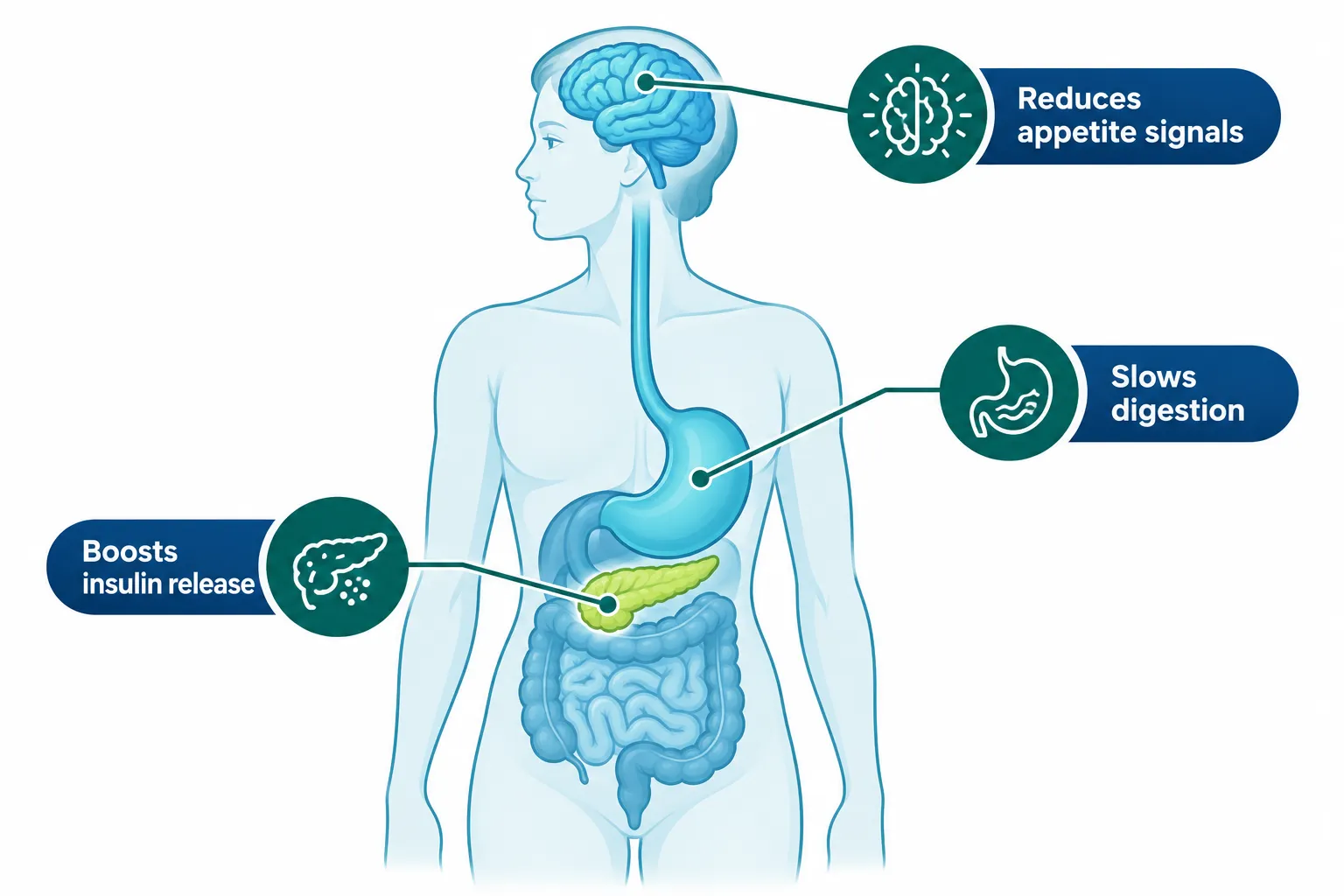
GLP-1 drugs are injectable or oral medications that mimic a gut hormone called glucagon-like peptide-1, which slows digestion, boosts insulin release, and reduces appetite signals in the brain. They were originally developed for type 2 diabetes and later approved for chronic weight management.[7]
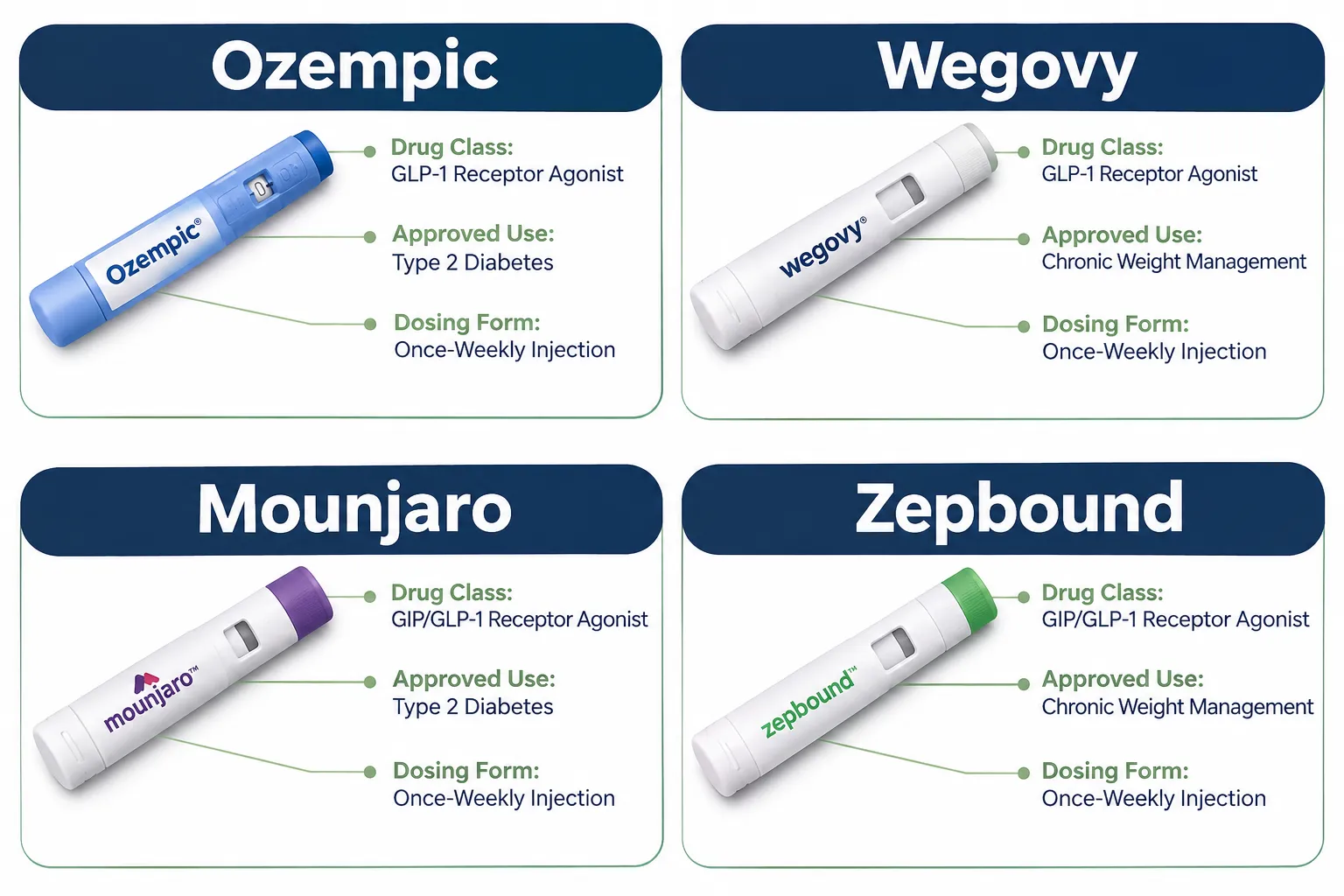
Ozempic and Mounjaro are approved primarily for diabetes, while Wegovy and Zepbound are approved for weight loss, though doctors sometimes prescribe diabetes versions off-label for weight management. The active ingredients differ by brand:
- Semaglutide, the active ingredient in Ozempic and Wegovy
- Tirzepatide, the active ingredient in Mounjaro and Zepbound, which also targets a second gut hormone receptor (GIP)
Because these drugs work on appetite and blood sugar at the same time, many patients see both weight loss and improved glucose control. If you’re weighing whether a GLP-1 fits your goals, our weight loss resource page breaks down how these treatments compare to other medical approaches.
A common mistake is assuming all four brands work identically. Tirzepatide drugs (Mounjaro, Zepbound) generally produce slightly greater average weight loss in clinical comparisons than semaglutide drugs (Ozempic, Wegovy), which is one reason tirzepatide products often carry similar or higher list prices.
Trump GLP-1 Prices: Costs for Wegovy, Ozempic, Zepbound, and Mounjaro Explained
Trump GLP-1 prices refer to the discounted monthly costs created through the November 2025 Most Favored Nation (MFN) pricing deal and the TrumpRx.gov platform that launched in early 2026. Under this framework, injectable GLP-1 drugs that once cost $1,000 to $1,350 a month now cost roughly $245 to $350 for most buyers, depending on insurance status.[10][8]
The November 6, 2025 White House fact sheet locked in two pricing tiers: a TrumpRx cash price and a separate Medicare MFN price. Here’s how the numbers broke down at launch:
| Drug | Prior list price (monthly) | TrumpRx cash price | Medicare MFN price |
|---|---|---|---|
| Ozempic (semaglutide injection) | about $1,000,$1,028 | about $350 | $245 |
| Wegovy (semaglutide injection) | about $1,349 | as low as $199 | $245 |
| Wegovy tablets | about $1,349 | as low as $149 | not applicable |
| Mounjaro (tirzepatide injection) | similar range to Ozempic | aligned with MFN framework | $245 |
| Zepbound (tirzepatide injection) | similar range to Wegovy | aligned with MFN framework | $245 |
Data drawn from the White House MFN fact sheet and the AMCP federal policy update.[10][8]
Choose TrumpRx if you’re uninsured or your plan doesn’t cover GLP-1 drugs, it’s generally the lowest flat cash price available outside Medicare. Choose Medicare MFN pricing if you’re a Medicare Part D beneficiary, since $245 a month applies automatically once the MFN rule takes effect for your plan. A common mistake is assuming TrumpRx pricing applies to Medicare claims, it doesn’t; Medicare uses its own MFN schedule.[10]
How Much Does Wegovy Cost Without Insurance
Without insurance, Wegovy costs between $149 and $499 a month depending on which discount program you use, or roughly $1,600 to $1,787 a month at full retail list price. The exact number depends on the dose, the formulation (tablet versus injection), and whether you’re buying through TrumpRx, NovoCare, or a retail pharmacy with no discount applied.[9][2][5]
Current uninsured pricing tiers for Wegovy, per NovoCare and independent pricing guides:
- New-patient introductory offer: $199 a month for the first two fills of 0.25 mg or 0.5 mg injections, through December 31, 2026[5]
- Standard injectable doses (0.25-2.4 mg): $349 a month[5][4]
- Wegovy HD (7.2 mg) injection: $399 a month[4]
- Wegovy tablets: $149 (1.5 mg), $199 (4 mg), $299 (9 mg and 25 mg)[5]
- Full retail, no discount: roughly $1,600,$1,787 a month, per GoodRx and Drugs.com[9][2]
Example: a patient starting Wegovy in late 2026 who qualifies for the NovoCare introductory offer pays $199 for their first two months on a low dose, then moves to $349 a month once they reach a maintenance dose, a fraction of the roughly $1,349 pre-discount list price.[10][5]
Ozempic Price Comparison: 2024 Versus Today’s Trump GLP-1 Prices
Ozempic’s price has dropped by more than two-thirds since 2024, when it commonly listed near $1,000 to $1,028 a month with no insurance. Under the current Trump GLP-1 pricing framework, most buyers now pay around $350 a month through TrumpRx or $245 a month if enrolled in Medicare.[10]
A quick before-and-after comparison:
- 2024 list price: approximately $1,000,$1,028 per month, no discount
- 2026 TrumpRx cash price: approximately $350 per month
- 2026 Medicare MFN price: $245 per month
This is one of the steepest drug-price reductions tied to a federal policy in recent memory, and it applies specifically to the injectable pen formulation most patients use for diabetes management. If you’re comparing Ozempic against newer options, the men’s health section of our site covers how metabolic conditions like type 2 diabetes intersect with broader health screening needs.
Edge case: patients using Ozempic off-label for weight loss (rather than diabetes) sometimes face different insurance coverage rules even though the drug and price are identical, since insurers often require a diabetes diagnosis code for Ozempic specifically.
Is Zepbound Cheaper Than Wegovy
Zepbound and Wegovy are priced very close to each other under current MFN and manufacturer programs, with both landing near $245 a month for Medicare enrollees and roughly $349 to $499 a month for cash-paying patients depending on the channel used.[8] Neither drug is consistently cheaper across every scenario, the better deal depends on which discount program you qualify for.
- Medicare patients: Zepbound and Wegovy both cost $245 a month under MFN rules, or $50 a month under the Medicare GLP-1 Bridge program through December 2027.[1][10]
- Cash-paying patients using manufacturer direct programs: Wegovy often starts lower, at $149,$349 depending on dose, while Zepbound and Wegovy sold outside MFN channels can both reach $499 a month.[8][5]
Choose Wegovy if you want access to the lowest-dose tablet option starting at $149 a month. Choose Zepbound if your doctor recommends tirzepatide for its typically stronger average weight-loss results and your insurance or Medicare plan already covers it at the $245 MFN rate. A common mistake is comparing list prices from different retailers without checking whether the quote includes a manufacturer savings card, the gap between discounted and full retail price can exceed $1,000 a month.[9]
Mounjaro vs Ozempic Cost: Which Is More Expensive
Mounjaro and Ozempic are priced at roughly the same level under Trump GLP-1 pricing rules, with both costing $245 a month for Medicare enrollees under MFN. Before these policy changes, Mounjaro’s list price without insurance was often comparable to or slightly higher than Ozempic’s, since tirzepatide formulations historically carried a premium over semaglutide.[10][8]
Key differences that affect what you actually pay:
- Both drugs now sit at the same $245 Medicare MFN price point, removing much of the historical cost gap for Medicare patients.
- Cash-paying patients may still see Ozempic priced slightly lower through TrumpRx (around $350) compared with non-MFN cash pricing on Mounjaro, which can run closer to $499 depending on the seller.[10][8]
- Mounjaro is approved for type 2 diabetes, so insurance coverage criteria mirror Ozempic’s, a diabetes diagnosis is typically required for standard coverage, separate from the weight-loss-focused Zepbound.
If cost is your deciding factor and you have Medicare, the two drugs are now essentially tied. If you’re uninsured, call ahead to compare current TrumpRx and manufacturer savings card pricing before choosing, since cash pricing shifts more often than Medicare’s fixed MFN rate.
Do Insurance Plans Cover GLP-1 Weight Loss Drugs
Insurance coverage for GLP-1 weight loss drugs varies widely by plan, employer, and state, and many commercial plans still exclude weight-loss indications even when they cover the same drug for diabetes. Medicare coverage has expanded significantly in 2026 through MFN pricing and the temporary GLP-1 Bridge program, but commercial coverage remains inconsistent.[10][1]
Who qualifies for GLP-1 insurance coverage:
- Medicare Part D beneficiaries qualify for the $245 MFN price on GLP-1 injectables automatically once their plan applies the negotiated rate.[10]
- Eligible Medicare patients also qualify for the $50-a-month GLP-1 Bridge program for Wegovy and Zepbound, running July 1, 2026 through December 31, 2027.[1]
- Some commercially insured patients can pay as little as $25 for up to a three-month Wegovy prescription if their employer plan already includes GLP-1 coverage.[5][9]
- Patients without a qualifying diagnosis (such as diabetes for Ozempic or Mounjaro) may face denials even with otherwise strong insurance.
Decision rule: if your plan denies coverage for weight-loss use, ask your doctor whether a diabetes-coded alternative or a manufacturer savings card brings the cost closer to the TrumpRx cash price. Women managing conditions like PCOS that affect weight and metabolism may find it useful to review coverage nuances on our women’s health page, since hormonal conditions sometimes change which diagnosis codes qualify for coverage.
Are GLP-1 Drug Prices Going Up or Down
GLP-1 drug prices are going down overall in 2026, driven by MFN negotiations, TrumpRx.gov, and competitive pressure between Novo Nordisk and Eli Lilly. Industry reporting in late 2026 points toward further wholesale price reductions expected in 2027 as manufacturers adjust list prices to stay competitive with government-anchored benchmarks.
Three forces are pushing prices lower:
- MFN pricing rules tie U.S. prices more closely to what other wealthy countries pay, which is historically lower than U.S. list prices.[10]
- TrumpRx.gov creates a direct-to-consumer cash channel that undercuts traditional pharmacy list pricing.[10]
- Manufacturer competition between semaglutide and tirzepatide brands keeps both companies adjusting savings card offers to avoid losing market share.[8][5]
The one exception: full retail list prices without any discount program applied (the numbers you’d see without a savings card, Medicare MFN rate, or TrumpRx account) have not dropped nearly as fast and still sit near $1,600 to $1,787 a month for some Wegovy formulations.[9][2] Always check which price tier a quote reflects before assuming it’s the lowest available.
Cheapest Way to Get GLP-1 Medication
The cheapest way to get GLP-1 medication in 2026 depends on your insurance status: Medicare enrollees should use the $50-a-month GLP-1 Bridge program if eligible, while uninsured patients generally get the best price through TrumpRx.gov or a manufacturer’s direct savings program like NovoCare.[1][10][5]

Practical steps to find your lowest price:
- Check if you’re eligible for the Medicare GLP-1 Bridge ($50 a month for Wegovy or Zepbound through December 2027).[1]
- If not on Medicare, compare TrumpRx.gov pricing against NovoCare’s Wegovy Savings Offer, both are manufacturer- and government-backed, not third-party resellers.[10][5]
- Ask your doctor about a manufacturer savings card even if you have commercial insurance; some plans combine coverage with a card to reach the $25 three-month price.[5]
- Avoid unverified online sellers advertising GLP-1 drugs without a prescription, legitimate GLP-1 medications require a prescription from a licensed provider, and products sold without one carry real safety risks, including counterfeit or mislabeled ingredients.
A common mistake is assuming any website labeled “compounded” or “generic” GLP-1 offers the same safety and dosing accuracy as an FDA-approved product. No interchangeable generic version of semaglutide or tirzepatide is approved in the U.S. as of October 2026, so “generic” listings online are a red flag worth questioning with your pharmacist.
Why Are GLP-1 Drugs So Expensive, and When Will Generics Arrive
GLP-1 drugs remain expensive at full list price because they’re still under patent protection, require complex manufacturing, and face high global demand that outpaces supply. No FDA-approved generic version of semaglutide (Ozempic, Wegovy) or tirzepatide (Mounjaro, Zepbound) exists yet, which is why price relief so far has come from government negotiation and manufacturer discount programs rather than generic competition.[7][10]
Patent protections on semaglutide and tirzepatide are expected to extend for several more years, meaning a true generic equivalent is not close on the horizon. In the meantime, the only paths to lower costs are:
- MFN-negotiated Medicare pricing ($245 a month)[10]
- TrumpRx.gov cash pricing (as low as $149,$350 a month depending on drug and dose)[10]
- Manufacturer savings cards and direct pharmacy programs ($149,$499 a month)[5][8]
If you’re budgeting long-term, assume current discount pricing is more stable than waiting for a generic. Forward-looking analyses suggest any future oral GLP-1 approvals will likely be slotted into the existing TrumpRx framework at similarly discounted starting prices rather than launching at old-style list prices.[10]
Side Effects of GLP-1 Drugs: Are They Worth the Cost
GLP-1 drugs commonly cause nausea, constipation, diarrhea, and fatigue, especially during dose increases, and most patients find these manageable while losing meaningful weight or improving blood sugar control. Whether the cost is “worth it” depends on your health goals, how your body tolerates the medication, and which price tier you’re paying.[7]
Common side effects to expect:
- Nausea and mild stomach upset, usually strongest in the first few weeks of a new dose
- Constipation or diarrhea
- Fatigue or low appetite beyond the intended effect
- Rare but serious risks your doctor should discuss, including gallbladder issues and pancreatitis
Decision rule: if you’re paying $245,$350 a month and seeing steady progress with tolerable side effects, most clinicians consider that a reasonable trade-off compared with the $1,000-plus pre-discount price for the same clinical benefit. If side effects are severe enough to require stopping, talk to your provider about dose adjustments before abandoning treatment altogether. Pairing any GLP-1 plan with sustainable habits, including the kind of produce-forward meals covered in our guide to plant-based recipes, can also ease digestive side effects for many patients. For a broader view of how medication fits into a complete health routine, our wellness section offers additional context.
How Long Do You Take GLP-1 Drugs Before Stopping
Most patients stay on GLP-1 drugs for many months to years, since weight regain is common when the medication is stopped without a long-term diet and activity plan in place. There’s no universal stopping point, the decision depends on your weight-loss goals, side effects, insurance access, and whether your doctor recommends a maintenance dose indefinitely.
Things that typically influence how long someone stays on treatment:
- Reaching a target weight or blood sugar goal your doctor sets with you
- Cost and insurance access changes, since losing Medicare MFN or savings-card pricing can make continued use harder to afford
- Side effects that don’t improve with dose adjustments
- A doctor’s recommendation to transition to a lower maintenance dose rather than stopping completely
Edge case: patients who stop a GLP-1 drug abruptly, without a nutrition and activity plan, often regain a meaningful portion of lost weight within months. Discuss a tapering or maintenance strategy with your provider rather than stopping cold, especially if cost is the main reason you’re considering it.
Conclusion
Trump GLP-1 prices have genuinely reshaped what Wegovy, Ozempic, Zepbound, and Mounjaro cost in 2026, cutting many patients’ monthly bills from over $1,000 to somewhere between $149 and $350, with Medicare enrollees often paying even less. The catch is that pricing now depends heavily on which channel you use, TrumpRx, Medicare MFN, a manufacturer savings card, or full retail, so the same drug can carry wildly different price tags depending on how you shop for it.
My practical advice: check your Medicare or insurance eligibility first, compare TrumpRx.gov against your drug’s manufacturer savings program second, and never assume a “generic” GLP-1 sold without a prescription is safe or legitimate. Talk with your doctor about which brand fits your health profile and budget, and revisit pricing every few months since this landscape is still shifting. For more guidance on building a complete weight-management plan around your prescription, visit the Health Trust MD homepage to explore related resources.
FAQ
What is the current Trump GLP-1 price for Ozempic? Ozempic costs about $350 a month through TrumpRx.gov for cash-paying patients, or $245 a month for Medicare enrollees under MFN pricing rules.[10]
Is Wegovy cheaper than Ozempic right now? Wegovy can be cheaper in tablet form, starting at $149 a month, while injectable Wegovy runs $199,$349 a month depending on the program, putting it roughly in line with or below Ozempic’s $350 TrumpRx price.[10][5]
Does Medicare cover Zepbound and Mounjaro? Yes. Medicare covers Zepbound and Mounjaro injections at $245 a month under MFN pricing, and eligible patients may qualify for Zepbound at $50 a month through the Medicare GLP-1 Bridge program running through December 2027.[8][1]
Are there generic versions of Ozempic or Wegovy? No. As of October 2026, there is no FDA-approved generic for semaglutide (Ozempic, Wegovy) or tirzepatide (Mounjaro, Zepbound), so savings come from government pricing programs and manufacturer discounts rather than generic competition.[7]
Can I buy GLP-1 drugs online without a prescription? No legitimate source sells FDA-approved GLP-1 drugs without a prescription. Products advertised that way carry real safety risks, including counterfeit ingredients and incorrect dosing.
Why did GLP-1 prices drop so much in 2026? Prices dropped because of Most Favored Nation pricing deals negotiated by the federal government and the launch of TrumpRx.gov, which created a direct cash-pay channel that undercuts old list prices.[10]
How much does Zepbound cost without insurance? Zepbound costs roughly $245,$499 a month without insurance depending on whether you access it through MFN-aligned pricing or a manufacturer’s direct cash program.[8]
Will GLP-1 prices keep falling after 2026? Industry analysts expect continued downward pressure on list and wholesale prices into 2027, driven by competition between manufacturers and the political difficulty of reversing MFN-era pricing commitments.
References
[1] What To Pay For Wegovy – https://www.wegovy.com/obesity/what-to-pay-for-wegovy.html [2] Wegovy – https://www.drugs.com/price-guide/wegovy [4] Savings And Support – https://www.novocare.com/hcp/savings-and-support.html [5] Wegovy – https://www.novocare.com/pharmacy/wegovy.html [7] Glp 1 Drug Best Weight Loss 3579236 – https://www.drugs.com/medical-answers/glp-1-drug-best-weight-loss-3579236/ [8] Federal Update Trump Administration Announces Deal Bring Most Favored Nation Pricing Glp 1s – https://www.amcp.org/letters-statements-analysis/federal-update-trump-administration-announces-deal-bring-most-favored-nation-pricing-glp-1s [9] Wegovy – https://www.goodrx.com/wegovy [10] Fact Sheet President Donald J Trump Announces Major Developments In Bringing Most Favored Nation Pricing To American Patients – https://www.whitehouse.gov/fact-sheets/2025/11/fact-sheet-president-donald-j-trump-announces-major-developments-in-bringing-most-favored-nation-pricing-to-american-patients/