Drug Prices Under Trump: Key Discounts, Reforms, and Savings Policies
Last updated: October 17, 2026
Quick Answer
Drug Prices Under Trump: Key Discounts, Reforms, and Savings Policies center on three moves: Most Favored Nation (MFN) pricing tied to what other wealthy countries pay, the TrumpRx.gov direct-to-consumer discount platform, and a Medicaid rebate expansion covering all 50 states as of September 2026 [1]. The administration says these changes produced the largest prescription drug price drop in over 60 years [2], though independent reviewers and patient advocates dispute how much credit the policies deserve [7][10]. Seniors on Medicare and uninsured patients buying directly through TrumpRx.gov are the two groups most likely to see real savings.
Key Takeaways
- Most Favored Nation pricing now applies to every state Medicaid program as of September 2026, tying U.S. drug costs closer to prices paid in other developed nations [1][3].
- The White House claims the largest prescription drug price drop in over 60 years occurred in August 2026, though this figure is contested [2][7].
- TrumpRx.gov, launched in February 2026 and expanded in May 2026, lets patients buy certain medications directly, bypassing traditional insurance middlemen [5][9].
- Medicare beneficiaries and Medicaid enrollees are positioned as the biggest winners, but uninsured cash-pay patients also get listed discounts through TrumpRx [10].
- Critics, including some health policy researchers, call parts of the pricing claims exaggerated and tied to unrelated market forces [7].
- The Great Healthcare Plan, unveiled in January 2026, aims to codify MFN savings and send rebate-style payments directly to patients [6][8].
- Long-term projections suggest continued savings if MFN pricing holds, but researchers flag uncertainty about real-world impact [4].
- Some pharmaceutical companies and trade groups have pushed back, warning MFN pricing could reduce incentives for new drug development.
What Drug Price Policies Did Trump Implement?
Trump’s drug pricing agenda rests on three connected policies: Most Favored Nation pricing, Medicaid rebate expansion, and the TrumpRx.gov consumer platform. Together these form the backbone of Drug Prices Under Trump: Key Discounts, Reforms, and Savings Policies as they stand in late 2026.
The MFN approach ties U.S. government drug payments to the lowest price paid by comparable wealthy nations such as Canada, Germany, or the United Kingdom. In September 2026, the administration extended MFN pricing to every state Medicaid program in the country, a move the White House frames as ending the practice of Americans paying more for the same medicine than patients overseas [1][3].
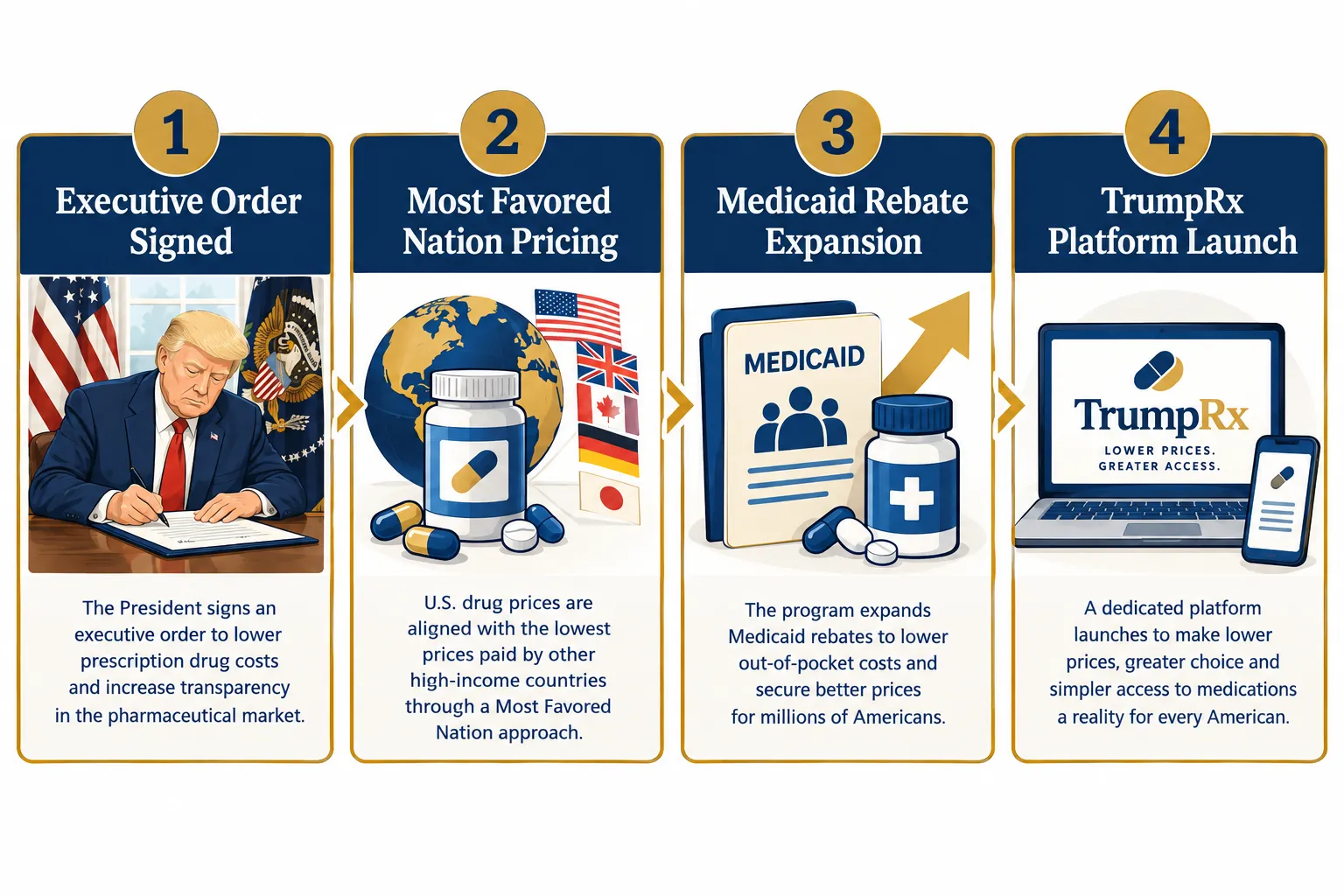
Alongside MFN, the Generous Medicaid Payment Model pairs state-level rebates with manufacturer agreements, intended to lower what state programs spend on brand-name drugs without cutting pharmacy access [3]. The third piece, TrumpRx.gov, gives individual patients a way to shop for drug prices outside the standard insurance and pharmacy benefit manager system [9].
Choose this policy mix matters if: you’re enrolled in Medicaid, you’re a Medicare beneficiary, or you pay cash for prescriptions without insurance coverage. These three groups are named specifically in the administration’s own policy announcements [1][5].
How Much Did Drug Prices Change Under the Trump Administration?
The administration reported what it called the largest prescription drug price drop in over 60 years in August 2026, though the exact percentage figures vary by drug class and payer type [2]. Independent fact-checkers and patient advocacy groups have challenged how much of that drop is attributable to the new policies versus existing market trends [7].
A May 2026 White House research analysis projected ongoing savings from the MFN framework, estimating continued downward pressure on list prices for multiple drug categories if the policy remains in place [4]. That same analysis acknowledged the projections depend on manufacturer compliance and state-level adoption speed [4].
Common mistake: assuming a single national percentage applies to every drug. In reality, savings vary widely by medication class, insurance type, and whether a patient uses Medicaid, Medicare, or TrumpRx.gov directly. A diabetes medication might see a different discount than a cardiovascular drug, even under the same MFN framework.
What Is the Trump Drug Pricing Executive Order About?
The core executive order behind Drug Prices Under Trump: Key Discounts, Reforms, and Savings Policies directs federal health agencies to tie drug payments to international reference prices and to expand direct-to-consumer purchasing options. The official text of this directive and related policy documentation appears in the federal compilation of presidential documents [8].
The order instructs the Department of Health and Human Services to negotiate with manufacturers using MFN benchmarks, and it authorizes the infrastructure behind TrumpRx.gov [8][9]. It also sets a framework for state Medicaid programs to adopt similar reference pricing, which culminated in the September 2026 nationwide Medicaid rollout [1].
Edge case: the order applies primarily to federal and state government health programs. Employer-sponsored private insurance plans are not automatically bound by MFN pricing unless insurers choose to adopt similar benchmarks voluntarily.
Which Medications Got Cheaper Under Trump?
Medications most affected include widely prescribed chronic disease drugs covered under Medicaid and Medicare, along with select medicines newly listed on TrumpRx.gov. The administration has highlighted broad categories rather than publishing a single master list, so savings differ by drug and by state [3][9].
Drug categories commonly cited in official materials include:
- Diabetes medications covered through expanded Medicaid rebates
- Cardiovascular drugs subject to MFN reference pricing
- Select specialty medications newly available through TrumpRx.gov direct ordering [10]
Weight-management prescriptions, including GLP-1 class drugs, have drawn particular attention because of their high list prices. If you’re researching cost-saving options for these medications, our guide to weight loss strategies covers both medical and lifestyle approaches that can complement any pricing changes you see at the pharmacy counter.
Decision rule: check TrumpRx.gov directly for your specific medication before assuming a discount applies. Listed prices on the platform are the most reliable way to confirm real savings, since broad policy announcements don’t guarantee every drug or every pharmacy reflects the new pricing immediately.
Drug Prices Under Trump: Key Discounts, Reforms, and Savings Policies for Seniors
Seniors enrolled in Medicare are positioned as primary beneficiaries of Drug Prices Under Trump: Key Discounts, Reforms, and Savings Policies, particularly through Medicaid-Medicare dual-eligible coverage and MFN-linked drug pricing. The administration’s Great Healthcare Plan specifically frames savings as money that should flow back to patients, including retirees on fixed incomes [6].
What Is the Medicare Drug Price Negotiation Rule Trump Proposed?
The Medicare drug price negotiation framework tied to this administration extends MFN-style reference pricing into Medicare drug payment calculations, building on existing negotiation authority established in prior federal law. The January 2026 Great Healthcare Plan announcement describes direct payments to patients as part of this broader negotiation strategy [6][8].
Who Benefits Most From Trump Drug Price Policies?
Medicaid enrollees, Medicare beneficiaries, and cash-pay patients using TrumpRx.gov benefit most directly, according to the administration’s own fact sheets [1][5][9]. Patients with employer-sponsored insurance see fewer guaranteed changes, since private plans are not automatically required to adopt MFN pricing.
Older adults managing multiple chronic conditions often spend a large share of their income on prescriptions, which is why preventive health habits matter alongside any pricing reform. Our wellness resources cover practical steps for reducing overall health costs, including medication management tips that work alongside federal pricing changes.
Example: a Medicare beneficiary on Medicaid for cardiovascular medication may see rebate-driven savings at the pharmacy within months of state adoption, while a privately insured working adult on the same drug may see no change at all until their employer’s plan adjusts.
How Do Trump Drug Discounts Work for Uninsured Patients?
Uninsured patients can use TrumpRx.gov to view and purchase select medications at listed discount prices without going through a traditional pharmacy benefit manager or insurance claim. The platform launched in February 2026 and expanded its drug list in May 2026 [9][5].
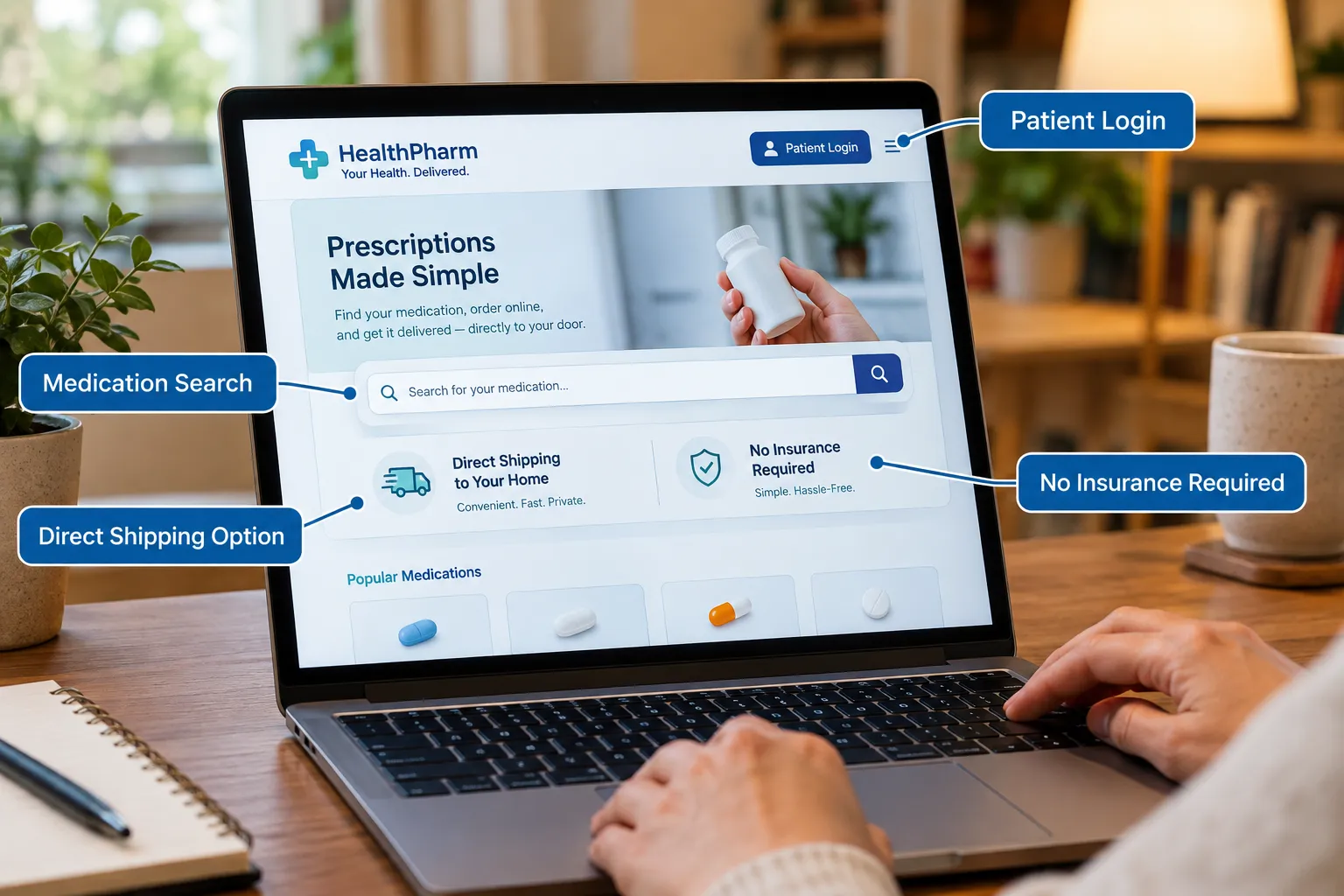
Here’s how the process generally works:
- Visit TrumpRx.gov and search for your specific medication.
- Compare the listed direct price against your current pharmacy price.
- Place an order through the platform if the medication is available and the price is favorable.
- Receive shipment directly, cutting out the standard insurance middleman step [5].
An independent comparison by NBC News and KFF in October 2026 found that TrumpRx pricing was competitive with, though not always lower than, prices paid in some other countries, depending on the specific drug examined [10]. That means uninsured patients should still compare prices before assuming TrumpRx.gov offers the absolute lowest option available.
Common mistake: assuming TrumpRx.gov covers every prescription drug. The platform’s list is limited to specific medications the administration has negotiated directly with manufacturers, so always check availability first [9].
Drug Prices Under Trump: Key Discounts, Reforms, and Savings Policies Compared to Biden-Era Rules
Trump’s MFN-based approach differs from Biden-era Medicare negotiation rules by applying reference pricing more broadly across Medicaid and by introducing a direct-to-consumer purchasing platform. Biden-era policy focused primarily on a narrower list of Medicare Part D negotiated drugs without a comparable consumer-facing discount site.
| Feature | Trump Administration Approach | Biden Administration Approach |
|---|---|---|
| Pricing benchmark | Most Favored Nation reference pricing [1] | Negotiated Medicare Part D pricing on a limited drug list |
| Medicaid scope | Extended to all 50 states [1][3] | State-by-state rebate programs, no uniform MFN rule |
| Consumer platform | TrumpRx.gov direct purchasing [9] | No comparable direct-to-consumer federal platform |
| Patient payments | Proposed direct rebate payments under Great Healthcare Plan [6] | Savings applied mainly at point of sale, not direct cash |
Choose Trump’s framework as the relevant comparison if you’re specifically evaluating Medicaid-wide pricing or direct-to-consumer options; choose Biden-era rules as context if you’re researching the original Medicare Part D negotiation list that predates MFN expansion.
What Are the Criticisms of Trump Drug Price Reforms?
Critics argue that some of the administration’s headline savings figures overstate the actual impact of MFN pricing and TrumpRx.gov, attributing part of the price drop to unrelated market and generic competition trends. An August 2026 critical analysis characterized certain administration claims as exaggerated or “bogus,” arguing other policy and market forces deserve more credit than officials acknowledge [7].

Additional criticisms include:
- Allegations that the president personally benefited financially from policies favoring large pharmaceutical companies, a claim detailed in an October 2026 investigative report [7].
- Concerns that MFN pricing could discourage pharmaceutical companies from launching new drugs in the U.S. market first, since lower guaranteed U.S. prices reduce early revenue potential.
- Questions about whether state Medicaid programs have the administrative capacity to implement rebate changes quickly and accurately.
Which Pharmaceutical Companies Opposed Trump Pricing Policies?
Specific company names tied to formal opposition campaigns are not detailed in the available public record reviewed here, but industry trade groups broadly have resisted MFN-style reference pricing in public statements, warning it could reduce research investment. If you’re tracking this issue, treat broad industry pushback as an ongoing, evolving story rather than a settled outcome.
Edge case: some manufacturers have publicly supported transparency measures like TrumpRx.gov while simultaneously opposing stricter MFN rebate requirements, showing the industry response is not uniform.
What Happened to Drug Prices After Trump Left Office, and Are These Reforms Still in Effect Today?
During the gap between Trump’s first term and his return to office, several of his original drug pricing executive orders stalled or were rescinded, and broader market-driven price trends took over. As of October 2026, the current MFN and TrumpRx.gov policies are active and expanding, according to the most recent White House releases [1][2].
Historical policy reviews covering 2025 and 2026 trace renewed MFN efforts as a continuation of ideas first floated during Trump’s earlier term, now implemented with expanded Medicaid scope and a functioning consumer platform. This suggests the current reforms carry more structural weight than earlier, largely symbolic attempts.
Quick example: a policy that existed only as an executive order in 2020 without full implementation now has concrete Medicaid rebate agreements across all 50 states as of September 2026, a meaningful shift from announcement to enforcement [1].
What Is the Difference Between Trump and Generic Drug Pricing?
Trump-era MFN pricing applies to brand-name and patented medications where the U.S. historically paid more than comparable countries; it does not directly set generic drug prices, which are already shaped by manufacturer competition. Generic drugs typically cost far less than brand-name equivalents regardless of federal pricing policy, because multiple manufacturers compete to sell the same chemical formula.
Key distinctions:
- MFN pricing targets brand-name drugs without generic competition, where a single manufacturer controls the price.
- Generic pricing already reflects market competition and tends to drop automatically once patent protection ends.
- TrumpRx.gov lists both brand-name discounts and some generic options, but the platform’s biggest price impact is typically on brand-name drugs that previously had no direct-to-consumer alternative [9].
If a generic version of your medication exists, it’s often still your cheapest option regardless of MFN policy changes. Patients managing conditions tied to hormonal health, such as those using treatments covered under women’s health or men’s health guidance, should check generic availability first before relying solely on federal pricing reforms.
Conclusion and Next Steps
Drug Prices Under Trump: Key Discounts, Reforms, and Savings Policies represent a real structural shift in how Medicaid, Medicare, and direct-to-consumer drug purchasing work in the United States as of late 2026. The MFN framework, Medicaid rebate expansion, and TrumpRx.gov platform have produced measurable changes for specific patient groups, even as critics dispute the scale of the administration’s claims [2][7].
Here’s what I’d recommend if you’re trying to actually use these policies to save money:
- Check TrumpRx.gov directly for your specific prescription before assuming a discount applies.
- Confirm whether your state has adopted the September 2026 Medicaid MFN rebates if you’re a Medicaid enrollee [1].
- Ask your pharmacist whether a generic version exists before relying on brand-name MFN pricing.
- Pair any drug savings with broader preventive health steps, since medication costs are only one part of your total healthcare spending. Our exploring plant-based healthy recipes guide offers practical, low-cost ways to support chronic disease management alongside prescription savings.
Policy details will likely keep shifting as states finish implementation and as independent analysts continue testing the administration’s savings claims. Stay close to primary sources like TrumpRx.gov and your state Medicaid office rather than relying on headline figures alone.
FAQ
What drug price policies did Trump implement in 2026? The main policies are Most Favored Nation reference pricing extended to all state Medicaid programs, the TrumpRx.gov direct-to-consumer discount platform, and the Great Healthcare Plan aimed at codifying savings and sending rebates to patients [1][6][9].
How much did drug prices actually drop under Trump? The administration reported the largest prescription drug price drop in over 60 years in August 2026, though independent critics argue the figure overstates the policy’s direct impact [2][7].
Is TrumpRx.gov available to everyone? Yes, TrumpRx.gov is open to the public, including uninsured patients, but it only covers a specific list of medications the administration has negotiated directly, not every prescription drug [5][9].
Does Trump drug pricing help seniors save money? Seniors on Medicare and Medicaid are among the groups most likely to see savings, since MFN pricing and Medicaid rebates target these programs directly, according to official White House materials [1][6].
Are these drug price reforms still in effect today? Yes, as of October 2026, MFN pricing and TrumpRx.gov remain active and have expanded, with Medicaid MFN rules now covering all 50 states [1].
What is the biggest criticism of Trump’s drug pricing claims? The main criticism is that the administration’s savings figures may be exaggerated and partly driven by unrelated market forces rather than the policies themselves, as argued in an August 2026 critical analysis [7].
Did pharmaceutical companies support or oppose these reforms? Industry response has been mixed: some companies support transparency tools like TrumpRx.gov while trade groups broadly oppose stricter MFN rebate rules, citing concerns about future drug development investment.
How is Trump’s drug pricing different from generic drug pricing? MFN policy targets brand-name drugs without generic competition, while generic drug prices are already shaped by market competition and typically remain the cheaper option regardless of federal policy changes.
References
[1] President Trump Extends Most Favored Nation Pricing To Every Medicaid Program In America – https://www.whitehouse.gov/releases/2026/09/president-trump-extends-most-favored-nation-pricing-to-every-medicaid-program-in-america/ [2] President Trump Delivers Largest Prescription Drug Price Drop In Over 60 Years – https://www.whitehouse.gov/releases/2026/08/president-trump-delivers-largest-prescription-drug-price-drop-in-over-60-years/ [3] Fact Sheet President Donald J Trump Announces Lower Drug Prices For All 50 State Medicaid Programs – https://www.whitehouse.gov/fact-sheets/2026/09/fact-sheet-president-donald-j-trump-announces-lower-drug-prices-for-all-50-state-medicaid-programs/ [4] Savings From Most Favored Nation Drug Pricing Policy – https://www.whitehouse.gov/research/2026/05/savings-from-most-favored-nation-drug-pricing-policy/ [5] Fact Sheet President Donald J Trump Announces Expansion Of Trumprx Gov To Bring Americans Transparency And Choice On Everyday Medicines – https://www.whitehouse.gov/fact-sheets/2026/05/fact-sheet-president-donald-j-trump-announces-expansion-of-trumprx-gov-to-bring-americans-transparency-and-choice-on-everyday-medicines/ [6] President Trump Unveils The Great Healthcare Plan To Lower Costs And Deliver Money Directly To The People – https://www.whitehouse.gov/releases/2026/01/president-trump-unveils-the-great-healthcare-plan-to-lower-costs-and-deliver-money-directly-to-the-people/ [7] Trump Profited From His Giveaway To Big Pharma While Jacking Up Drug Costs – https://truthout.org/articles/trump-profited-from-his-giveaway-to-big-pharma-while-jacking-up-drug-costs/ [8] Dcpd 202600568 – https://www.govinfo.gov/content/pkg/DCPD-202600568/pdf/DCPD-202600568.pdf [9] Fact Sheet President Donald J Trump Launches Trumprx Gov To Bring Lower Drug Prices To American Patients – https://www.whitehouse.gov/fact-sheets/2026/02/fact-sheet-president-donald-j-trump-launches-trumprx-gov-to-bring-lower-drug-prices-to-american-patients/ [10] Trump Lowest Drug Prices Trumprx Discounts Report Rcna600716 – https://www.nbcnews.com/health/health-news/trump-lowest-drug-prices-trumprx-discounts-report-rcna600716