TrumpRx Mounjaro Price: Out-of-Pocket Costs and Coupon Savings
Last updated: October 17, 2026
Quick Answer
The TrumpRx Mounjaro price for the lowest-strength single-dose pen sits around $499 a month in cash, reflecting a discount of roughly 55% off the drug’s list price [1][2]. That figure applies to self-pay purchases through the TrumpRx portal and LillyDirect fulfillment, not to commercial insurance copays or Medicare plan costs, which follow separate pricing rules [4][7]. Some analyst estimates put self-pay tirzepatide (Mounjaro’s active ingredient) as low as $299 to $449 a month depending on dose and timing, so the exact number can shift [3].
Key Takeaways
- The TrumpRx Mounjaro price for the entry-level pen is about $499 per month in cash, a savings of roughly 55% versus the undiscounted list price [1][2].
- TrumpRx is a federal pricing portal tied to a Most Favored Nation (MFN) deal between the Trump administration and drugmakers Eli Lilly and Novo Nordisk [4][7].
- Medicare and Medicaid patients get a separate deal: plan cost is capped near $245 a month, with copays around $50 for eligible beneficiaries [4].
- Manufacturer copay cards, run through Lilly, can bring Mounjaro down to as low as $25 a month for some people with commercial insurance [6].
- TrumpRx savings apply to self-pay, direct purchases through LillyDirect fulfillment; they generally do not stack with retail pharmacy insurance coverage [1][5].
- Mounjaro treats type 2 diabetes; its sister drug Zepbound, same active ingredient, is approved for chronic weight management [9][10].
- Alternatives like Ozempic and Wegovy use a different active ingredient (semaglutide) and have their own separate discount structures [3][7].
- Coupon terms, dose tiers, and eligibility rules can change, so check the TrumpRx portal directly before assuming a price is locked in [1][5].
What Is Mounjaro and What Does It Treat
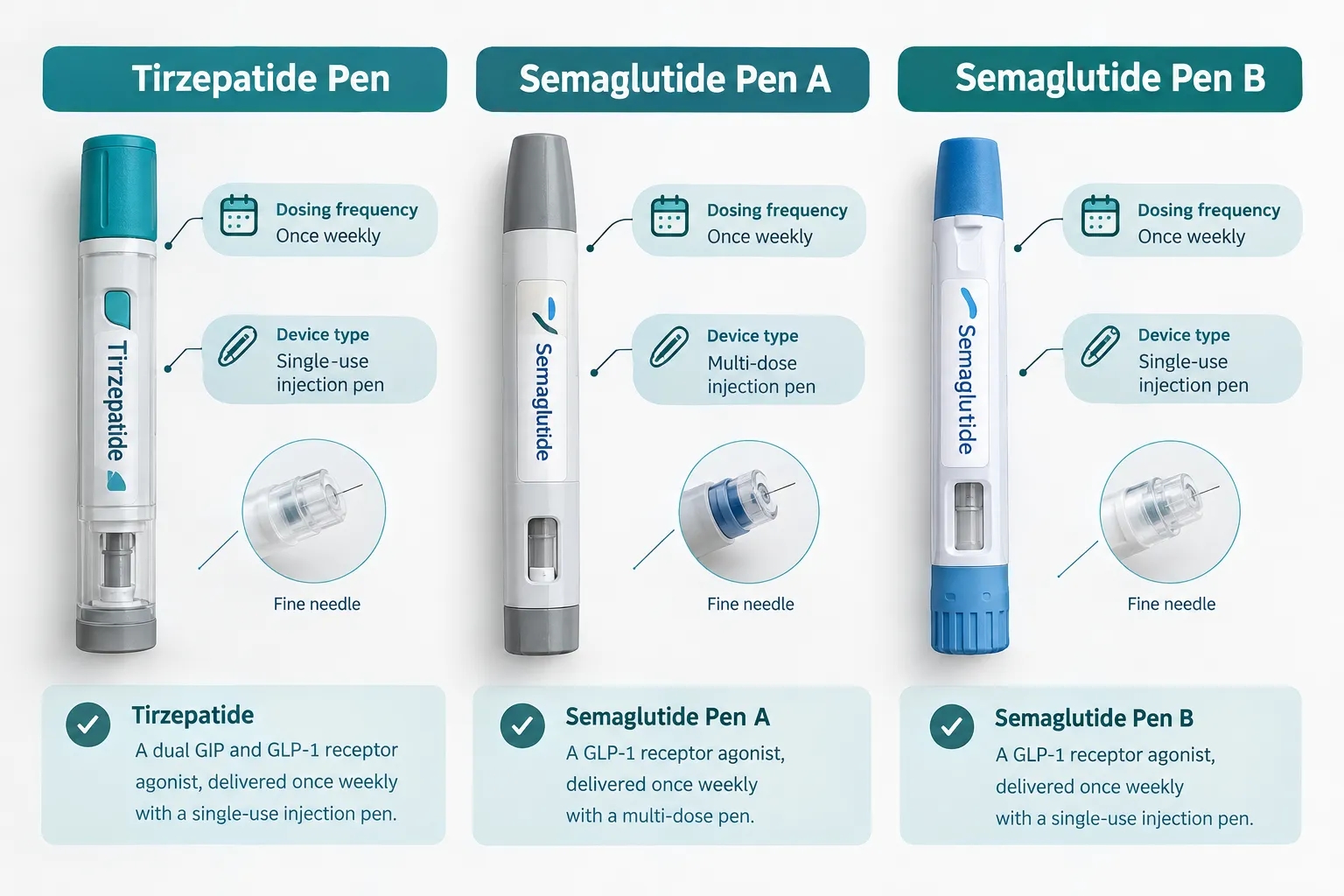
Mounjaro is the brand name for tirzepatide, an injectable medication approved by the FDA to help adults with type 2 diabetes manage blood sugar levels [9][10]. It belongs to a drug class that activates both GIP and GLP-1 receptors, which is part of why it tends to produce stronger blood sugar and weight effects than older diabetes drugs.
Doctors prescribe Mounjaro specifically for type 2 diabetes, while Lilly’s related product Zepbound (same active ingredient, different branding and approved use) targets chronic weight management in adults with obesity or weight-related health conditions [9]. The distinction matters for pricing and insurance: a plan may cover Mounjaro for diabetes but deny Zepbound for weight loss, or vice versa, depending on diagnosis codes and formulary rules.
- Mounjaro is for adults with type 2 diabetes, used alongside diet and exercise.
- It comes as a prefilled pen, self-injected once a week.
- Dose strengths typically range from 2.5 mg up to 15 mg, titrated upward over time.
- Zepbound shares the same molecule but carries a separate indication for weight management.
Choose Mounjaro if your doctor has diagnosed type 2 diabetes and you need an additional option beyond metformin or other first-line therapies. Choose Zepbound instead if your primary goal is weight loss and you don’t have a diabetes diagnosis, since insurance and coupon programs are coded differently for each product.
How Much Does Mounjaro Cost Without Insurance, and Why Is It So Expensive
Without insurance, Mounjaro’s list price has historically run well above $1,000 per month for a standard monthly supply, which is why cash-paying patients often look to the TrumpRx Mounjaro price discount or manufacturer coupon programs instead of paying full list price [2][3]. The underlying cost driver is the U.S. list-price system, where manufacturers set a starting price that gets negotiated down through pharmacy benefit managers, rebates, and now federal pricing deals.
Mounjaro, along with other GLP-1 and dual-agonist drugs, is expensive for a few interconnected reasons:
- Development and manufacturing cost. Biologic injectables require complex production, which manufacturers cite as part of the price justification.
- High demand, limited competition. Only a handful of drugs in this class exist, so there has been less downward price pressure from generics.
- Rebate-driven list pricing. U.S. drug pricing often sets a high list price specifically so insurers can negotiate rebates; cash payers without insurance don’t benefit from those backroom rebates unless they use a coupon or discount portal.
- New MFN pricing deals. The 2025 Most Favored Nation agreement between the administration and manufacturers like Lilly and Novo Nordisk aims to tie U.S. prices closer to what other wealthy countries pay, which is the mechanism behind the TrumpRx discount structure [4][7].
A common mistake is assuming the list price on a pharmacy receipt is the only price available. In practice, self-pay patients who shop around through TrumpRx, LillyDirect, or manufacturer savings cards often pay a fraction of that sticker price [1][6].
TrumpRx Mounjaro Price: Out-of-Pocket Costs and Coupon Savings Explained
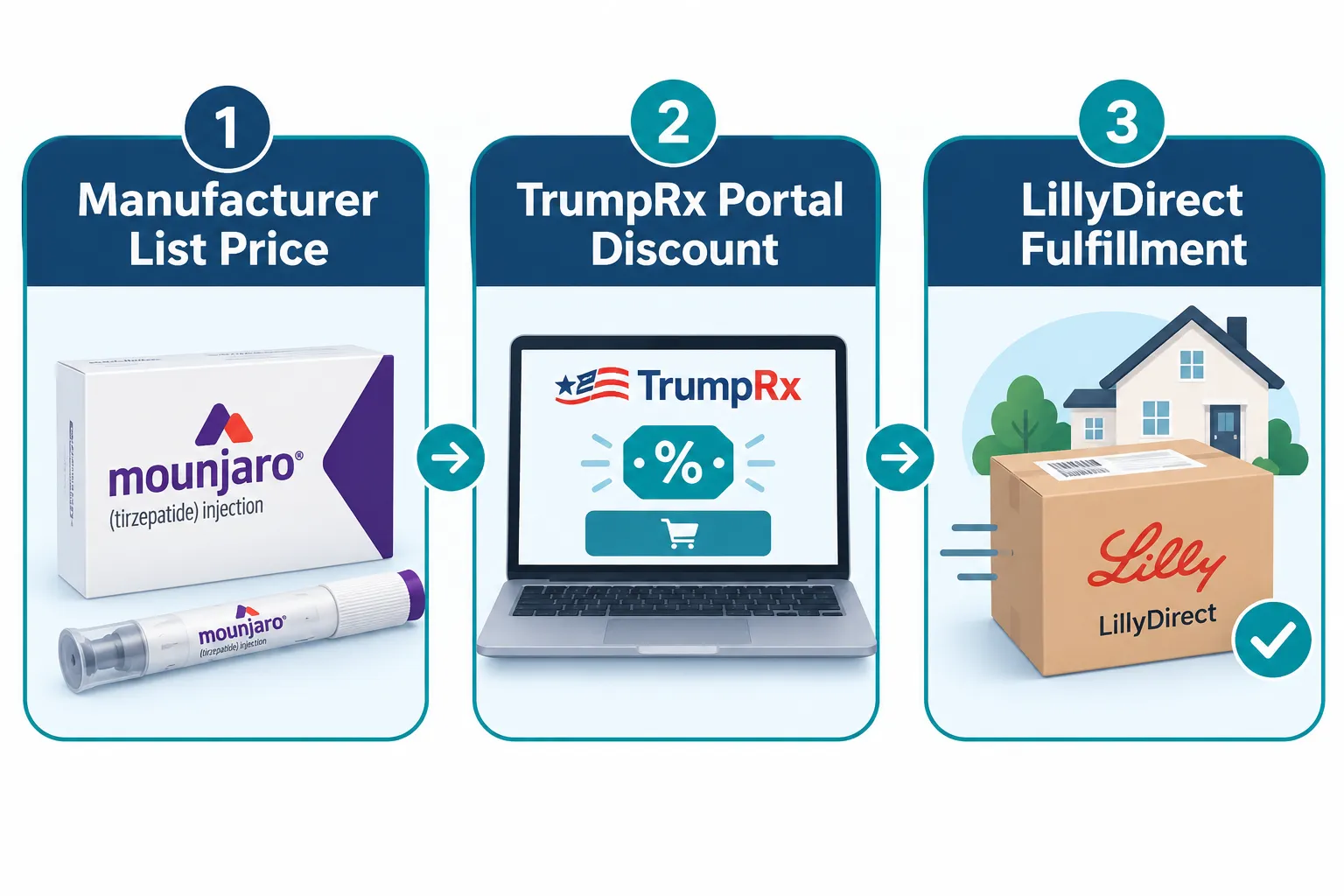
The TrumpRx Mounjaro price for the lowest-strength single-dose pen currently runs about $499 a month in cash, which reflects an estimated 55% discount off the drug’s list price under the federal Most Favored Nation pricing framework [1][2][4]. TrumpRx is a government-linked online portal where eligible patients can purchase select medications, including Mounjaro, at the negotiated self-pay rate.
Here’s how the TrumpRx Mounjaro coupon savings structure generally works:
- Portal access. Patients browse or search for Mounjaro on the TrumpRx site, which lists available doses and current self-pay pricing [1][5].
- Discount applied automatically. The roughly 55% reduction off list price is reflected in the displayed price, no separate coupon code needed in most cases [1][2].
- Fulfillment through LillyDirect. Orders route through Lilly’s direct-to-consumer pharmacy and delivery system, LillyDirect, rather than a traditional retail pharmacy counter [3][5].
- Dose selection matters. Higher-strength pens (7.5 mg, 10 mg, 12.5 mg, 15 mg) generally cost more than the entry-level 2.5 mg or 5 mg pens, even within the discounted structure [1][5].
Some industry estimates suggest the real-world range for self-pay tirzepatide through TrumpRx spans from about $299 to $449 a month depending on dose and timing of the report, which is lower than the commonly cited $499 figure [3]. That spread exists because pricing on newer government-linked portals has shifted since launch, and different outlets have captured snapshots at different points. If you’re budgeting, treat $499 as a reasonable upper estimate for the lowest dose and expect some fluctuation.
Edge case: if you’re newly starting treatment and your doctor prescribes a titration dose below the standard starting pen, confirm that dose is actually listed on TrumpRx before assuming the advertised price applies to your prescription.
Mounjaro Price With Insurance vs Without, and Using Coupons With Coverage
Mounjaro’s price with insurance can be dramatically lower than the TrumpRx self-pay rate, sometimes as low as $25 a month, but only if your plan covers the drug and you qualify for a manufacturer copay card [6]. Without insurance, the TrumpRx or LillyDirect self-pay price (roughly $499, possibly less depending on dose and timing) becomes the relevant benchmark instead [1][3].

| Payment path | Typical monthly cost | Who it applies to |
|---|---|---|
| Commercial insurance + manufacturer copay card | As low as $25 | Commercially insured patients with an active diabetes diagnosis and covered formulary status [6] |
| Commercial insurance, no coverage for Mounjaro | Full list price or denied claim | Patients whose plan excludes Mounjaro or requires prior authorization that fails |
| TrumpRx / LillyDirect self-pay | About $299 to $499 | Uninsured patients or those choosing to bypass insurance entirely [1][2][3] |
| Medicare/Medicaid under MFN deal | Plan cost capped near $245, copay around $50 | Eligible government program beneficiaries [4] |
Can you use Mounjaro coupons with insurance? Generally, manufacturer copay cards are designed to work alongside commercial insurance, reducing your copay after your plan processes the claim [6]. TrumpRx’s self-pay discount, by contrast, is built for people paying cash through the direct portal and typically cannot be combined with insurance billing at a retail pharmacy, since it’s a separate purchasing channel rather than a copay reduction on an insurance claim [1][5].
A frequent mistake is trying to apply a TrumpRx-advertised price at a local retail pharmacy counter. That price is tied to the TrumpRx/LillyDirect purchasing path, not to your insurance card at CVS, Walgreens, or a grocery store pharmacy [1][5][6].
Is Mounjaro Covered by Medicare or Medicaid
Mounjaro coverage under Medicare and Medicaid expanded under a 2025 Most Favored Nation pricing deal that caps the plan cost near $245 a month with copays around $50 for eligible beneficiaries [4]. Before this deal, GLP-1 and dual-agonist drugs for weight-related indications faced tighter restrictions under federal health programs, though diabetes-coded prescriptions had an easier path to coverage.
Key points on government program coverage:
- Medicare Part D coverage depends on formulary status; the MFN deal specifically targets lowering the negotiated plan cost for GLP-1 class drugs, including tirzepatide-based products [4][7].
- Medicaid coverage varies by state, since Medicaid programs set their own formularies within federal guidelines, but the MFN pricing framework is designed to extend lower costs across government payers [4].
- Diagnosis coding still matters. A diabetes diagnosis generally improves the odds of coverage compared with an off-label or weight-management-only prescription.
Decision rule: if you’re on Medicare or Medicaid, check with your specific plan administrator before assuming the $245 cap applies automatically. Confirm whether your plan has adopted the updated MFN pricing terms, since rollout timing differs by plan and state [4][7].
Mounjaro Pen Refill Cost Per Month
A single-dose Mounjaro pen refill typically covers one week of treatment, so a monthly refill usually means four pens, and the per-month cost scales with the dose strength you’re prescribed [1][9]. At the TrumpRx self-pay rate, the lowest-strength pen runs close to $499 for a monthly set, while higher-dose pens can cost more within the same discounted framework [1][2].
- Starting doses (2.5 mg, 5 mg): generally the lowest-priced tier on TrumpRx.
- Mid-range doses (7.5 mg, 10 mg): moderate step up in price, common after a few months of titration.
- Maximum doses (12.5 mg, 15 mg): typically the highest-priced tier, reserved for patients who’ve built up tolerance.
If your dose changes, your monthly cost changes too. A common edge case: patients assume the advertised “starting at” price applies to every dose, when in reality it usually reflects only the lowest strength pen [1][5].
Does the TrumpRx Mounjaro Coupon Work at All Pharmacies, and How Long Does It Last
The TrumpRx Mounjaro discount works through the TrumpRx portal and LillyDirect fulfillment specifically, not at arbitrary retail pharmacies, so you can’t simply walk into any drugstore and expect the TrumpRx price to apply at the register [1][5]. The program is structured as a direct-to-consumer purchasing channel rather than a universal pharmacy coupon.
- Where it works: the official TrumpRx portal, with orders fulfilled through LillyDirect’s delivery system [1][5].
- Where it typically does not work: independent retail pharmacy counters processing a standard insurance claim, since that’s a separate billing pathway [6].
- Retail pharmacy discount cards (such as those offered through chains like CVS) exist as a separate savings mechanism and are not the same program as TrumpRx [6].
On duration, government-linked pricing deals and manufacturer coupon terms are subject to renewal and change, and coverage reporting has noted that GLP-1 discount terms can shift or expire as agreements are renegotiated [7][8]. There’s no fixed “coupon expiration date” published as a guarantee; instead, treat the current TrumpRx price as valid until the portal or official announcements say otherwise, and recheck before refilling if it’s been several months [7][8].
Mistake to avoid: don’t assume a price you saw months ago is still current. Re-verify on the TrumpRx portal each time you reorder, since MFN-related pricing has been described in media coverage as an evolving rollout rather than a one-time fixed deal [8].
Mounjaro Price Comparison: Ozempic vs Wegovy
Mounjaro, Ozempic, and Wegovy are not the same drug, and their TrumpRx and discount pricing structures differ because Ozempic and Wegovy use semaglutide while Mounjaro uses tirzepatide [3][9][10]. Comparing them head-to-head requires looking at both the active ingredient and the specific discount channel each manufacturer offers.
| Drug | Active ingredient | Primary approved use | Discount pathway |
|---|---|---|---|
| Mounjaro | Tirzepatide | Type 2 diabetes | TrumpRx / LillyDirect self-pay discount [1][9] |
| Ozempic | Semaglutide | Type 2 diabetes | Novo Nordisk savings programs, separate MFN terms [7] |
| Wegovy | Semaglutide | Chronic weight management | Novo Nordisk savings programs, separate MFN terms [7] |
Choose Mounjaro if your doctor is treating type 2 diabetes and tirzepatide’s dual-receptor mechanism fits your treatment plan. Choose Ozempic or Wegovy if your prescriber recommends semaglutide specifically, often based on your medical history or insurance formulary preferences. Pricing between these drugs can differ meaningfully even under similar federal pricing deals, since each manufacturer negotiates and publishes its own terms [4][7].
How to Get Mounjaro Cheaper: Alternatives and Patient Assistance Eligibility
The cheapest realistic paths to Mounjaro are the TrumpRx self-pay discount, a Lilly manufacturer copay card for insured patients, or a patient assistance program for those who qualify based on income and insurance status [1][6]. Each option targets a different financial situation, so the right choice depends on whether you have insurance at all.
- If you have commercial insurance and Mounjaro is covered: apply for the manufacturer copay card first, since it can bring costs down to as low as $25 a month [6].
- If you’re uninsured or your plan denies coverage: use the TrumpRx portal for the self-pay discounted price, generally in the $299 to $499 range depending on dose [1][2][3].
- If you’re on Medicare or Medicaid: ask your plan about the MFN-related pricing cap, which targets roughly $245 plan cost with about $50 copays [4].
- If your income is low and you have no coverage: ask your prescriber’s office about patient assistance program eligibility; these programs typically require proof of income, residency, and lack of adequate insurance, and criteria are set by the manufacturer rather than by TrumpRx itself [6].
A practical example: a self-employed patient with no health insurance who doesn’t qualify for Medicaid would likely get the best price through TrumpRx self-pay rather than waiting on a patient assistance application, since TrumpRx pricing is available immediately without an income-verification process [1][2].
For broader context on weight management strategies, diet support, and general wellness alongside any GLP-1 therapy, resources like our weight loss guidance hub and general wellness section can help round out a treatment plan. Patients also often pair medication with nutrition changes; our guide on plant-based healthy recipes offers practical meal ideas that complement GLP-1 treatment. For sex-specific health considerations tied to metabolic conditions, see our men’s health resources and women’s health resources. You can also browse our home page for the full range of condition guides.
Frequently Asked Questions
What is the current TrumpRx Mounjaro price? The lowest-strength single-dose pen runs about $499 a month in cash on TrumpRx, roughly 55% off list price, though some reports cite a lower range of $299 to $449 depending on dose and timing [1][2][3].
Does the TrumpRx discount apply at my local pharmacy? No. The discount applies through the TrumpRx portal with fulfillment via LillyDirect, not at a standard retail pharmacy counter processing insurance [1][5].
Can I stack a manufacturer copay card with TrumpRx pricing? No. Manufacturer copay cards work with commercial insurance claims, while TrumpRx is a separate cash self-pay channel; they are not designed to combine [1][6].
Is Mounjaro covered by Medicare? Coverage has expanded under a 2025 Most Favored Nation deal capping plan cost near $245 a month with roughly $50 copays, but confirm with your specific plan since rollout timing varies [4].
Why does Mounjaro cost so much without any discount? High list pricing reflects manufacturing complexity, limited competition in the GLP-1/dual-agonist drug class, and a rebate-driven U.S. pricing system that doesn’t benefit uninsured cash payers unless they use a discount channel [2][3][4].
Is Mounjaro the same as Ozempic or Wegovy? No. Mounjaro uses tirzepatide; Ozempic and Wegovy use semaglutide. They’re different molecules with separate pricing and discount programs [3][9][10].
How long will the TrumpRx Mounjaro price stay this low? There’s no published fixed expiration date; pricing terms tied to the MFN framework are subject to change as agreements evolve, so recheck the portal before each reorder [7][8].
Who qualifies for a Mounjaro patient assistance program? Eligibility generally requires proof of low income, U.S. residency, and lack of adequate insurance coverage; exact criteria are set by the manufacturer, not by TrumpRx [6].
Conclusion
The TrumpRx Mounjaro price: out-of-pocket costs and coupon savings landscape boils down to three realistic paths. If you have commercial insurance and your plan covers Mounjaro, start with the manufacturer copay card, which can push costs down to roughly $25 a month [6]. If you’re uninsured, the TrumpRx self-pay discount, landing somewhere between $299 and $499 depending on dose, is currently your best bet for predictable pricing [1][2][3]. And if you’re on Medicare or Medicaid, ask your plan directly whether the new MFN-related cap near $245 has taken effect for your coverage [4].
My practical next step for readers: call your prescriber’s office before your next refill and ask them to check both your insurance formulary status and your eligibility for a manufacturer copay card. Then compare that number against the current TrumpRx listing for your exact dose. Prices on this drug have moved quickly since the MFN framework rolled out in 2025, so the smartest move is to re-verify rather than rely on a number you saw months ago [7][8].
References
[1] Mounjaro – https://trumprx.gov/p/mounjaro [2] Cost – https://scriptreceipt.com/mounjaro/cost/ [3] How Much Will Zepbound Be On Trump Rx – https://formblends.com/articles/glp1-hub/how-much-will-zepbound-be-on-trump-rx [4] Federal Update Trump Administration Announces Deal Bring Most Favored Nation Pricing Glp 1s – https://www.amcp.org/letters-statements-analysis/federal-update-trump-administration-announces-deal-bring-most-favored-nation-pricing-glp-1s [5] Browse – https://trumprx.gov/browse?page=4 [6] Prescription Savings – https://www.cvs.com/content/prescription-savings [7] Novo Lilly Sign Mfn Pricing Deal Trump Administration – https://pharmaphorum.com/news/novo-lilly-sign-mfn-pricing-deal-trump-administration [8] Trump Rx Rollout Dr Oz Glp1 B2915597 – https://www.the-independent.com/news/world/americas/us-politics/trump-rx-rollout-dr-oz-glp1-b2915597.html [9] Tirzepatide – https://nowpatient.com/medications/tirzepatide [10] Mounjaro – https://nowpatient.com/medications/mounjaro