Understanding Donald Trump’s New Prescription Drug Policies & Price Changes
Last updated: October 17, 2026
Quick Answer
Understanding Donald Trump’s new prescription drug policies and price changes starts with one framework: Most-Favored-Nation (MFN) pricing, which ties U.S. drug costs to the lowest prices paid by comparable wealthy nations. Combined with a new direct-to-consumer platform called TrumpRx and expanded Medicaid pricing rules, these policies have contributed to what the administration calls the largest recorded prescription drug price drop in over 60 years [4]. Not every drug or patient benefits equally, and some of the savings depend on which pharmacy, insurer, or program you use.
Key Takeaways
- Most-Favored-Nation pricing is the core mechanism behind Trump’s drug policy, linking U.S. prices to the lowest price charged in other developed countries [1].
- TrumpRx, a direct-to-consumer drug platform, launched in late 2026 and advertises discounts of up to 80% on select medications [2].
- High-profile cuts have hit GLP-1 drugs like Ozempic and Wegovy, along with Repatha, through individual manufacturer MFN deals [3].
- Medicaid programs nationwide gained MFN pricing access starting in September 2026, extending beyond the original Medicare focus [6].
- Consumer Price Index data from 2026 shows the steepest prescription drug price decline in decades, though analysts debate how much credit belongs to the policy itself versus other market forces [9].
- Brand-name specialty drugs are the primary target of MFN deals; many generics were already inexpensive and see smaller direct effects.
- Insurance premiums are not guaranteed to drop just because list prices fall, since premiums depend on many other cost factors.
- Future changes, including possible rollback of Inflation Reduction Act negotiation provisions, remain speculative and tied to ongoing political debate.
What Are Trump’s Prescription Drug Price Policies
Trump’s prescription drug price policies center on forcing U.S. drug prices down to match what other wealthy countries pay, using a mix of executive action, direct negotiation with manufacturers, and a new retail platform. The administration describes this as making America the “best price in the world” instead of the historical pattern where the U.S. often pays more than peer nations for the same medications [7].
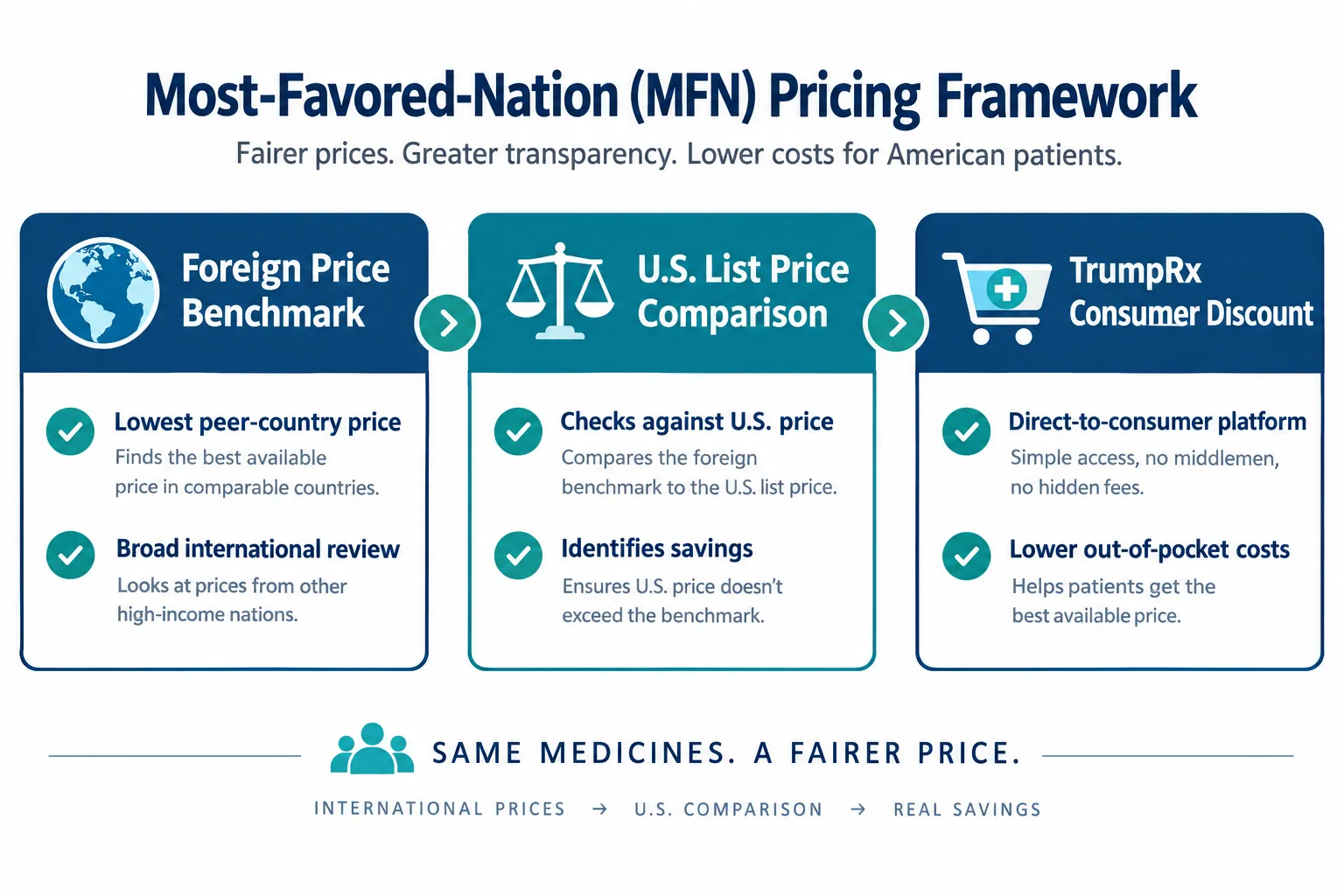
The policy package includes several connected pieces:
- An April 2025 executive action directing federal agencies to pursue MFN pricing and reform Medicare drug payment rules [1][5].
- Individual deals struck with pharmaceutical manufacturers to lower list prices on specific high-cost drugs [3].
- The TrumpRx platform, giving consumers a direct purchasing channel outside traditional insurance billing [2].
- Expansion of MFN pricing into state Medicaid programs as of September 2026 [6].
Choose to pay attention to this policy set if you take a brand-name specialty drug, rely on Medicare or Medicaid, or regularly compare U.S. drug prices to what friends or family pay abroad. The framework matters less if you mainly use low-cost generics that were already inexpensive before any of these changes.
How Do Trump’s Drug Policies Affect Medicare Prices
Trump’s drug policies affect Medicare prices mainly by changing how drug payment rates are set and by pushing manufacturers toward MFN pricing commitments tied to Medicare Part B and Part D. The April 2025 executive action specifically targeted Medicare drug payment structures as part of the broader pricing push [1][5].
Key mechanisms include:
- Directing federal health agencies to explore MFN pricing models within Medicare payment systems [1].
- Encouraging manufacturers to offer Medicare-specific price concessions in exchange for favorable treatment or avoided penalties [5].
- Building on (not entirely replacing) the drug price negotiation authority that already existed under prior law.
Common mistake: Assuming Medicare drug negotiation under Trump is a brand-new program. In reality, it builds on an existing negotiation structure and layers MFN pricing concepts on top of it, rather than starting from scratch. Medicare beneficiaries should check their Part D plan’s formulary each year, since negotiated or MFN-adjusted prices apply to specific drugs, not the entire drug list.
Which Prescription Drugs Will Get Cheaper Under Trump
The drugs seeing the biggest price cuts under Trump’s policies are high-cost brand-name specialty medications, especially GLP-1 weight-loss and diabetes drugs, cholesterol treatments, and HIV medications. Specific MFN deals have targeted Ozempic, Wegovy, and Repatha, among others [3].
The TrumpRx pricing grid, as it has rolled out, covers a broad portfolio of categories:
| Drug category | Examples cited | Discount channel |
|---|---|---|
| GLP-1 / diabetes | Ozempic, Wegovy | MFN manufacturer deal, TrumpRx |
| Cholesterol | Repatha | MFN manufacturer deal |
| HIV treatment | Multiple antiretrovirals | TrumpRx price grid [10] |
| Hepatitis C | Direct-acting antivirals | TrumpRx price grid |
| Respiratory | Inhalers | TrumpRx price grid |
| Insulin | Multiple formulations | TrumpRx price grid |
Quick example: A patient prescribed Wegovy who previously paid a high list price out of pocket may now find a lower cash price through TrumpRx, even without using insurance, though actual savings depend on dosage, pharmacy, and whether a manufacturer coupon already applied.
Trump Drug Price Negotiation Policy Explained
The negotiation policy works by combining government leverage, international price benchmarking, and direct manufacturer agreements rather than a single top-down price-setting law. The administration frames it as getting “the best prices in the world” by refusing to let the U.S. subsidize lower prices charged abroad [7][8].
The process generally follows this pattern:
- Federal officials identify drugs where the U.S. price is far above prices in comparable countries.
- The administration applies pressure, public messaging, and MFN benchmarks to push manufacturers toward lower U.S. list prices [8].
- Manufacturers negotiate specific deals, sometimes tied to Medicare, Medicaid, or the TrumpRx platform [2][3].
- Agreed prices get published or built into tools like TrumpRx so consumers can access them directly [2].
Decision rule: If a drug has a direct MFN deal announced by name, you can reasonably expect a documented price reduction. If a drug has no announced deal, don’t assume automatic savings just because the general policy exists.
When Do Trump’s Prescription Drug Changes Take Effect
The timeline for Trump’s prescription drug changes spans from April 2025 through late 2026, with different pieces activating at different points rather than one single effective date. This phased rollout matters because it explains why some patients saw savings earlier than others.
Rough timeline:
- April 2025: Executive action launches the MFN and Medicare payment reform push [1][5].
- July 2025: Follow-up actions aim to secure “best prices in the world” commitments from manufacturers [7].
- November-December 2025: Major and then “largest” developments in bringing MFN pricing to American patients are announced [2][3].
- Late 2026: TrumpRx platform launches publicly with its consumer-facing discount grid [2].
- September 2026: MFN pricing extends to every Medicaid program in the country [6].
- August 2026: Administration reports the largest recorded prescription drug price drop in over 60 years, based on 2026 CPI data [4][9].
Edge case: A specific drug deal can be announced on paper months before the discount is actually visible at a pharmacy counter or on TrumpRx, because systems integration and manufacturer rollout take time.
How Much Will Prescription Drugs Cost Under Trump Policies
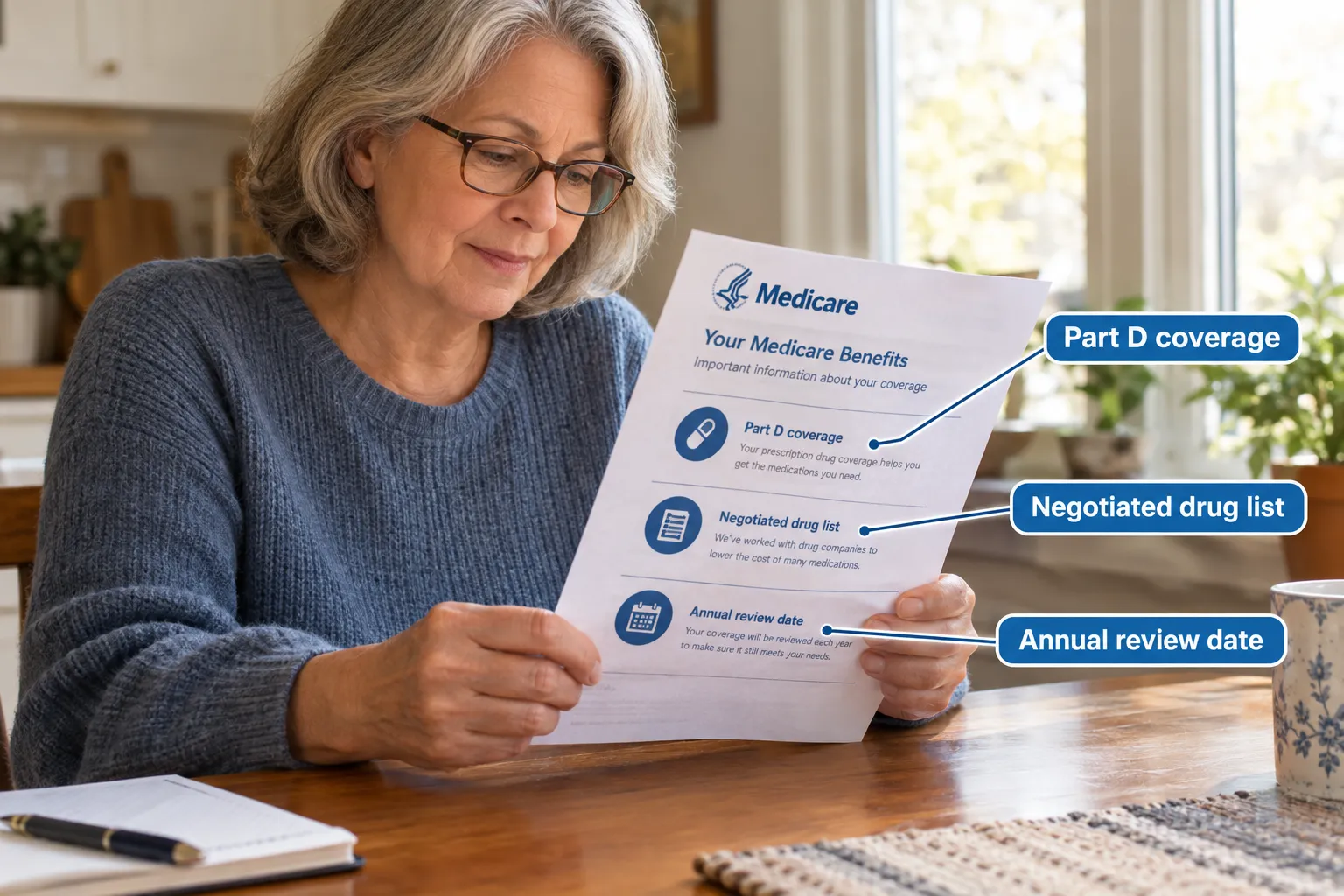
Costs vary widely by drug, so there is no single dollar figure that applies to everyone, but the overall trend recorded in 2026 Consumer Price Index data shows the steepest prescription drug price decline in decades [9]. TrumpRx specifically advertises discounts reaching up to 80% off certain medications [2].
What drives the variation:
- Drugs with a named MFN deal (like Ozempic or Repatha) tend to show the sharpest, most publicized cuts [3].
- Drugs without an individual deal may see smaller or no direct price movement from this policy alone.
- Pharmacy choice matters: cash prices through TrumpRx can differ from insurance-negotiated prices at a traditional pharmacy.
- Insurance coverage can sometimes make a drug cheaper than even a discounted cash price, depending on your plan’s deductible and copay structure.
Common mistake: Comparing a TrumpRx cash price directly to an insurance copay without checking which one is actually lower for your specific plan year. Sometimes insurance still wins, especially if you’ve already met your deductible.
Trump vs Biden Prescription Drug Price Policies Comparison
The biggest difference between the two administrations’ approaches is mechanism: Biden-era policy relied primarily on the Inflation Reduction Act’s Medicare negotiation authority and penalty-based price caps, while Trump’s approach leans on Most-Favored-Nation benchmarking, direct manufacturer deals, and a retail platform.
| Feature | Trump administration approach | Biden administration approach |
|---|---|---|
| Core mechanism | MFN international price benchmarking [1] | Inflation Reduction Act Medicare negotiation |
| Consumer access tool | TrumpRx direct-to-consumer platform [2] | Medicare drug price negotiation list |
| Medicaid reach | Expanded MFN to all Medicaid programs (Sept 2026) [6] | Focused mainly on Medicare |
| Messaging | “Best prices in the world” framing [7] | Inflation and affordability framing |
| Future risk | Possible rollback of IRA provisions discussed in Project 2025 plans | Negotiation list set to expand under existing law |
Choose to track Trump-era policy if you want to know about MFN deals and TrumpRx. Choose to track IRA-based negotiation rules if you want to understand the Medicare negotiation list structure that predates this administration and may still run in parallel.
Who Benefits Most From Trump’s Drug Pricing Plan
Patients taking expensive brand-name specialty drugs with an announced MFN deal benefit most clearly, since those are the medications with documented, publicized price cuts. People on GLP-1 drugs, certain HIV treatments, and cholesterol medications fall into this group most directly [3][10].
People less likely to see a dramatic personal impact:
- Patients on widely available generic drugs that were already cheap before these policies.
- Patients whose insurance already negotiated a lower price than the TrumpRx cash price.
- Patients in regions where pharmacy participation in the TrumpRx discount network is still limited.
Quick example: Someone managing HIV with a regimen highlighted in the TrumpRx price grid may see a meaningful drop in out-of-pocket cost, while someone taking a generic blood pressure pill that already cost a few dollars a month likely won’t notice much change [10].
Will My Insurance Premiums Change With Trump Drug Policies
Lower list prices on specific drugs do not automatically translate into lower insurance premiums, because premiums are set using many cost factors beyond any single drug category. Analysts have specifically questioned how much of the 2026 price decline should be attributed to policy versus other market dynamics [9].
Factors that influence whether your premium changes:
- Your insurer’s overall claims experience across all members, not just drug costs.
- Whether your plan already excluded or capped coverage for the specific drugs affected by MFN deals.
- Administrative and regulatory costs unrelated to drug pricing.
- State-level insurance market rules that vary independently of federal drug policy.
Common mistake: Expecting your monthly premium bill to drop right after reading about a prescription drug price cut. Premium changes usually show up, if at all, during your plan’s next renewal cycle, and only reflect a small slice of the system’s total cost picture.
What Drugs Are Excluded From Trump’s Price Controls
Drugs without an individual MFN deal or a TrumpRx listing generally fall outside the direct price control effects of this policy, even though the broader framework technically could expand to cover them later. The current rollout is deal-by-deal and category-by-category rather than universal [2][3].
Categories more likely to sit outside current coverage:
- Niche or newly approved drugs that haven’t yet been part of a negotiation round.
- Older generic drugs where prices were already low and manufacturers saw little reason to negotiate further.
- Drugs where the manufacturer has not reached an MFN agreement with the administration.
Edge case: A drug could be partially covered, meaning one dosage or formulation has an MFN deal while a related formulation from the same manufacturer does not. Always check the specific product name and dosage, not just the drug’s general category.
How To Find Cheaper Prescriptions Under New Policies
The most direct way to find cheaper prescriptions right now is to check the TrumpRx platform for your specific medication, then compare that price against your insurance copay before filling a prescription. This two-step comparison avoids overpaying in either direction.
Step-by-step checklist:
- Search your exact drug name and dosage on the TrumpRx platform [2].
- Call your pharmacy and ask for your insurance copay price for the same drug and dosage.
- Compare both numbers, including any pharmacy dispensing fees.
- Ask your doctor or pharmacist whether a generic or therapeutic alternative might cost even less.
- If you have Medicare or Medicaid, check whether your specific plan already reflects MFN pricing adjustments [6].
For broader wellness context around managing chronic conditions tied to many of these high-cost drugs, resources on women’s health and men’s health can help you understand lifestyle factors that sometimes reduce medication needs over time.
Does Trump’s Plan Affect Generic vs Brand Name Drugs Differently
Yes, the plan affects brand-name drugs far more directly than generics, since MFN deals and TrumpRx listings have mostly targeted expensive, patent-protected medications rather than the broader generic drug market. Generic drugs already operate in a competitive pricing environment that keeps most prices low without special intervention.
Why the distinction matters:
- Brand-name specialty drugs (GLP-1s, biologics like Repatha) are where international price gaps were largest, making them prime MFN targets [3].
- Generic manufacturers already compete on price, so there’s less headroom for a dramatic government-driven cut.
- Patients switching from brand to generic when clinically appropriate often save more than waiting for a brand-name MFN deal to reach their specific drug.
Decision rule: If your brand-name drug has a generic or biosimilar equivalent, compare that cost against any MFN-discounted brand price before assuming the brand name is now the cheaper option.
What Happened To Previous Drug Price Negotiations Under Trump
During Trump’s first term and early second-term actions, drug price negotiation efforts focused on laying regulatory groundwork, including the April 2025 executive action that directed agencies to pursue MFN pricing and reform Medicare payment rules [1][5]. Later in 2025, the administration built on this groundwork with additional actions aimed at securing “best prices in the world” commitments [7].
Timeline of escalation:
- Early 2025: Foundational executive direction on lowering drug prices [1][5][8].
- Mid-2025: Expanded push toward international best-price commitments [7].
- Late 2025: Major, then “largest to date,” developments in MFN pricing announced [2][3].
Common mistake: Treating the April 2025 action as the finish line. It was the starting framework; the more visible consumer-facing results (TrumpRx, Medicaid expansion) arrived over a year later [2][6].
Can Pharmaceutical Companies Refuse Trump’s Price Limits
Pharmaceutical companies are not legally forced into every MFN deal, since much of the framework relies on negotiated agreements, public pressure, and incentives rather than a single binding price-control statute covering all drugs. Companies that decline to participate in a specific deal may face public criticism or threatened regulatory consequences, but the structure is deal-based.
What this means practically:
- Manufacturers that sign MFN agreements get featured in official announcements and platforms like TrumpRx [2][3].
- Manufacturers that have not reached a deal keep their existing pricing structure for now.
- Future policy shifts, including scenarios described in Project 2025-style proposals or potential changes to Inflation Reduction Act provisions, could alter this balance, but these remain projections rather than settled law.
Edge case: A company might negotiate a deal for one drug while continuing standard pricing on a different product in its portfolio, which is why checking drug-specific deal status matters more than checking a company’s general policy stance.
Comparing The Full Policy Picture
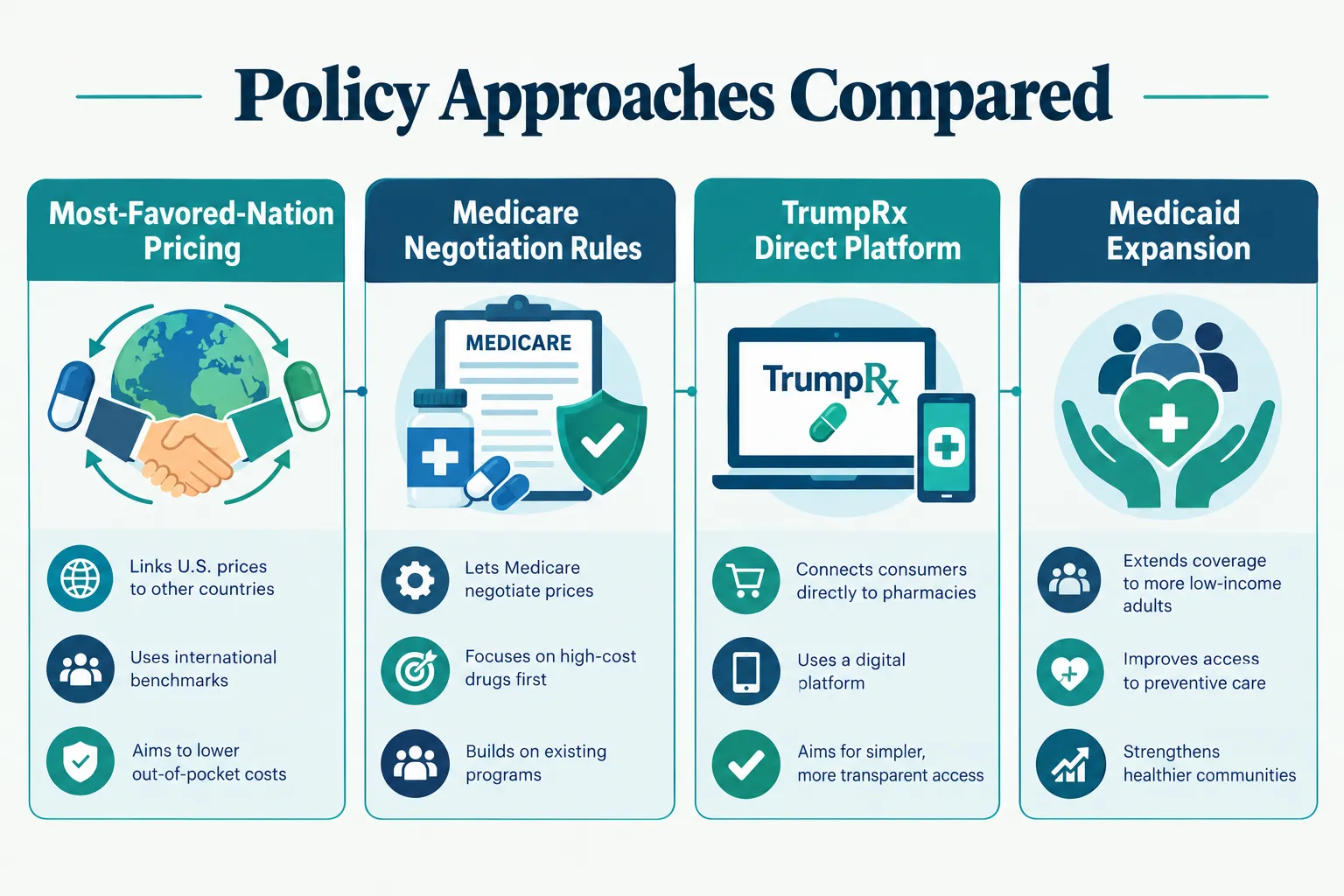
The table below groups the main building blocks of Trump’s prescription drug approach for quick reference.
| Policy piece | What it does | Who it mainly affects |
|---|---|---|
| MFN framework | Benchmarks U.S. prices to lowest peer-country prices [1] | Patients on high-cost brand drugs |
| TrumpRx platform | Direct-to-consumer purchasing with steep discounts [2] | Cash-paying and underinsured patients |
| Medicare payment reform | Adjusts how Medicare pays for certain drugs [5] | Medicare beneficiaries |
| Medicaid MFN expansion | Extends MFN pricing to state Medicaid programs [6] | Medicaid enrollees |
| Manufacturer deals | Drug-specific price agreements [3][10] | Patients on named drugs (Ozempic, Wegovy, Repatha, HIV meds) |
For readers managing chronic conditions alongside medication costs, our weight loss and wellness resources cover complementary strategies that can reduce overall dependence on higher-cost prescriptions over time.
Frequently Asked Questions
What is Most-Favored-Nation pricing in simple terms? It means the U.S. pays a drug price no higher than the lowest price charged for the same drug in comparable wealthy countries [1].
Is TrumpRx the same as my regular pharmacy? No. TrumpRx is a separate direct-to-consumer platform offering its own discount pricing, which you compare against your regular pharmacy and insurance pricing [2].
Does this policy apply to all prescription drugs? No. It applies mainly to drugs with an announced MFN deal or TrumpRx listing, not every medication on the market [2][3].
Will Medicare drug prices drop automatically? Not automatically for every drug. Medicare pricing changes depend on which specific drugs are included in negotiation or MFN agreements [1][5].
Are insulin prices affected? Yes, insulin is listed within the TrumpRx discount price grid covering multiple formulations [10].
Could these policies be reversed? Future changes are possible, including discussions around rolling back certain Inflation Reduction Act provisions, but as of October 2026 these remain proposals rather than finalized law.
How do I know if my specific drug has a price cut? Check the TrumpRx platform directly and ask your pharmacist whether your exact drug and dosage has an announced MFN agreement [2][3].
Does this affect Medicaid patients too? Yes. As of September 2026, MFN pricing extended to every Medicaid program in the country [6].
Conclusion
Understanding Donald Trump’s new prescription drug policies and price changes comes down to three moving parts: Most-Favored-Nation pricing benchmarks, the TrumpRx consumer platform, and expanded Medicaid and Medicare rules. Together, these have coincided with the largest recorded prescription drug price drop in decades, according to 2026 CPI data [4][9], though the size of the benefit depends heavily on which specific drug you take and which purchasing channel you use.
Your next step is practical: look up your exact medication on TrumpRx, compare that price to your insurance copay, and ask your pharmacist whether an MFN deal already applies to your prescription. Don’t assume savings are universal, and don’t assume your insurance premium will shift just because a headline drug got cheaper. Check your own drug, your own dosage, and your own plan before drawing conclusions about what this policy actually means for your wallet.
References
[1] Fact Sheet President Donald J Trump Announces Actions To Lower Prescription Drug Prices – https://www.whitehouse.gov/fact-sheets/2025/04/fact-sheet-president-donald-j-trump-announces-actions-to-lower-prescription-drug-prices/ [2] Fact Sheet President Donald J Trump Announces Largest Developments To Date In Bringing Most Favored Nation Pricing To American Patients – https://www.whitehouse.gov/fact-sheets/2025/12/fact-sheet-president-donald-j-trump-announces-largest-developments-to-date-in-bringing-most-favored-nation-pricing-to-american-patients/ [3] Fact Sheet President Donald J Trump Announces Major Developments In Bringing Most Favored Nation Pricing To American Patients – https://www.whitehouse.gov/fact-sheets/2025/11/fact-sheet-president-donald-j-trump-announces-major-developments-in-bringing-most-favored-nation-pricing-to-american-patients/ [4] President Trump Delivers Largest Prescription Drug Price Drop In Over 60 Years – https://www.whitehouse.gov/releases/2026/08/president-trump-delivers-largest-prescription-drug-price-drop-in-over-60-years/ [5] Lowering Drug Prices By Once Again Putting Americans First – https://www.whitehouse.gov/presidential-actions/2025/04/lowering-drug-prices-by-once-again-putting-americans-first/ [6] President Trump Extends Most Favored Nation Pricing To Every Medicaid Program In America – https://www.whitehouse.gov/releases/2026/09/president-trump-extends-most-favored-nation-pricing-to-every-medicaid-program-in-america/ [7] Fact Sheet President Donald J Trump Announces Actions To Get Americans The Best Prices In The World For Prescription Drugs – https://www.whitehouse.gov/fact-sheets/2025/07/fact-sheet-president-donald-j-trump-announces-actions-to-get-americans-the-best-prices-in-the-world-for-prescription-drugs/ [8] Dcpd 202501211 – https://www.govinfo.gov/content/pkg/DCPD-202501211/pdf/DCPD-202501211.pdf [9] Prescription Drug Prices Trump Mfn Cpi 75272c1a6eeac615014b3252971460da – https://apnews.com/article/prescription-drug-prices-trump-mfn-cpi-75272c1a6eeac615014b3252971460da [10] Trump Rx Plan Includes Sharp Cuts To Hiv Drug Prices – https://www.washingtonblade.com/2025/12/19/trump-rx-plan-includes-sharp-cuts-to-hiv-drug-prices/