How Trump Prescription Prices Are Changing Out-of-Pocket Drug Costs
Last updated: October 17, 2026
Quick Answer
How Trump prescription prices are changing out-of-pocket drug costs depends heavily on which medication you take and which program covers you. The White House reported the largest recorded drop in prescription drug prices in over 60 years, but the real-world savings are concentrated in specific drugs like GLP-1 treatments, Medicaid enrollees, and buyers using the new TrumpRx.gov portal [1][7]. Millions of other patients, especially those relying on commercial insurance or drugs outside the targeted list, have seen little change or even rising costs tied to Part D subsidy phase-outs [10].
Key Takeaways
- The White House announced the largest recorded prescription price drop in more than 60 years, though the dollar-level impact on most individual bills is modest [1][4].
- Most Favored Nation (MFN) pricing now extends to every state Medicaid program, tying US prices closer to what other wealthy countries pay [2][5].
- GLP-1 obesity and diabetes drugs saw the steepest price cuts, but eligibility rules limit who actually qualifies [1][3].
- TrumpRx.gov offers real discounts on select drugs, but it is not the universal “lowest price in the world” portal it was promoted as [7][9].
- Medicare’s GLOBE pricing pilot, once framed as a broad most-favored-nation experiment, has been scaled back to a narrower program [6][8].
- Part D premium subsidies are being phased out, which could raise costs for some Medicare enrollees even as drug list prices fall [10].
- Independent analysts describe Trump’s direct role in the price decline as “more complicated” than the administration’s framing suggests [4][9].
- Savings are real for some seniors in specific high-cost drug categories, but many Americans outside Medicare and Medicaid see little benefit [10].
What Is Trump’s Prescription Drug Price Plan
Trump’s prescription drug price plan combines three main tools: Most Favored Nation pricing agreements, a direct-to-consumer discount portal called TrumpRx.gov, and a narrower Medicare pricing pilot known as GLOBE. Together, these are meant to tie US drug prices closer to the lower prices paid in other developed countries [1][7][8].
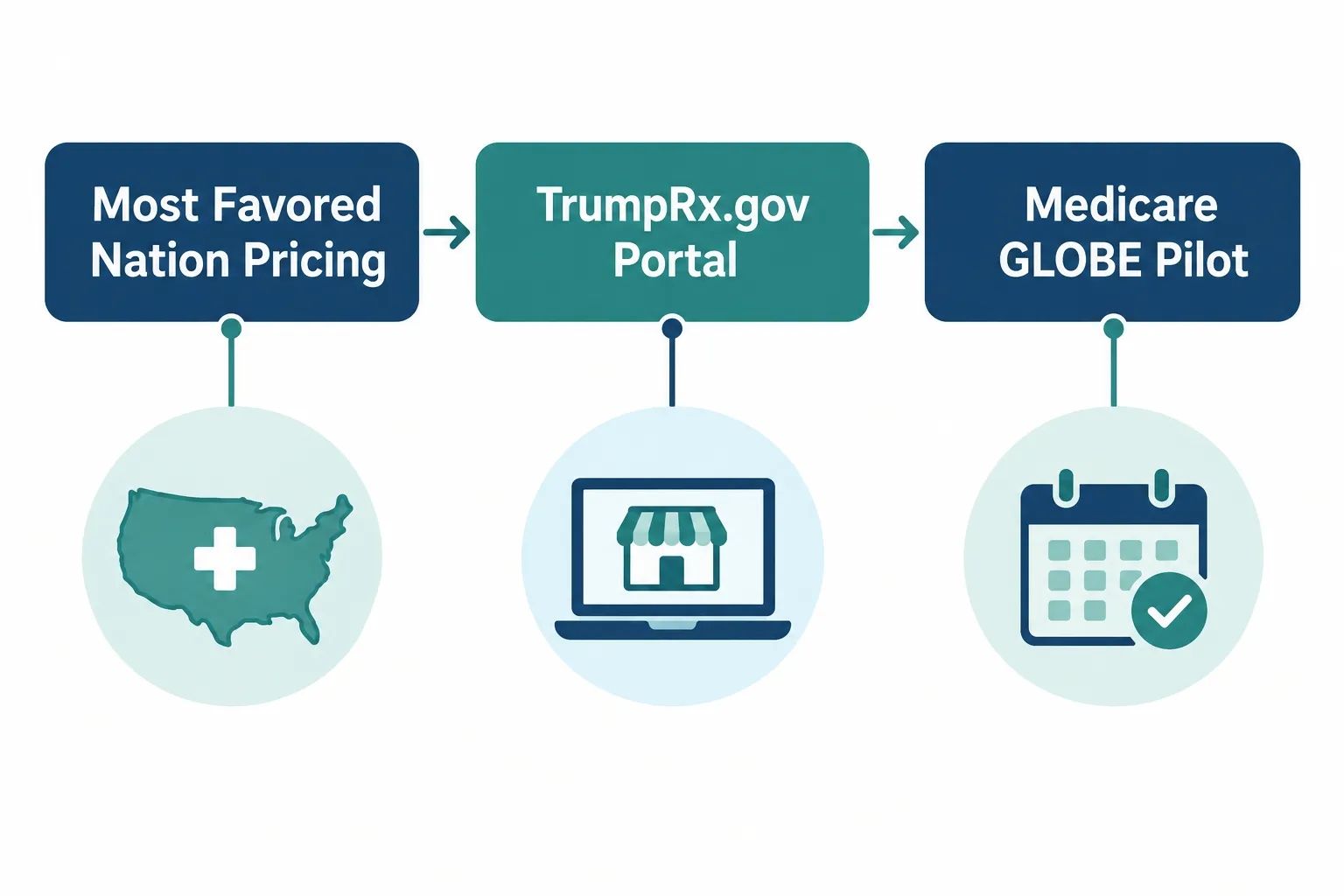
The plan works through negotiated deals rather than a single law. The administration struck agreements with drug manufacturers to lower list prices on certain products, then extended Most Favored Nation terms into Medicaid programs nationwide [2][5]. Separately, TrumpRx.gov launched as a government-backed marketplace where patients can buy select medications at negotiated rates without going through insurance [7]. The Medicare GLOBE pilot, originally pitched as a sweeping most-favored-nation rule for Medicare Part B and Part D, now covers a smaller set of drugs and a shorter list of participating plans than first announced [6][8].
Choose to watch this plan closely if: you take a GLP-1 drug, you’re enrolled in Medicaid, or you buy drugs through TrumpRx.gov. It matters less if: your drug isn’t on the negotiated list and you rely entirely on standard commercial insurance.
How Trump Prescription Prices Are Changing Out-of-Pocket Drug Costs for Everyday Patients
For most patients, how Trump prescription prices are changing out-of-pocket drug costs comes down to one question: is your specific drug on a negotiated list? If yes, your copay or cash price may have dropped noticeably. If no, your bill likely looks the same as before [9][10].
The administration points to a headline statistic: the largest recorded drop in prescription drug prices in over 60 years [1]. But that figure reflects list-price averages across targeted drugs, not a blanket reduction across every pharmacy shelf. Independent reporting found the real-world effect on individual households is “mixed,” with some drugs becoming cheaper and others remaining far more expensive than the same drug sold abroad [9][10].
Here’s what tends to separate winners from people who see no change:
- Winners: Medicaid enrollees taking drugs under Most Favored Nation terms, seniors on specific high-cost specialty drugs, and patients who qualify for GLP-1 discount programs.
- No real change: People with standard commercial insurance taking drugs outside the negotiated list, and cash-pay patients buying drugs not listed on TrumpRx.gov.
- Possible cost increase: Some Medicare Part D enrollees losing premium subsidies that previously offset other costs [10].
A common mistake is assuming a national price cut automatically lowers your personal copay. Insurance formularies, tier placement, and deductible status still determine what you actually pay at the counter.
Which Prescription Drugs Are Covered Under Trump Price Changes
Not every prescription drug is covered under Trump’s price changes. Coverage is limited to drugs where the administration negotiated specific Most Favored Nation agreements, drugs listed on TrumpRx.gov, and select drugs included in the Medicare GLOBE pilot [1][6][7].
The covered list leans heavily toward high-cost, high-visibility drug categories:
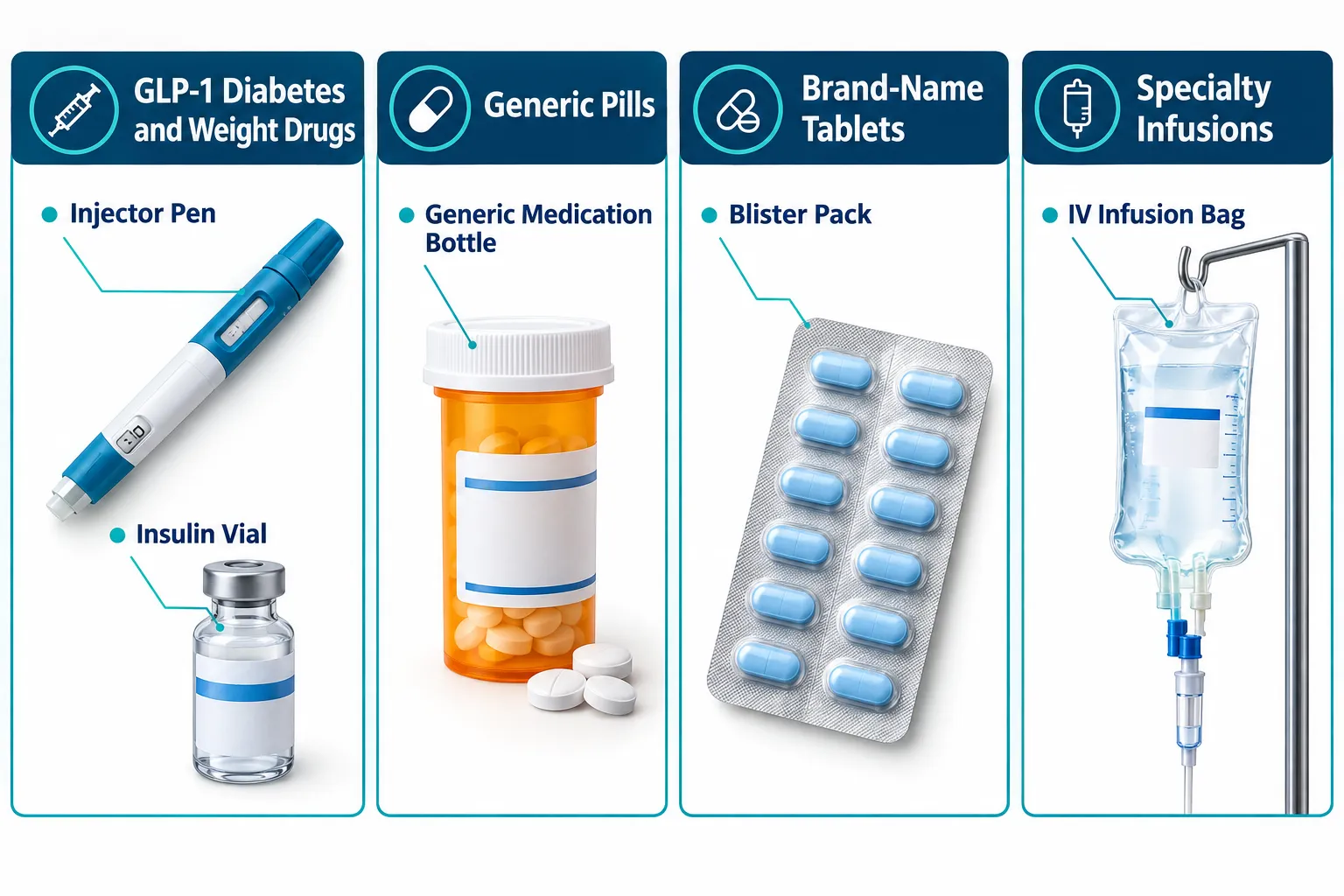
- GLP-1 diabetes and obesity medications
- Select specialty and biologic drugs with existing manufacturer rebate deals
- A limited set of drugs distributed through TrumpRx.gov
- Certain Medicaid-reimbursed drugs now under Most Favored Nation terms [2][5]
If your prescription falls into a common generic category, like standard blood pressure pills or antibiotics, it is less likely to be part of the headline negotiated program, since those drugs were already relatively affordable before these policies began.
Edge case: A drug can be partially covered, meaning the brand-name version is discounted under one program while a generic equivalent is not part of any negotiated deal at all. Always check the exact drug name and dosage, not just the drug class.
What Medications Got Cheaper Under Trump Policies, and Are Brand-Name Drugs Included
The medications that got cheaper under Trump policies cluster around GLP-1 diabetes and weight-management drugs, which saw some of the steepest negotiated cuts, along with a set of brand-name specialty drugs tied to Medicaid Most Favored Nation terms [1][3]. Brand-name drugs are included, but only the specific products named in each agreement, not brand-name drugs broadly.
This distinction matters because “brand-name drugs got cheaper” is often reported as a blanket statement when the reality is narrower:
- GLP-1 drugs for diabetes and obesity: among the largest reported price reductions [1][3]. If you’re exploring these options, our weight loss resource covers how these medications fit into broader treatment plans.
- Select Medicaid-covered brand-name specialty drugs: price cuts tied directly to new state-level Most Favored Nation contracts [2][5]
- Many other brand-name drugs: list prices largely unchanged, since they fall outside current negotiated agreements [9]
Quick example: A patient on a Medicaid-covered GLP-1 drug in a participating state may see a meaningfully lower copay. A patient on a different brand-name drug for, say, an autoimmune condition, may see no change at all unless that specific drug was named in a deal.
Trump Drug Pricing vs Biden Administration: How Out-of-Pocket Drug Costs Compare
Trump’s approach to drug pricing differs from the Biden administration’s strategy mainly in method: Biden-era policy leaned on Medicare’s statutory negotiation authority under the Inflation Reduction Act for a defined list of drugs, while Trump’s plan relies more on voluntary Most Favored Nation agreements, a direct-sale portal, and a scaled-back Medicare pilot [4][6][9].
| Feature | Trump-era approach | Biden-era approach |
|---|---|---|
| Primary tool | Most Favored Nation deals, TrumpRx.gov, GLOBE pilot | Medicare drug price negotiation under statute |
| Scope | Expanding to all state Medicaid programs; narrower Medicare pilot | Fixed list of negotiated Medicare drugs |
| Consumer access | Direct-to-consumer portal for select drugs | Negotiated prices applied through Medicare plans |
| Reported outcome | Largest recorded price drop headline, mixed real-world effect | Targeted price caps on a defined drug list |
Analysts note that attributing the recent price decline entirely to either administration oversimplifies a multi-year process involving manufacturer negotiations, existing rebate structures, and market competition that predate either policy push [4][9]. If you’re weighing both approaches, the practical takeaway is the same: check your specific drug, not the political headline.
When Do Trump Prescription Price Changes Take Effect
Trump prescription price changes are rolling out on a staggered timeline rather than a single start date. Most Favored Nation Medicaid pricing was extended nationwide in September 2026, TrumpRx.gov launched earlier in the year, and the Medicare GLOBE pilot has been implemented in phases with reduced scope compared to its original announcement [1][2][6][7].
A simple timeline:
- Early 2026: TrumpRx.gov launches as a direct discount portal for select drugs [7].
- Mid-2026: Administration announces record-setting price drop figures tied to manufacturer agreements [1].
- September 2026: Most Favored Nation pricing extended to all 50 state Medicaid programs [2][5].
- Fall 2026: Medicare GLOBE pricing pilot scaled back from its original broader design [6][8].
Decision rule: If you’re on Medicaid, check your state’s effective date for Most Favored Nation terms, since rollout speed can vary by state administrative capacity even though the policy applies nationwide.
How to Find Out If Your Medication Is Affected by Trump Pricing
The fastest way to find out if your medication is affected is to check three places: your pharmacy benefit manager’s updated formulary, the TrumpRx.gov drug list, and your state Medicaid drug price schedule if you’re enrolled in Medicaid [5][7].
Step-by-step checklist:
- Search your exact drug name and dosage on TrumpRx.gov.
- Call your pharmacy and ask if your drug’s negotiated price or copay tier changed recently.
- If you’re on Medicaid, ask your state program whether your drug falls under the new Most Favored Nation agreement.
- If you’re on Medicare, check whether your plan participates in the GLOBE pilot and whether your drug is on its list [6][8].
- Compare your last three pharmacy receipts for the same prescription to spot any real change in your out-of-pocket amount.
Common mistake: Relying on news headlines about “record drug price drops” instead of checking your actual receipt. The national average and your personal bill are not the same number.
Does Trump Drug Pricing Apply to Medicare and Medicaid
Yes, but unevenly. Most Favored Nation pricing now applies to every state Medicaid program, while Medicare’s version of most-favored pricing, the GLOBE pilot, applies to a much smaller and more selective set of drugs and plans than originally promised [2][5][6][8].
Key distinctions:
- Medicaid: Broad, nationwide application of Most Favored Nation terms across all 50 states [2][5].
- Medicare: Narrower GLOBE pilot covering specific drugs and participating plans, scaled back from its original design [6][8].
- Medicare Part D: Premium subsidies are being phased out in some cases, which can offset drug savings with higher monthly premiums [10].
If you’re a Medicare enrollee, it’s worth reviewing your wellness and preventive care options alongside your drug plan, since premium changes can affect your total annual health spending even when individual drug prices fall.
How Do Insurance Copays Change With Trump Drug Pricing
Insurance copays change with Trump drug pricing mainly when a plan’s formulary tier is updated to reflect a new negotiated manufacturer price. If your insurer hasn’t adjusted its formulary for your specific drug, your copay generally stays the same regardless of national price announcements [9][10].

What actually moves your copay:
- A manufacturer rebate deal that lowers the price your insurer pays, which can lower your copay tier
- A shift from brand to a Most Favored Nation-priced equivalent under Medicaid
- Loss of a Part D premium subsidy, which raises your monthly cost even if your drug copay itself doesn’t change [10]
Edge case: Some patients report their copay stayed flat while their monthly premium rose, producing a net cost increase despite a “cheaper drug” headline. Always compare total monthly spending, not just the per-prescription copay.
Which States Are Affected by Trump Prescription Price Changes
All 50 states are affected by the Most Favored Nation Medicaid pricing extension, since the policy applies to every state Medicaid program rather than a selected subset [2][5]. However, the practical rollout speed and administrative implementation can still vary by state.
What this means in practice:
- Every state Medicaid program is now subject to Most Favored Nation pricing terms [2][5].
- States with larger Medicaid populations may see bigger aggregate savings simply due to scale, not because the policy itself differs by state.
- TrumpRx.gov and the Medicare GLOBE pilot operate at the federal level and are not state-restricted, though plan participation in GLOBE varies [6][7][8].
If your state Medicaid office hasn’t updated its drug pricing information yet, that’s an implementation lag, not evidence the policy doesn’t apply to you.
What Happens if Your Drug Isn’t Included in the Trump Pricing Program
If your drug isn’t included in any Trump-era pricing program, your price and copay are determined the same way they were before these policies: by your insurer’s formulary, manufacturer list price, and any existing rebate arrangements [9][10]. No automatic discount applies.
In that situation, your options are limited to standard cost-reduction strategies:
- Ask your doctor about a generic or therapeutic alternative that might already be cheaper
- Check manufacturer patient-assistance programs directly, separate from TrumpRx.gov
- Compare pharmacy cash prices, since they can vary significantly even for the same uncovered drug
- Review whether a 90-day supply through mail order lowers your per-unit cost
Quick example: A patient on a common cholesterol medication not listed on any negotiated program will likely pay the same price in 2026 as in 2025, regardless of national headlines about record-setting drug price drops.
How Do Trump Drug Prices Compare to Other Countries
Trump drug prices move closer to other countries’ prices only for drugs covered under Most Favored Nation agreements; for everything else, the US still often pays more than peer nations [1][9]. The Most Favored Nation structure specifically ties the US price for covered drugs to the lowest price among comparable developed countries.
Reporting on this gap found a mixed picture: some drugs under negotiated deals now sit close to international prices, while many others sold in the US remain priced far above what the same drug costs abroad, even after the administration’s announcements [9][10]. TrumpRx.gov marketing promised “lowest in the world” pricing, but independent checks found that claim does not hold universally across the platform’s full drug catalog [7][9].
Decision rule: Don’t assume international price parity applies to your drug just because it applies to a few widely publicized ones like GLP-1 medications.
Can You Get Your Old Medication Prices Back if They Increased
There is no current federal program that reverses a drug price increase back to a prior year’s level. If your out-of-pocket cost rose, typically due to a Part D premium subsidy phase-out or a formulary change, your realistic options are to seek assistance programs or switch plans during an open enrollment period, not to request a price rollback [10].
Practical steps if your cost went up:
- Confirm whether the increase came from your premium, your copay, or your deductible, since each has a different fix.
- Check if you’re eligible for manufacturer or nonprofit patient-assistance programs.
- During your next open enrollment window, compare Medicare or marketplace plans that may offer better drug coverage for your specific medications.
- Ask your pharmacist about therapeutic alternatives that might be cheaper under your current plan.
For broader context on managing health costs alongside medication expenses, our men’s health and women’s health resources cover preventive strategies that can reduce reliance on costly prescriptions over time.
FAQ
Does Trump’s drug pricing plan lower every prescription price? No. It lowers prices only for drugs covered by specific Most Favored Nation deals, TrumpRx.gov listings, or the Medicare GLOBE pilot. Most other drugs are unaffected [1][6][7].
Is the “largest drug price drop in 60 years” claim accurate? The White House reported this figure based on targeted negotiated drugs, and independent analysts note the real-world, drug-by-drug impact is more complicated than the headline suggests [1][4][9].
Will my Medicare premium go up because of these changes? Possibly. Some Part D premium subsidies are being phased out, which can raise monthly costs even when a specific drug’s price falls [10].
Are GLP-1 drugs actually cheaper now? For many patients, yes, GLP-1 obesity and diabetes drugs saw some of the largest reported price cuts, though eligibility and insurance coverage still vary [1][3].
Does TrumpRx.gov guarantee the lowest price in the world? No. While it offers real discounts on select drugs, reporting found it is not universally the lowest-price option compared to international pricing [7][9].
Is the Medicare GLOBE pilot the same as what was first announced? No. It has been scaled back from a broader most-favored-nation Medicare rule to a narrower pilot covering fewer drugs and plans [6][8].
Do these changes apply the same way in every state? Medicaid’s Most Favored Nation pricing applies to all 50 states, but Medicare GLOBE participation and TrumpRx.gov use are not state-restricted and may roll out unevenly [2][5][6].
What should I do if my drug isn’t covered by any program? Check manufacturer assistance programs, ask about generic alternatives, and compare pharmacy cash prices, since no automatic federal discount will apply to uncovered drugs [9][10].
Conclusion
How Trump prescription prices are changing out-of-pocket drug costs is not a single story with one answer. For patients on specific GLP-1 drugs, certain Medicaid-covered brand-name products, or select TrumpRx.gov listings, real savings exist and in some cases are significant [1][2][3][7]. For millions of other Americans on drugs outside these negotiated deals, or facing reduced Part D subsidies, costs have stayed flat or even crept upward [10].
My honest read: treat the national headlines as a starting point, not a guarantee about your own pharmacy bill. Check your specific drug against TrumpRx.gov and your state’s Medicaid pricing schedule, ask your pharmacist directly whether your copay tier changed, and review your Medicare plan during open enrollment if your premium rose. The policy landscape will likely keep shifting through 2026 and beyond, and the most reliable way to protect your wallet is to verify your own prescriptions rather than assume a broad policy change automatically applies to you.
References
[1] President Trump Delivers Largest Prescription Drug Price Drop In Over 60 Years – https://www.whitehouse.gov/releases/2026/08/president-trump-delivers-largest-prescription-drug-price-drop-in-over-60-years/ [2] President Trump Extends Most Favored Nation Pricing To Every Medicaid Program In America – https://www.whitehouse.gov/releases/2026/09/president-trump-extends-most-favored-nation-pricing-to-every-medicaid-program-in-america/ [3] Dcpd 202600568 – https://www.govinfo.gov/content/pkg/DCPD-202600568/pdf/DCPD-202600568.pdf [4] Prescription Drug Prices Trump Mfn Cpi – https://apnews.com/article/prescription-drug-prices-trump-mfn-cpi-75272c1a6eeac615014b3252971460da [5] Fact Sheet President Donald J Trump Announces Lower Drug Prices For All 50 State Medicaid Programs – https://www.whitehouse.gov/fact-sheets/2026/09/fact-sheet-president-donald-j-trump-announces-lower-drug-prices-for-all-50-state-medicaid-programs/ [6] Medicare Drug Price Experiment Shrinks – https://www.axios.com/2026/10/02/medicare-drug-price-experiment-shrinks [7] Fact Sheet President Donald J Trump Launches Trumprx Gov To Bring Lower Drug Prices To American Patients – https://www.whitehouse.gov/fact-sheets/2026/02/fact-sheet-president-donald-j-trump-launches-trumprx-gov-to-bring-lower-drug-prices-to-american-patients/ [8] Medicare Globe Drug Pricing Scaled Back – https://thehill.com/newsletters/healthcare/6124862-medicare-globe-drug-pricing-scaled-back/ [9] Trump Republicans One Health Care Story Facts Tell Another Prescription Drugs Pharma Prices – https://www.thebulwark.com/p/trump-republicans-one-health-care-story-facts-tell-another-prescription-drugs-pharma-prices [10] Midterms Election Trump Drug Prices Affordability – https://www.nytimes.com/2026/10/16/business/midterms-election-trump-drug-prices-affordability.html